
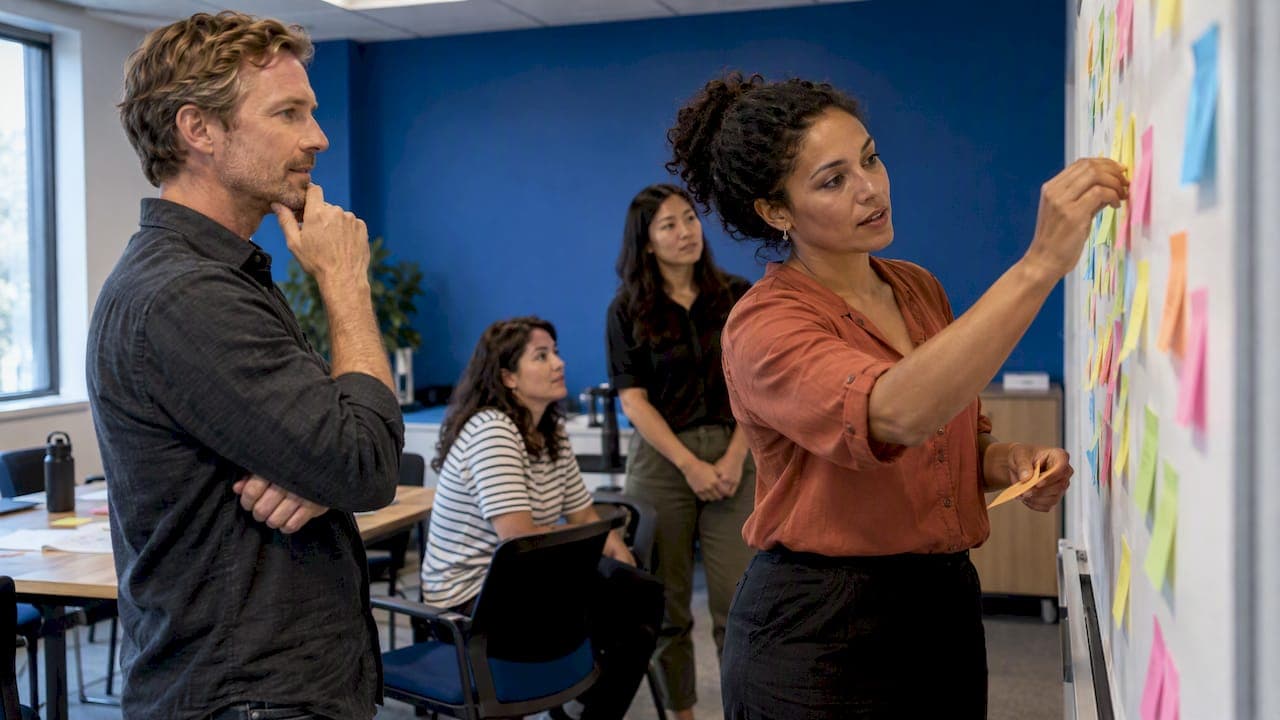
Workshop facilitation is the work of guiding a group toward a shared goal without steering the content yourself. You design the process, protect the conversation and keep the group on its agenda, while the participants supply the expertise and own the decisions. This guide covers what that looks like in practice, how to plan and run a session, which techniques earn their place, and how to scope the work if you facilitate as an independent project manager or consultant.
TL;DR
- Facilitation is process work. NN/g defines it as unobtrusive, objective guidance that helps a group progress toward a goal, which is different from teaching or presenting.
- Most sessions are won or lost before the day: define outcomes with the sponsor, then prepare participants with focused pre-work.
- Psychological safety is something you build on purpose, with ground rules, turn-taking and a visible place for off-topic issues.
- If you sell facilitation, quote preparation and follow-up as real hours and define the follow-up deliverable in writing.
- Skill comes from repetition: run small sessions, ask for feedback and adapt your style instead of copying someone else's.
Table of Contents
- What a facilitator actually does
- Plan the session before you open the room
- Run the day: a step-by-step flow
- Running workshops online
- How to build your facilitation skills
- Our perspective: facilitation as a freelance PM skill
- Selling and scoping facilitation as a freelancer
- Where The Freelance PM Club fits
- FAQ
- Sources
What a facilitator actually does
A lot of first-time facilitators treat the job as a presentation with more sticky notes. It is not. A presenter delivers content. A facilitator manages how a group works with content that already sits in the room.
That distinction shapes everything else. A facilitator acts as a neutral process expert: managing group dynamics, making sure people participate fairly and helping the group reach decisions. The subject-matter knowledge belongs to the participants. If you start arguing for an option, you stop being useful as a neutral guide, and the group stops owning its answer.
NN/g's guidance goes further on style. Its authors argue that facilitation is an art that needs constant adaptation: you should be ready to improvise, stay true to your own personality, whether that is bubbly or stern, and stay strictly neutral on the content so the group takes ownership of the outcome.

The roles you will switch between
A University of California extension guide on collaborative adaptive management lists five core competencies: serving as a learner, a model, a leader, a coach and a healer. The same guide separates the working roles in a meeting: leader, recorder, facilitator and participants. In a small session one person often covers several of these, which is where trouble starts. If you facilitate and take notes and also push your own opinion, you will do all three badly.
A practical rule: if you can, hand the recorder role to someone else. If you cannot, say so openly at the start and agree how notes will be captured, for example on a shared screen or a wall everyone can see.
When you need an outside facilitator
The same guide says an independent facilitator is essential for complex problem solving or high-conflict groups, because neutrality protects the session from power imbalances and dominant voices. That is the commercial case for hiring one, and it is useful to say out loud when a client asks why their own manager cannot run the session. A boss who has a stake in the answer is not neutral.
Plan the session before you open the room
The visible part of facilitation is perhaps a third of the work. The rest is design.
Start with the outcome, not the agenda
A practitioner's statement of work for a board retreat engagement describes the sequence well: partner with key leaders to co-design the session, plan, prepare, then facilitate. The co-design step is the one beginners skip. Before you build a single slide or exercise, sit with the sponsor and settle three things:
- What decision, plan or shared understanding must exist at the end?
- Who must be in the room for that to be possible?
- What happens with the output afterwards, and who owns it?
If the sponsor cannot answer the first question, you do not have a workshop yet. You have a meeting that wants to be one. A workshop gives you better questions and some momentum, not finished solutions, so be honest with sponsors about what one session can deliver.
Use pre-work to shorten the live time
The ten rules for running interactive workshops published on PubMed Central stress preparation, including preparing participants with focused materials ahead of time. In our experience of how project work runs, a short pre-read or a three-question form lets people arrive with positions formed, so the live time goes to discussion instead of orientation. A session that would otherwise need four hours can often be tightened considerably.
Keep pre-work to something people will actually do: one page, one question, 15 minutes at most.
Build the agenda in blocks
A simple structure holds up for most half-day sessions:
| Block | Purpose | Typical content |
|---|---|---|
| Opening | Set purpose and rules | Goal, agenda, ground rules, check-in |
| Diverge | Surface ideas and information | Silent writing, small groups, round-robin |
| Converge | Cluster, rank, decide | Dot voting, criteria matrix, discussion |
| Commit | Turn decisions into actions | Owners, dates, next steps |
| Close | Check the goal was met | Check-out, feedback, summary promise |
Build slack into every block. Groups run long, and the converge block is the one that usually gets squeezed.
Run the day: a step-by-step flow
1. Open with purpose and ground rules
State the goal in one sentence and show the agenda. Ask the group to agree on a few working rules: one conversation at a time, phones away unless needed, challenge ideas not people. A short check-in, where everyone says one thing in the first few minutes, gets every voice into the room early, which makes it far easier to hear from quieter people later.
2. Build psychological safety deliberately
Research published in 2026 on peer feedback found that psychological safety decides whether feedback is received as developmental or as exposing, and that clear structure and modeled behavior shape it. The setting was students giving presentations, not corporate workshops, so treat it as a close parallel rather than direct proof. The practical lesson carries over: participants look to the person in charge of the process to set the tone. Without clear boundaries and turn-taking, people may protect themselves and disengage.
A systematic review in the Journal of Educational Sciences frames safety as something a facilitator has to achieve through questioning, reflection and navigating the organization, not something that appears on its own. In practice that means:
- Model respectful language, especially when you disagree with a comment.
- Set a clear turn-taking protocol and enforce it kindly.
- Thank people for hard contributions, particularly early on.
- Interrupt a dominant speaker by redirecting, for example: "Let me pull in a few voices we have not heard yet."
3. Use a parking lot for sidetracks
A technique sheet from NOAA's Digital Coast lists the parking lot among standard facilitation techniques, alongside breakout groups and others. The idea is simple: write off-topic but important issues on a visible sheet, so the person who raised one knows it was heard. Then keep your promise and review the sheet before closing. If the parking lot becomes a graveyard, people stop trusting it.

4. Choose techniques that fit the moment
No single technique suits every group. These are worth knowing:
- Breakout groups. Useful when the group is too large for everyone to speak. Give each group a precise question and a time limit, and ask for a report in one or two sentences.
- Round-robin. Everyone speaks once, in order, before anyone speaks twice. Good for opening and for hearing from quiet participants.
- Silent brainwriting. A paper on brainwriting premortems describes brainwriting as the silent sharing of written ideas in a structured group setting, with sessions of 10 to 30 minutes. It works well when a few loud voices tend to set the direction.
- Dot voting. A fast way to rank a long list so discussion can focus on the top few items.
- Premortem. Ask the group to imagine the project has failed and write down why. It surfaces risks that people hesitate to raise in open discussion.
5. Handle difficult moments
A few patterns come up repeatedly:
- The dominant voice. Use structured turns, written input first, or a private word at the break.
- The silent group. Move to pairs or silent writing, then return to the full group.
- The sponsor who takes over. Agree before the session on how they will take part, and remind them gently of that agreement.
- The argument that will not end. Name it, note both positions, move it to the parking lot or ask what information would settle it.
6. Close the loop
Do not let a session end on discussion. Read back the decisions, assign owners and dates, and run a short check-out. Then tell people when they will receive the summary, and send it on that date. Credibility in facilitation is mostly built in the days after.
Running workshops online
Virtual sessions need the same design with tighter timing. Shorter blocks, more breaks and explicit turn-taking help, because people cannot read the room by body language. Use a shared digital board for silent writing and clustering, and give each exercise a visible timer. Send a short tech check beforehand so the first ten minutes are not spent on audio problems. Keep groups smaller than you would in a room if participation matters.
How to build your facilitation skills
Facilitation is learned by doing. Some habits speed it up:
- Start small. Run a 60-minute retrospective or planning session with a team that is forgiving.
- Ask for feedback at the end: one thing that helped, one thing that did not.
- Self-monitor. The educational review linked above highlights reflective self-monitoring as part of the craft. Write a five-line debrief after each session.
- Use a competency list. A facilitator core competencies checklist includes items such as designing agendas with clear outcomes and keeping meetings focused on those outcomes. It makes a good self-assessment.
- Observe others. Watch how experienced facilitators handle silence, conflict and time.
Our perspective: facilitation as a freelance PM skill
We work with independent project managers and consultants every day, and we see the same pattern: facilitation is one of the quickest ways to make a PM's value visible to a client. Kickoffs, planning sessions, retrospectives, risk workshops and stakeholder alignment sessions all call for it, and a PM who runs them well is easy to rehire.
It also suits people moving from a corporate role into freelance work. You already know how decisions stall inside organizations. As an outside facilitator you are neutral by position, and that is something an internal manager cannot offer.
Our advice is to treat facilitation as a craft you practice in public, with structure. Build a small library of agendas you trust, keep templates for pre-work and summary reports, and get feedback from peers who do the same work. A good community shortens the learning curve far more than reading alone, because you can borrow tested formats and talk through a session that went wrong.
The last point is about positioning. Do not sell "a workshop". Sell the outcome: an aligned team, a prioritized backlog, a decision the board can stand behind. Clients pay for results they can describe to their own leadership.
— Ashanti
Selling and scoping facilitation as a freelancer
If you facilitate for clients, the session itself is the visible deliverable and the smallest part of your time.
Price the hidden hours
A statement of work from a facilitation consultant shows the structure: co-design, planning, preparation, facilitation. Practitioners commonly work with a preparation-to-delivery ratio of about 2:1 when they quote. Treat that as a starting assumption, not a law. A first session for a new client with unclear goals needs more preparation, and a repeat format needs less. Track your own hours across three or four engagements and use your own numbers.
Define follow-up as its own deliverable
Write into the agreement exactly what happens after the session, for example one summary report of outcomes delivered within a set number of days. Without that line, clients tend to assume unlimited advice afterwards. Additional follow-up becomes a separate, priced piece of work.
Find the right clients
Facilitation work usually comes from relationships, so how you talk to prospects matters. A consultative selling approach, where you ask about the client's problem before proposing a format, mirrors the way you will run the workshop itself. Your discovery call is the first facilitated conversation the client experiences.
When the workshop is about how a group should make decisions, you can also point clients toward practical material on setting up decision-making in a young company. That page is written for South African startups, so check local legal details before relying on it elsewhere.
Where The Freelance PM Club fits
If you want to add facilitation to your freelance offer, The Freelance PM Club gives you a place to do it with other independent project managers. Membership includes a community, courses, templates and tools, career coaching and a job board built for freelance PM and consulting roles. Plans on our subscriptions page start with Job Board Access at $5 per month, then Freelancer Pro at $10 per month and Freelancer Elite at $20 per month. If you would rather talk through your path first, our coaching is a good starting point.
FAQ
What is the difference between facilitating and presenting?
A presenter delivers content and holds the floor. A facilitator guides the group's own work and stays neutral on the content. Participants bring the expertise, and you manage the process so the group reaches its own decisions.
How do I facilitate a workshop for the first time?
Start with a small, low-stakes group and a clear outcome agreed with the sponsor. Send brief pre-work, open with the goal and ground rules, use one or two simple techniques such as round-robin and dot voting, and close with owners and dates. Ask for feedback and write a short debrief afterward.
What skills does a facilitator need?
The UC extension guide cited above names five core competencies: learner, model, leader, coach and healer. In practical terms you need agenda design, active listening, neutral questioning, time management and the ability to handle conflict calmly. These develop through repeated practice and honest feedback.
How long should preparation take?
It depends on the group and the stakes. Some practitioners quote about two hours of preparation for each hour of delivery, which is a useful starting point when you price a first engagement. Adjust it with your own tracked hours.
Do I need an outside facilitator?
Usually when the topic is complex, the stakes are high or the group has conflict or clear power imbalances. A neutral outsider can protect the process in those cases. For routine team meetings, a trained internal facilitator is often enough.
Sources
- Workshop Facilitation 101, NN/g
- Facilitation Skills for a Collaborative Adaptive Management Process, UC ANR
- Ten Simple Rules for Running Interactive Workshops, PMC
- Board Retreat Facilitation statement of work, Mendocino Coast Health Care District
- Students' perceptions of psychological safety during peer feedback, PMC
- Systematic literature review, Journal of Educational Sciences
- Quick Reference: Facilitation Techniques, NOAA Digital Coast
- Brainwriting Premortem, PMC
- Facilitator Core Competencies, VCU