

Stable scope and a hard deadline point to fixed-price. Uncertain, exploratory, or fast-changing work points to time and materials (T&M). That's the whole decision in one sentence, but the fine print determines whether you actually get the outcome you're picking for.
Here's the catch most guides skip: T&M is only cheaper than fixed-price when the client shows up and manages it. Fixed-price looks safer because the number is locked in, but that number usually carries a built-in cushion for everything the vendor doesn't yet know. You're not avoiding risk with a fixed-price contract. You're paying someone else to hold it.
Before you sign anything, do this:
- Run the decision checklist below against your actual project, not the version you wish you had.
- If you land on fixed-price, tighten your scope document and acceptance criteria now.
- If you land on T&M, set up governance controls before work starts, not after the invoices get uncomfortable.
Key Takeaways
Fixed-price transfers estimation risk to the vendor at a premium, while time and materials keeps costs visible but demands active client governance to control the total.
| Point | Details |
|---|---|
| Match model to scope stability | Choose fixed-price when requirements are well-defined and deadlines are firm. |
| Budget for the risk premium | Expect fixed-price quotes to include a 15–30% cushion for unknowns. |
| T&M needs real oversight | Set sprint budgets, not-to-exceed caps, and weekly burn reports before work starts. |
| Default to discovery-first hybrids | Run a short fixed-price discovery phase, then move to T&M or milestone-based fixed-price. |
| Write governance into the SOW | Specify acceptance criteria, change-order turnaround, and reporting cadence explicitly. |
Table of Contents
- Time and Materials vs Fixed Price: What Each Contract Actually Means
- Fixed-Price vs Time and Materials: Weighing the Trade-offs
- When Should You Choose Fixed-Price vs T&M?
- Governance Controls That Make Each Model Actually Work
- The Hybrid Pattern Most Experienced Teams Actually Use
- Building Your Procurement Checklist
- Where The Freelance PM Club Fits Into This Decision
- What Actually Separates Good Decisions From Guesswork Here
- Sources
Time and Materials vs Fixed Price: What Each Contract Actually Means
A fixed-price contract sets a single total cost in the statement of work (SOW) for a defined scope of work. The vendor absorbs the estimation risk. If the work takes longer than planned, that's the vendor's problem, not yours, as long as scope hasn't changed. Common clauses include:
- Detailed acceptance criteria tied to each deliverable
- Milestone payments released on sign-off
- A formal change-order process for anything outside the original scope
A time and materials (T&M) contract bills hourly or daily rates plus material costs, and you pay as work happens. The final cost isn't fixed at signing; it's determined during execution. T&M agreements typically include a not-to-exceed cap, regular burn reporting, and defined team composition so you know who's billing hours and at what rate.
One clarification worth making early: T&M is not the same as a cost-plus contract, which reimburses costs plus a fixed or percentage fee on top. T&M rates already bundle profit into the hourly or daily figure, so there's no separate markup layer to negotiate.
Fixed-Price vs Time and Materials: Weighing the Trade-offs
Fixed-price buys budget certainty and a simpler approval process. Your finance team likes a single number they can put in a purchase order. The cost is that vendors price in uncertainty, and any scope change triggers a negotiation that can stall momentum for weeks.
T&M buys flexibility and real transparency into where the money goes. You can pivot the backlog mid-project without renegotiating a contract. The cost is that it demands a client who actively manages the engagement, because nothing stops the clock from running if nobody's watching the meter.
| Factor | Fixed-Price | Time and Materials |
|---|---|---|
| Who carries estimation risk | Vendor | Client |
| Where cost surfaces | Baked into the quoted total, often with a 15–30% risk premium | Visible on periodic invoices |
| Best for | Stable, well-defined scope | Iterative or exploratory work |
| Governance demand | Low during execution, high at scoping | High throughout |
| Change-order friction | High | Low |
Neither model eliminates risk. Fixed-price moves it into the planning phase; T&M moves it into ongoing oversight, which is why active governance matters more than the contract type itself.
When Should You Choose Fixed-Price vs T&M?
Ask these questions before you draft anything:
- Are requirements stable? If your team can write acceptance criteria today that will still be accurate in three months, fixed-price is workable.
- Is there a hard deadline tied to a launch, regulation, or event? Fixed-price forces the vendor to commit to a date; T&M does not.
- Is a product owner available weekly to review progress and reprioritize? If not, T&M will drift without anyone catching it.
- Are the technical unknowns resolved? Unresolved architecture or integration questions are the single biggest reason fixed-price bids balloon mid-project.
A rough rule practitioners use: when requirements are well documented and sufficiently clear, fixed-price tends to hold up. Below that threshold, you're asking a vendor to price a moving target, and they will price in the uncertainty whether you like it or not.
Pro Tip: *Don't compare contract types on sticker price alone.
The finance lens matters here too. A fixed-price number already includes a vendor risk premium for the unknowns the vendor can't fully price. T&M skips that premium but shifts the cost of managing uncertainty onto your team's time. Total cost of ownership, not the headline number, is what should drive the decision.
Governance Controls That Make Each Model Actually Work
A contract type is only as good as the controls wrapped around it.
For T&M engagements, put these in place before the first invoice arrives:
- Sprint-level budgets so overruns get caught weekly, not quarterly
- A hard not-to-exceed clause tied to the overall engagement
- A prioritized, visible backlog the vendor works from
- Weekly burn dashboards and demo sessions
- An empowered product owner who can make calls in real time
For fixed-price engagements, the controls shift earlier in the process:
- A detailed SOW with testable acceptance criteria, not vague language
- A defined turnaround time for change-order requests, so scope disputes don't stall the project
- Milestone sign-offs tied to payment releases
- Quality gates before each milestone is marked complete
Both models benefit from a consistent forecast cadence, tracked defect metrics, and an audit trail on every invoice or milestone payment. Pro Tip: Ask for burn reports in the same format every week. Vendors who resist a standard reporting template are usually the ones you need it from most.
The Hybrid Pattern Most Experienced Teams Actually Use
Few experienced project managers pick purely fixed-price or purely T&M for anything beyond a small, well-understood task. The pattern that shows up again and again is a short fixed-price discovery phase, followed by either T&M for the build or a series of fixed-price milestones.

The logic is straightforward: discovery reduces the very uncertainty that makes fixed-price bids expensive. Once you've got a usable spec and resolved the major technical questions, you can quote (or accept) a fixed-price milestone with confidence, or move into T&M knowing the backlog is real instead of speculative. This phased approach directly addresses the estimation-risk problem instead of just splitting the difference.
Common examples:
- Two-week fixed-price discovery sprint, then T&M for an evolving product build
- Fixed-price discovery, then fixed-price milestones for each major release
- Capped T&M for the full engagement, with a not-to-exceed ceiling that behaves like insurance against runaway hours
Use this pattern whenever you're not fully confident in your answers to the decision questions above.
Building Your Procurement Checklist
Once you know which model fits, turn it into contract language before you send an RFP or SOW.
- Classify the project. Score it against the decision questions above and write down the evidence, not just your gut call.
- Choose the model and attach the right activities. Fixed-price pairs with a discovery phase or detailed spec; T&M pairs with caps and milestone checkpoints.
- Specify the contract language. Name the reporting cadence, the not-to-exceed clause, the change-order turnaround, and the acceptance criteria explicitly in the document.
- Run a risk review with finance and legal. Confirm acceptance tests are measurable and that everyone understands where the risk premium sits.
Pro Tip: Attach a one-page "governance summary" to the SOW itself. When a dispute happens six months in, that page is what everyone actually reopens, not the 40-page contract.
Where The Freelance PM Club Fits Into This Decision
Getting the contract type right is only half the job. Writing the SOW language, the change-order clauses, and the reporting cadence that make it stick is where most of these agreements actually fail.
The Freelance PM Club maintains a library of SOW and contract templates built around exactly these scenarios: fixed-price acceptance criteria, T&M not-to-exceed clauses, and hybrid discovery-to-build language. Members also get access to:
- Career coaching for freelancers negotiating contract terms with new clients
- A community of working PMs who've run both models and can talk through edge cases
- Governance and reporting templates you can drop straight into a live engagement
If you're advising a client or running procurement internally, pulling from tested templates beats drafting contract language from scratch every time.
What Actually Separates Good Decisions From Guesswork Here
Most advice on fixed-price versus T&M treats it like a coin flip between "safe" and "flexible." That framing undersells how much the outcome depends on execution, not contract type.
The conventional wisdom oversells fixed-price as the low-risk default. It isn't. It's a transfer of risk to the vendor, and vendors price that transfer into the number you sign. If your organization has thin governance capacity and picks fixed-price purely to avoid oversight, you'll pay for that avoidance in the quote, and again in change-order friction the moment reality doesn't match the SOW.
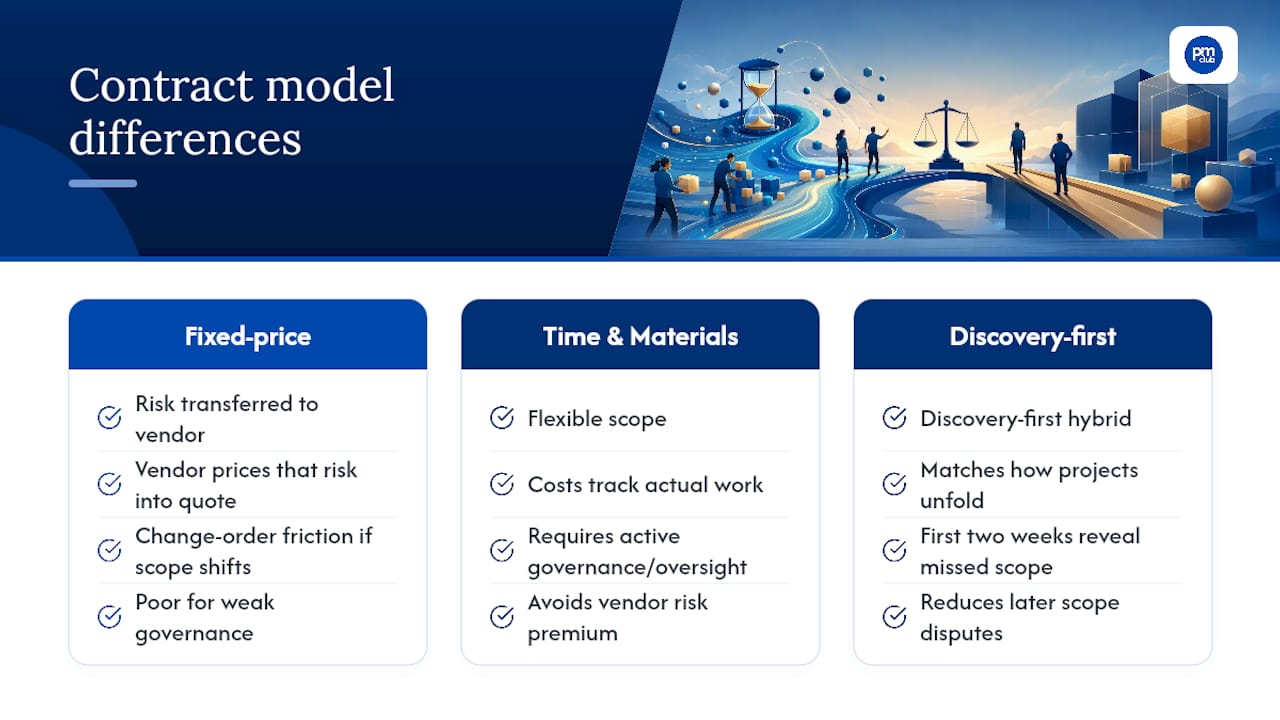
What I think gets underrated is the discovery-first hybrid. It's not a compromise. It's the model that most closely matches how real projects unfold, where the first two weeks always reveal something the original scope missed. Teams that skip discovery to save time usually spend far more of it later, arguing over what "in scope" meant.
Prioritize honest self-assessment of your governance capacity before you pick a model. A great contract can't compensate for a product owner who never shows up to a demo.
— Ashanti
Sources
- Fixed-Price vs. Time and Materials Contracts — NetSuite
- T&M vs Fixed price — Pragmatic Coders
- Fixed Price vs. Time & Materials: 2026 Selection Framework — Coderio