

Scope creep is the uncontrolled expansion of a project's requirements beyond what was originally agreed, without a matching increase in time, budget, or resources. The moment you notice it happening, stop the new work, log the request in writing, and run a quick impact check before saying yes. Everything else in scope creep management is a variation on that one habit, built into templates and workflows you can reuse on every contract.
TL;DR:
- Clear scope statements with explicit exclusions and a testable work breakdown structure prevent misunderstandings that lead to scope creep.
- Implementing a quick, five-step change request process ensures all modifications are assessed and approved before work begins.
- Weekly scope reviews with a scope register help identify small, accumulating requests before they result in schedule and budget overruns.
- Unmanaged scope creep typically erodes profit margins, delays schedules, and damages team morale and client trust.
- Starting with a well-defined scope baseline and a documented change process makes it easier to quantify and address scope overruns after they occur.
Table of Contents
- What Scope Creep Actually Means (And Why It's Not the Same as Change)
- What Causes Scope Creep? 5 Patterns to Watch For
- What Does Scope Creep Look Like in Practice?
- The Real Risks of Letting Scope Creep Go Unchecked
- How Do You Prevent Scope Creep Before It Starts?
- What's a Fast Change Control Process for Scope Creep Solutions?
- Which Templates and Tools Actually Prevent Scope Creep?
- How Do You Catch Scope Creep Before It Compounds?
- How Do You Recover From Scope Creep That's Already Happened?
- Who's Behind This Playbook
- Why Scope Discipline Is a Reputation Strategy, Not a Contract Clause
- Get Scope Control Templates and Coaching from The Freelance PM Club
- Sources
- FAQ
What Scope Creep Actually Means (And Why It's Not the Same as Change)
Scope creep happens when work grows past the original plan while your timeline and budget stay frozen. That mismatch is the entire problem. A client adding features is normal; a client adding features for free, off the record, is scope creep.
The distinction that trips up most freelance PMs is planned change versus creep. Planned change goes through approval: someone requests it, you assess the impact, both sides agree on a trade-off, and the baseline updates. Creep skips all of that. It arrives disguised as a small favor, a verbal "sure, why not," or an assumption nobody questioned out loud.
Three artifacts define where the line sits:
- Scope baseline: the approved version of scope, cost, and schedule you measure every change against.
- Work breakdown structure (WBS): the deliverables broken into pieces small enough to estimate and test.
- Scope statement: a short document naming what's included, what's excluded, and how success gets judged.
Without these three, scope creep in project management becomes almost impossible to prove, let alone stop, because there's nothing concrete to compare the new request against.
What Causes Scope Creep? 5 Patterns to Watch For
Most creep traces back to one of five recurring failures. Spotting the pattern early is often the difference between a five minute conversation and a three week fight over invoices.
- Vague or missing scope and exclusions. If your scope statement doesn't say what's out, clients will assume it's in.
- Ad hoc stakeholder requests. An executive pings you directly, skips the usual channel, and expects a yes because of who they are.
- Weak or absent change control. No submission process means every request gets a verbal answer instead of a documented decision.
- Late-discovered requirements. Something the team didn't know about surfaces in week six, and priorities shift to absorb it.
- Internal feature creep. Your own team polishes past the brief because "it'll only take an hour," and those hours pile up.
PMI's research on scope creep points to unclear requirements, inconsistent requirements gathering, and thin sponsor involvement as the leading drivers, especially on longer engagements where priorities naturally drift over months. A traceability matrix that links each requirement to a business objective closes a lot of these gaps before they open, because there's no room left for "assumed" inclusions nobody actually approved.
What Does Scope Creep Look Like in Practice?
Abstract definitions don't stick. Here's how creep shows up on actual contracts:
- A client emails mid-sprint asking for an extra feature that never appeared in the acceptance criteria, framed as "just a quick add."
- A stakeholder gives a verbal okay in a status meeting to extend a deliverable, and the team runs with it because pushing back felt awkward.
- A six-month engagement collects a dozen small "can you just" requests, none individually alarming, that together eat three weeks of unbilled time.
That last pattern is the one freelance PMs underestimate most. No single ask looks worth a fight. Scope creep often compounds this way: dozens of reasonable-sounding favors stack up until the project is unrecognizable from the signed proposal, and there's no single moment you can point to as "when it went wrong."
The Real Risks of Letting Scope Creep Go Unchecked
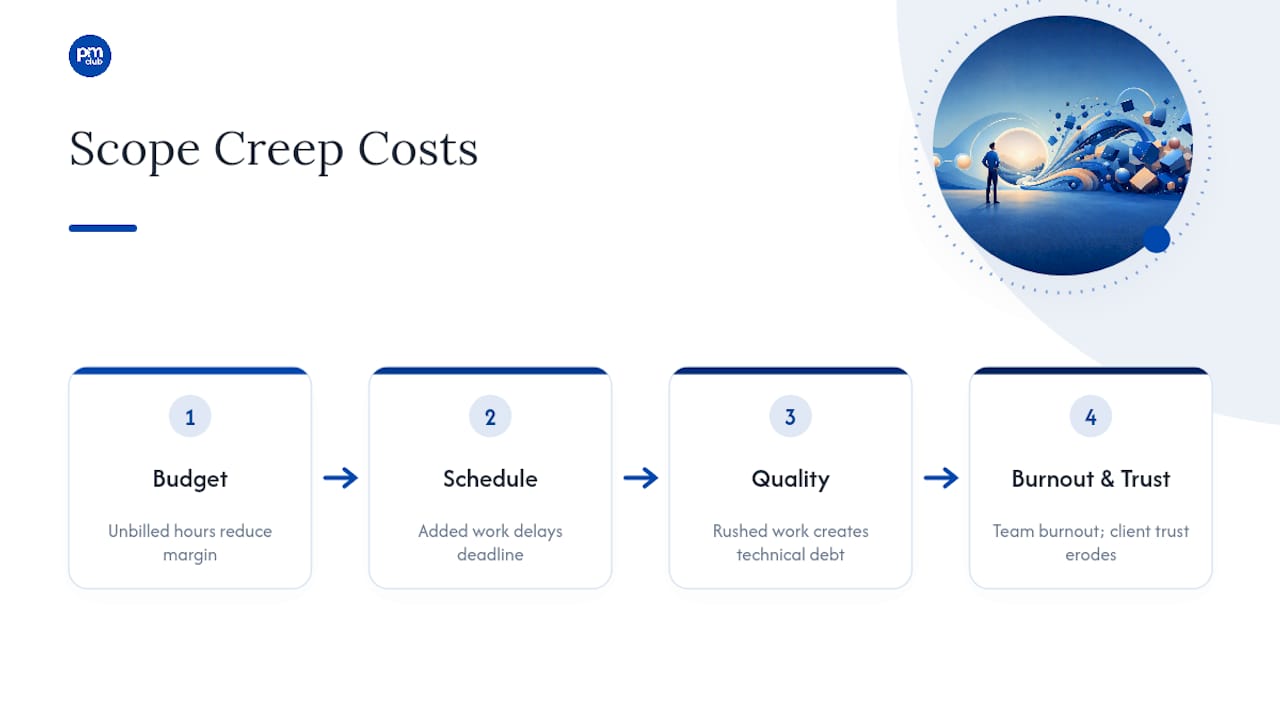
Unmanaged creep hits four places at once, and they compound each other.
Budget takes the first hit: hours you didn't bill for eat directly into your margin, sometimes turning a profitable contract into a break-even one. Schedule slips next, because every unbilled hour spent on an extra request is an hour not spent on what was actually promised by the deadline. Quality erodes as the team rushes to cover both the original scope and the add-ons, and that rush shows up later as technical debt someone has to fix.
Scope creep's compounding cost: Scope creep typically results in schedule delays and budget overruns precisely because neither the calendar nor the invoice gets adjusted to match the added work. The fourth cost is harder to invoice for but often the most expensive: team burnout and eroded client trust, since nobody enjoys delivering more for the same fee, and clients start assuming "extra" is always free.
How Do You Prevent Scope Creep Before It Starts?
Prevention beats every recovery tactic, and it starts before the contract is signed, not after the first change request lands.
Write a scope statement short enough that people actually read it. One page, plain language, with an explicit exclusions list. A concise scope statement stakeholders will actually use beats a forty-page contract nobody opens after the kickoff call. Pair it with a WBS that breaks deliverables into pieces small enough to test, because vague deliverables are exactly what invite "well, I assumed that included..." conversations three weeks later.
Assign approval authority up front and put it in a simple RACI: who can request a change, who assesses it, who signs off. Then run a real kickoff, not a courtesy call, where you walk through scope, exclusions, and the change process, and get documented sign-off before work starts.
- Scope statement: one page, explicit inclusions and exclusions, plain success criteria.
- WBS: deliverables broken down until each piece is independently testable.
- RACI: names attached to who requests, assesses, approves, and pays for changes.
- Kickoff sign-off: a dated, written acknowledgment that scope and process are understood.
Pro Tip: Send the signed scope statement back to the client after kickoff with a one-line note: "This is what we're building. Anything outside this list goes through the change process below." That single email becomes your reference point for every future conversation about "extra" work.
What's a Fast Change Control Process for Scope Creep Solutions?
A change control process only works if it's fast enough that people actually use it instead of routing around it with a favor.
Here's a five-step version built for solo and small-team freelance work:
- Submit: the requester fills out a short form with who, what, why, priority, and their guess at effort.
- Assess impact: you run it against a checklist covering time, cost, scope, risk, and quality.
- Frame the trade-off: present concrete options, swap this for that, defer to phase two, fund it as an add-on, or extend the deadline.
- Record the decision: write down what was chosen and why, even if the answer was no.
- Update the baseline: adjust the scope statement, WBS, and schedule to reflect the approved change.
The change request itself needs only a handful of fields to work:
- Requester name and date
- What's being requested, in one sentence
- Why it matters to the business
- Priority (urgent, important, nice-to-have)
- Estimated effort and owner
A formal change control process makes trade-offs visible instead of letting a verbal yes quietly become a scope change nobody accounted for. Ask one question for every request: does this change the deadline, the effort, the risk, or the outcome? If the answer is yes to any of those, the request needs an explicit trade-off decision, not an informal nod.
Which Templates and Tools Actually Prevent Scope Creep?
You don't need enterprise software to run this well. A scope statement template, a change request template, and a scope register cover most of what a freelance PM needs.
The scope statement needs project name, objectives, deliverables, explicit exclusions, and success criteria. The change request template needs the fields listed above plus a decision box: approved, deferred, or rejected, with a reason. Keep a scope register as a simple running log of every request, whether it was approved, and its impact on hours and deadline.
- A spreadsheet with tabs for scope baseline, change log, and impact checklist covers most solo contracts.
- A work management board (Trello, Asana, or similar) tracks each change request as a card moving through submit, assess, and decide.
- Connected artifacts: scope statement, WBS, baseline, and acceptance criteria only work if you actually check new requests against them, not just file them away.
How Do You Catch Scope Creep Before It Compounds?
Weekly reviews are where most freelance PMs skip a step, and it's the step that catches creep while it's still cheap to fix.
Run a fifteen-minute scope review every week: pull up the scope register, ask what's changed, and flag anything that touched deliverables without a logged change request. Maintaining a visible scope register and reviewing it regularly catches small additions while they're still small, rather than after they've compounded into a missed deadline.
Track three numbers: how many change requests got approved this month, how much effort those changes added against your original estimate, and how far you've drifted from planned milestones. Watch the behavioral signals too, since numbers lag reality by a week or two.
- Repeated small "can you just" requests from the same stakeholder.
- Disagreements over whether a deliverable meets acceptance criteria.
- Rising rework on things the team thought were already finished.
How Do You Recover From Scope Creep That's Already Happened?
If creep already ate three weeks of unbilled time, the fix isn't apologizing, it's quantifying and choosing.
- Run a rapid impact assessment and move the out-of-scope work into a separate cost line so it's visible.
- Present the client with concrete options: cut scope, extend the deadline, add budget, or swap a deliverable for the new one.
- Use plain language: "Here's what we agreed to, here's what's been added, and here's the trade-off I recommend."
Separating out-of-scope work into its own accounting turns a vague argument about fairness into a specific number both sides can react to.
Who's Behind This Playbook
This guide was written by Ashanti for The Freelance PM Club, drawing on how change control actually plays out across the Club's freelance PM community. The resource library includes scope statement and change request templates, and some users report turning chronic scope disputes into fixed-fee change orders that protected their margins. The template library and member case studies are worth a look if you want the paperwork already built.
Why Scope Discipline Is a Reputation Strategy, Not a Contract Clause
Clients remember the PM who protected the timeline more than the one who said yes to everything. A short script helps: "I can absolutely make that happen. Here's what it moves, and here's the trade-off I'd recommend." That's not friction. It's the job.
— Ashanti
Get Scope Control Templates and Coaching from The Freelance PM Club
Freelancers rarely lose money on the work they scoped. They lose it on the work nobody wrote down. The Freelance PM Club exists for exactly that gap: a members' template library with ready-to-use scope statements, change request forms, and impact checklists, so you're not building your change control process from a blank document at 11 PM before a client call.

Membership includes career coaching focused on how freelance PMs negotiate scope and pricing with clients, plus a community where users compare notes on what actually worked when a client pushed back on a change order. For engagements complex enough to need dedicated delivery support, a partner like 121 Group's CMS rebuild practice shows how scope discipline scales on larger technical projects. If you're tired of rebuilding your scope process from scratch on every contract, check out membership and the template library and see what's already built for you.
Sources
- Scope creep in project management: How to manage it — Atlassian
- Project Management Scope Creep: Definition & fixes — Asana
- Top five causes of scope creep — PMI
- Monday
FAQ
How Is Scope Creep Managed?
Scope creep is managed with a documented scope baseline, a formal change control process, and regular scope reviews that catch small additions before they compound. The Freelance PM Club's members lean on scope statement and change request templates to keep this fast and low-friction.
What Is a Famous Example of Scope Creep?
Large public infrastructure and IT projects are the most commonly cited examples, where added requirements and shifting requirements without rebaselined budgets or timelines led to major cost overruns. The underlying pattern, small approved-sounding additions accumulating unchecked, shows up just as often on freelance contracts, only at a smaller dollar scale.
What Is Scope Creep, and What's an Example?
Scope creep is uncontrolled expansion of project requirements without matching increases in time or budget, like a client asking a freelance PM to add a reporting dashboard mid-project that was never in the original proposal. It typically causes schedule delays and budget overruns when the added work isn't formally approved.
How Do You Stop Scope Creep?
Stop it by pausing on any undocumented request, logging it as a formal change request, and running a quick impact check on time, cost, and risk before agreeing to anything. Pair that habit with a short scope statement and a weekly scope register review, and most creep gets caught while it's still a five-minute conversation.