

Yes, freelancers should run an adapted RACI matrix on client projects, and the single most important move is naming one client-side Accountable approver, in writing, per deliverable, before work starts. Skip that and you inherit the classic freelance headache: three stakeholders giving three different opinions on your draft, and nobody willing to say "approved."
The fix takes ten minutes at kickoff.
- Name one Accountable approver per deliverable inside your SOW, not a committee.
- List everyone else as Consulted or Informed so feedback has a lane.
- Tie your invoice trigger to that person's written sign-off, not "the client feels good about it."
The Freelance PM Club keeps a copy-paste RACI template in its resource library built for exactly this, with SOW language you can drop straight into a proposal.
Key Takeaways
Freelancers who adapt RACI by naming one client-side Accountable approver per deliverable get faster approvals, fewer unpaid revisions, and cleaner billing triggers.
| Point | Details |
|---|---|
| One Accountable per deliverable | Name a single client-side approver in the SOW, never a committee. |
| Consulted list stays small | Cap reviewers at two or three names to prevent feedback bottlenecks. |
| Written acceptance drives billing | Tie invoice triggers to documented sign-off, not verbal approval. |
| Update RACI at milestones | Revisit roles whenever scope changes or new stakeholders join. |
| The Freelance PM Club provides templates | Members get copy-paste RACI tables and SOW clause language for approval triggers. |
Table of Contents
- What Is a RACI Matrix for Freelancers?
- Why Should Freelancers Bother With a RACI Chart?
- How Do You Map Freelancer and Client Roles in a RACI Chart?
- How Do You Build and Confirm a RACI Matrix for a Project?
- What Does a Copy-Paste RACI Template Look Like?
- What Mistakes Do Freelancers Make With RACI Matrices?
- How Do You Write RACI Into Proposals, SOWs, and Billing?
- What Do Freelance PMs Say About Using RACI With Clients?
- Why the Standard RACI Advice Falls Short for Solo Freelancers
- Get RACI Templates and SOW Language Built for Freelance Work
- Frequently Asked Questions
- Sources
What Is a RACI Matrix for Freelancers?
A RACI matrix maps every task or deliverable to four roles: Responsible, Accountable, Consulted, and Informed. The Wikipedia entry on the responsibility assignment matrix frames it as a grid, tasks down one side, people across the top, with a single letter in each cell showing who does what.
Here's what each letter actually means on a real project:
- Responsible (R): The person who does the work. On most freelance gigs, that's you.
- Accountable (A): The person who owns the outcome and signs off. Exactly one per task, always.
- Consulted (C): People whose input shapes the work before it's finished, like a legal reviewer or a technical lead.
- Informed (I): People who get updates but don't weigh in.
The rule that makes RACI work is simple: one Accountable, at least one Responsible, per task. Two Accountables on the same deliverable is how you end up with contradictory feedback and no one willing to make the call.
You'll also see variants like RASCI (adds "Support"), DACI (built around Driver, Approver, Contributor, Informed for decisions), and RAPID. They're worth knowing exist, but for solo client work, plain RACI is usually enough.
Why Should Freelancers Bother With a RACI Chart?
Because the alternative, no defined roles, is what turns a two-week project into a six-week email chain. RACI charts speed up decision-making and reduce overlapping feedback specifically because they force one person to own the yes-or-no.
For freelancers, that translates into three concrete wins. Fewer revision cycles, because one named approver can't contradict themselves the way a group of five stakeholders can. Faster invoicing, because "approved" has a clear trigger instead of a vague sense that the client is happy. And less noise in your inbox, because Consulted and Informed people know their lane and stop replying-all with conflicting notes.
The billing angle matters more than most freelancers realize. Unpaid rework almost always traces back to unclear approval authority. Someone who was never actually the Accountable party asked for a change, you made it for free, and then the real decision-maker asked for something different.
- Map roles before you send the proposal, not after the client pushes back.
- Put the Accountable name in writing inside the SOW, not just in a kickoff call.
- Route every change request through that one person, no exceptions.
Pro Tip: Send your draft RACI matrix as a separate one-page attachment with the proposal, not buried in a scope document. Clients skim scope documents. They read a one-page role map.
How Do You Map Freelancer and Client Roles in a RACI Chart?
For solo engagements, the whole model tilts toward client governance. Gruv.ai's guidance on RACI for freelance projects puts it plainly: shift the Accountable role to a named client-side approver and tie written acceptance directly to billing. You're almost always Responsible. The client owns Accountable.
Here's the mapping that works for most solo or small-team freelance engagements:
- You (the freelancer) = Responsible. You produce the deliverable, on time, to the agreed spec.
- Client approver = Accountable. One named person, not "the marketing team," signs off on each deliverable.
- Subject-matter experts = Consulted. A brand designer, a legal reviewer, a technical lead, anyone whose input shapes the work before it's final.
- Broader stakeholders = Informed. Executives, other departments, anyone who needs the update but has no say in approval.
When you're writing this into a proposal, generic labels like "stakeholder" invite ambiguity. Use specific role names instead:
- Client approver: the one person whose sign-off triggers your invoice.
- Project sponsor: whoever holds budget authority, useful when they're different from the approver.
- Billing contact: the person who actually processes your invoice, which sometimes isn't the approver at all.
Understanding how client roles differ from your own also helps here. If you're negotiating scope with someone acting more as a strategic partner than a task assigner, the distinction between freelancer and consultant roles can clarify who should actually hold the Accountable seat versus who's just Consulted.
The biggest trap in this section is letting Consulted and Informed lists grow. Every extra name in Consulted is another person who thinks they get a vote. Cap it at two or three people who genuinely need to weigh in before you finalize a deliverable. Everyone else goes in Informed, where they get a status update and nothing more.

How Do You Build and Confirm a RACI Matrix for a Project?
Start with deliverables, not people. List every discrete output the project produces, along with the decision points inside each one, before you assign a single role.
- List deliverables and decision points. A website redesign might break into wireframes, copy, visual design, and final build, each with its own approval moment. Don't lump the whole project into one row.
- Assign R, A, C, I with the one Accountable rule. For every deliverable, write down who's Responsible (you), who's Accountable (the named client approver), who's Consulted, and who's Informed. Note the approval artifact next to each Accountable name, an email, a signed form, a comment marked "approved" in a shared doc. Vague verbal approval doesn't count.
- Review the RACI at kickoff and get written acceptance. Walk through the matrix on your kickoff call, confirm the Accountable approver agrees to the role, and get that agreement in writing, even if it's just a reply email that says "confirmed."
- Tie acceptance to billing and define the change path. Every invoice trigger should reference the Accountable approver's written sign-off. Every change request should route through that same person, with a clear path for how scope changes get priced.
Wrike's research on RACI usage notes the chart earns its keep most at project start and gets reviewed regularly afterward, not filed away and forgotten. That's the part freelancers skip. You build the matrix, send it once, and never look at it again. Then scope drifts, a new stakeholder shows up mid-project, and nobody remembers who's actually Accountable anymore.
Revisit the matrix at every major milestone, not just kickoff. If a new decision-maker enters the picture (a client hires a new marketing director partway through, say), update the Accountable field immediately and get written confirmation from the outgoing and incoming approver both.
Pro Tip: Keep your RACI matrix in the same document as your project timeline. When a client asks "why is this delayed," you can point to the exact row where their team hasn't delivered a Consulted input yet.
What Does a Copy-Paste RACI Template Look Like?
A working RACI table needs just five columns: the deliverable, and then R, A, C, I. Fill in names, not job titles, wherever possible, since "marketing" isn't accountable for anything, but Sarah in marketing is.
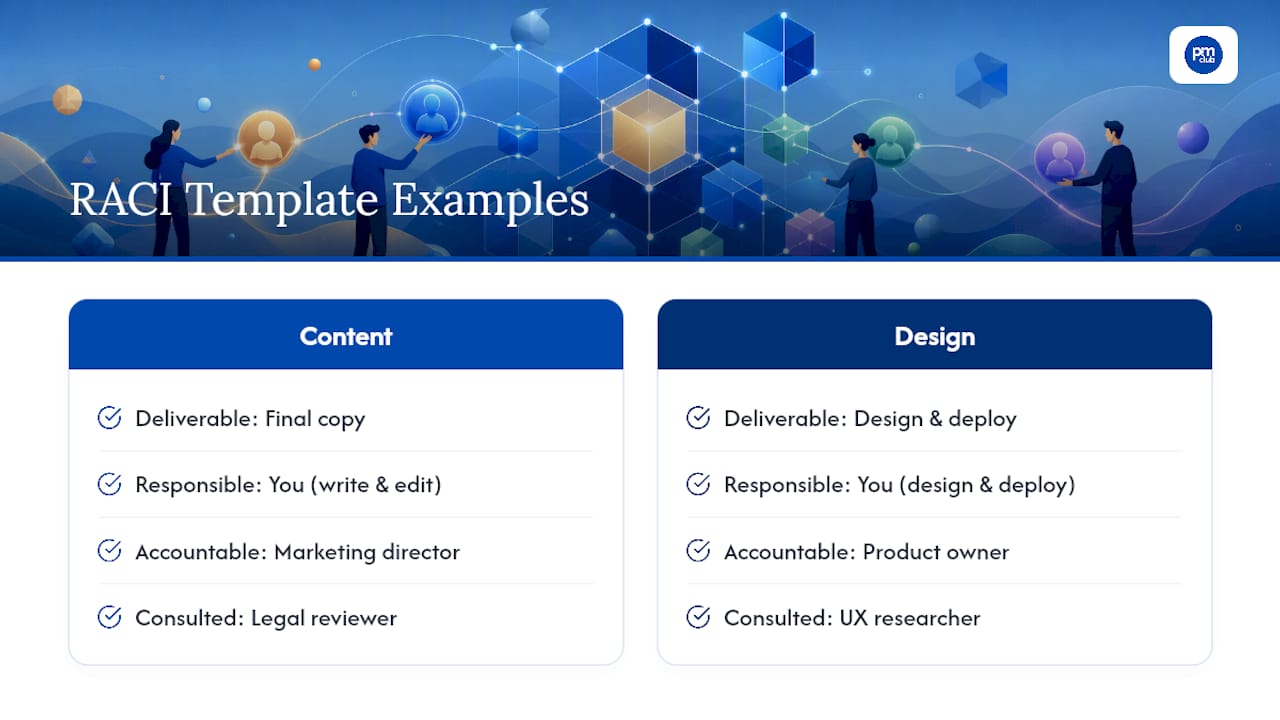
Two quick worked examples show how this shifts by project type.
Example A: content project. You're Responsible for writing and editing. The marketing director is Accountable for approving the final copy. A legal reviewer is Consulted on claims language before publish. The client's CEO is Informed once the piece goes live. One approval loop, one sign-off, invoice sent.
Example B: design, review, deployment. You're Responsible for the design and the deployment. The product owner is Accountable, the one person who says "ship it." A UX researcher is Consulted during the review phase. The support team is Informed post-launch so they know what changed. Notice the Accountable seat doesn't move between phases, even though Consulted parties rotate in and out.
Ones makes a point worth repeating: a simple template with one worked example beats a long conceptual write-up almost every time. Copy the table above into your next proposal, swap in real names, and you're done in fifteen minutes.
What Mistakes Do Freelancers Make With RACI Matrices?
The mistake that breaks RACI fastest is multiple Accountables on one deliverable. Two people both marked "A" means two people both think they have final say, and you'll find out they disagree at the worst possible moment, usually right before a deadline.
The fix is blunt: consolidate to one Accountable name per row, even if it means an awkward conversation with the client about who actually holds decision authority.
- Too many Consulted names. Atlassian's guidance on RACI charts recommends keeping the list of reviewers tight and revisiting the chart regularly, because a bloated Consulted column is where feedback goes to die in committee. Cap it at two or three people.
- No real approval artifact. "The client seemed fine with it on the call" is not documentation. Require something written, an email, a comment, a signed acceptance form, tied to the named Accountable approver.
- No feedback deadline. Open-ended review windows invite scope creep. State a deadline for Consulted input in the SOW itself, not just in a casual Slack message.
Pro Tip: If a client insists on a "committee approval" model, ask them to name one person who breaks ties. You're not fighting their internal process, you're just making sure someone owns the final call.
How Do You Write RACI Into Proposals, SOWs, and Billing?
The matrix only has teeth if your SOW makes it enforceable. That means naming the approver, the approval artifact, the feedback channel, and the deadline in the actual contract language, not just in a slide you showed during the pitch.
- Name the specifics in the SOW. Include the Accountable approver's name and title, the format of acceptance (email, signed form, comment thread), the channel for feedback (one shared doc, not five separate email threads), and a hard deadline for review.
- Write the billing trigger explicitly. Language like "Invoice issued upon written approval from [named Accountable approver]" removes ambiguity about when payment is due. Gruv.ai's framework for freelance RACI recommends this kind of operational specificity precisely because vague acceptance language is where freelancers lose money.
- Route change requests through one person. Document every scope change request in writing and require it to come from, or be confirmed by, the Accountable approver. If a Consulted party asks for a change, that's feedback, not an approved scope shift, until the Accountable person signs off on it.
This is also where communication structure matters beyond the contract itself. Clear stakeholder roles reduce the back-and-forth that eats freelance hours, a point echoed in broader project communication management research, which ties structured role clarity to fewer delays and less rework across project types.
What Do Freelance PMs Say About Using RACI With Clients?
Practitioners who've run this pattern across multiple client engagements tend to land on the same conclusion: the matrix isn't the hard part. Getting the client to commit to one Accountable name, in writing, before the first draft goes out, is the part that actually prevents disputes.
The projects that stall aren't the complicated ones. They're the ones where three people can say no and nobody can say yes. Naming one Accountable approver up front solves more disputes than any clause you could add to a contract.
Freelancers working through The Freelance PM Club's templates and coaching sessions consistently report the same shift once they start naming an Accountable approver in every SOW: fewer revision rounds, and invoices that go out closer to the delivery date instead of weeks later.
Why the Standard RACI Advice Falls Short for Solo Freelancers
Most RACI content is written for internal teams sorting out who does what across departments. That's not your problem. Your problem is a client who wants to stay involved in every decision while also expecting you to just handle it.
The conventional advice, map every stakeholder, define every task, treats RACI as a documentation exercise. For freelancers, it's a negotiation tool. The matrix's real value shows up the moment a client tries to get feedback from someone who was never named Accountable. You point to the SOW. Conversation over.
What gets underrated is how much of this lives in contract language, not project management theory. A perfectly built RACI chart that never makes it into your SOW is decoration. The billing trigger, tied explicitly to the Accountable approver's written sign-off, is what actually protects your time and your invoice.
If you take one thing from this, prioritize the SOW language over the chart's visual polish. A messy table with one named approver and a clear billing trigger beats a beautiful matrix with no enforcement mechanism behind it.
Get RACI Templates and SOW Language Built for Freelance Work
Building this system from scratch for every proposal wastes hours you could bill instead. The Freelance PM Club's resource library carries ready-to-use RACI templates, SOW clause language for approval triggers, and coaching sessions where you can workshop a specific client's role structure before you send the proposal.

Members get the copy-paste table format used throughout this piece, plus billing-trigger phrasing you can drop straight into a contract, and access to workshops where practitioners troubleshoot real client scenarios, like what to do when a client insists on group approval. That combination shortens the setup time from a few hours of trial and error to about fifteen minutes of filling in names.
If you're sending a proposal this week, visit The Freelance PM Club and pull the RACI template before you finalize your SOW. Getting the Accountable approver named correctly on the first draft saves you the awkward renegotiation later.
Frequently Asked Questions
Is a RACI matrix overkill for a solo freelance project? No, if you scale it down. A three-row table with deliverable, Accountable approver, and feedback deadline takes ten minutes and prevents most approval disputes.
Who should be Accountable on a freelance project, me or the client? The client, in almost every case. You're Responsible for the work; the client names one person to own the approval decision.
What's the difference between RACI and RASCI? RASCI adds a "Support" role for people who help without owning the task. Most freelance engagements don't need the extra category.
Can I use RACI without special project management software? Yes. A shared spreadsheet or a table inside your proposal document works fine. Some project management tools support RACI directly inside task views if you're already running client work through one.
How often should I update the RACI matrix during a project? Review it at every major milestone and whenever a new stakeholder enters the picture, not just once at kickoff.