

A RACI matrix is a grid that assigns one of four roles (Responsible, Accountable, Consulted, Informed) to every person on every task, so no one wonders who owns a decision or who just needs a heads up. The core value is preventing missed handoffs: instead of three people assuming someone else will sign off, one name is accountable, one or more people do the work, and everyone else knows exactly how involved they should be. Teams reach for it on cross-functional projects, client engagements with multiple stakeholders, and any initiative where "I thought you had that" has already caused a problem.
TL;DR:
- Assigning only one person as accountable per task ensures clear ownership and prevents decision-making bottlenecks.
- Limiting the number of consulted stakeholders improves decision speed and reduces communication overload.
- Regularly updating the RACI matrix, especially after scope changes or personnel shifts, maintains its accuracy and usefulness.
- Using role-based columns over individual names helps maintain clarity during team changes and project iterations.
- Avoiding overcomplication by keeping the matrix focused on key tasks improves team trust and practical use.
Table of Contents
- Understanding RACI Roles: Responsible, Accountable, Consulted, Informed
- Why Use a RACI Matrix, and Where It Falls Short
- How to Create a RACI Matrix Step by Step
- RACI Matrix Examples You Can Adapt Today
- Common RACI Mistakes and How to Fix Them
- RACI Variations: RASCI, RACI-V, and DACI Explained
- Keeping the RACI Matrix Alive Through the Project
- What RACI Taught Me About Freelance Project Delivery
- Get Templates and Coaching to Put RACI Into Practice
- Sources
- FAQ
Understanding RACI Roles: Responsible, Accountable, Consulted, Informed
The four letters look simple until you're actually filling in a grid and two people both think they're in charge. Getting the definitions precise up front saves you from that argument later.
Responsible is the person or people who do the work. On a task like "draft the client proposal," the Responsible party is whoever is writing it. There can be more than one Responsible per task. If a designer and a copywriter are both building a landing page, they're both Responsible for that row.
Accountable is the person who owns the outcome and signs off. This is the role people confuse with Responsible most often, and it's the one that breaks matrices when it's wrong. The Accountable person doesn't necessarily do the work; they answer for whether it got done right. A freelance PM might be Accountable for a project timeline while a subcontractor is Responsible for building the actual schedule. The defining rule here is non-negotiable: one Accountable person per task, never more.
Consulted covers people whose input shapes the work before it's finalized. This is two-way communication. A legal reviewer consulted on contract language will weigh in, and that input changes the draft. Consulted should be a short list, not everyone who might have an opinion.
Informed covers people who need to know the outcome but have no input into it. This is one-way communication, typically after the fact. A department head informed about a completed migration doesn't need to review it; they just need the update.
Here's a quick way to stress-test any row you've filled in:
- Does exactly one person hold the A? If two people are Accountable, the task has no real owner.
- Does every task have at least one R? A task with no Responsible party is a task nobody is actually doing.
- Is every C someone whose input would change the outcome, not just someone who wants to be looped in?
- Could any I become a periodic update instead of a standing entry? If they never act on the information, they may not need real-time visibility.
One statistic worth internalizing: research from the University of Leeds's project delivery guidance points out that overloading the Consulted and Informed columns creates communication overhead heavy enough to slow decisions down. A matrix with 12 people consulted on every task isn't more thorough. It's a bottleneck with a spreadsheet attached.
Why Use a RACI Matrix, and Where It Falls Short
The benefits show up fastest on projects where ownership has gotten fuzzy. When every task has a named Accountable person, the "who dropped this" conversation mostly disappears, because there's only one name to ask. Handoffs get cleaner too: a Responsible party who knows exactly which Consulted reviewer to loop in before finalizing a deliverable doesn't waste a review cycle sending it to the wrong person.
The practical gains break down like this:
- Clarity of ownership. Every task has a name attached to the outcome, not a team.
- Fewer missed handoffs. Cross-functional work fails most often at the seams between roles, and RACI forces you to name those seams explicitly.
- Faster onboarding. A new team member or subcontractor can read the matrix and know who to ask instead of guessing.
- A built-in communications plan. Treating the matrix as part of your communications structure means you've already decided who gets told what, and how often.
But RACI has real limits, and pretending otherwise sets teams up for frustration. It's a static tool describing formal roles, and it doesn't capture informal power dynamics. The Consulted engineer whose opinion actually carries more weight than the Accountable manager's is invisible on the grid. RACI also gets rigid fast on projects that change scope weekly. If your task list is obsolete by Friday, you'll spend more time updating cells than doing the work they describe.
For small teams of two or three people who already talk daily, a full matrix can be overkill. A one-line note in a project brief ("Maria owns final approval, everyone else weighs in in Slack") often does the same job with none of the maintenance. Save the formal matrix for projects where the stakeholder list is long enough that memory alone won't hold it.
How to Create a RACI Matrix Step by Step
Building a RACI matrix badly takes ten minutes and produces a document nobody trusts. Building it well takes maybe an hour, and it's the difference between a tool people check and one that sits in a folder untouched. Here's the process, adapted from the step-by-step method MindTools recommends:
-
List every task and deliverable by name. "Marketing" is not a task. "Approve final ad copy for the Q2 campaign" is a task. Vague labels are the number one reason RACI matrices fall apart, because two people can read "manage vendor relationship" and picture completely different jobs. Break big phases into discrete, nameable actions.
-
Decide whether to use role titles or individual names. Role-based columns ("Project Manager," "Client Reviewer") hold up better over time since they don't need updating every time someone leaves. Named columns are more precise for a single, short engagement where you know exactly who's involved and won't be swapping people mid-project. Freelancers running one-off consulting gigs often go with names; agencies running recurring project types tend to prefer roles.
-
Assign R and A first, before touching C and I. For each task, ask: who does the work, and who owns the outcome? Apply the one-A rule immediately. If you find yourself wanting to write two Accountable names into one cell, that's a signal the task needs to be split into two tasks, not that the rule needs bending.
-
Add Consulted and Informed with restraint. For each name you're tempted to add as Consulted, ask whether their input would actually change the deliverable. If not, move them to Informed or drop them from that row entirely.
-
Check the load on every row and column. Scan for tasks with no Responsible party (nobody's actually doing it) and for people who show up as Accountable on ten different rows (they're now a bottleneck, whether or not they're the right approver). Rebalance before you circulate the draft.
-
Prune unnecessary Cs and Is. This step gets skipped constantly, and it's the one that determines whether people actually read the matrix later. A row with six Consulted names trains people to ignore the Consulted column entirely.
-
Communicate the matrix to everyone named in it. Don't just save the file. Walk through it in a kickoff meeting or share it with a short explanation of what each letter means for the people seeing it for the first time. Link it inside your project management tool so it's not a separate document people forget exists.
-
Schedule a review point. Pick a trigger, not just a date. Phase gates, major scope changes, and personnel turnover are the moments a RACI actually needs revisiting, and building that into the plan from day one avoids the matrix quietly going stale.
Pro Tip: Draft the task list before you even think about names or roles. Teams that start by assigning people first tend to build the task list around who's available rather than what the project actually requires, and you end up with gaps nobody notices until a deliverable falls through the cracks.
RACI Matrix Examples You Can Adapt Today
Seeing a filled-in grid makes the rules click faster than any explanation. Here are two short, realistic examples: one for a marketing website launch, one for a freelance consulting deliverable.
Example 1: Marketing website launch. A small team is relaunching a company site. The task rows might include content drafting, design mockups, developer build, legal review of the privacy policy, and final go-live approval.
Notice the Accountable letter moves depending on who actually owns that outcome. The client is Accountable for the final go-live decision even though the PM is Responsible for executing it, because it's the client's site and their approval that matters.
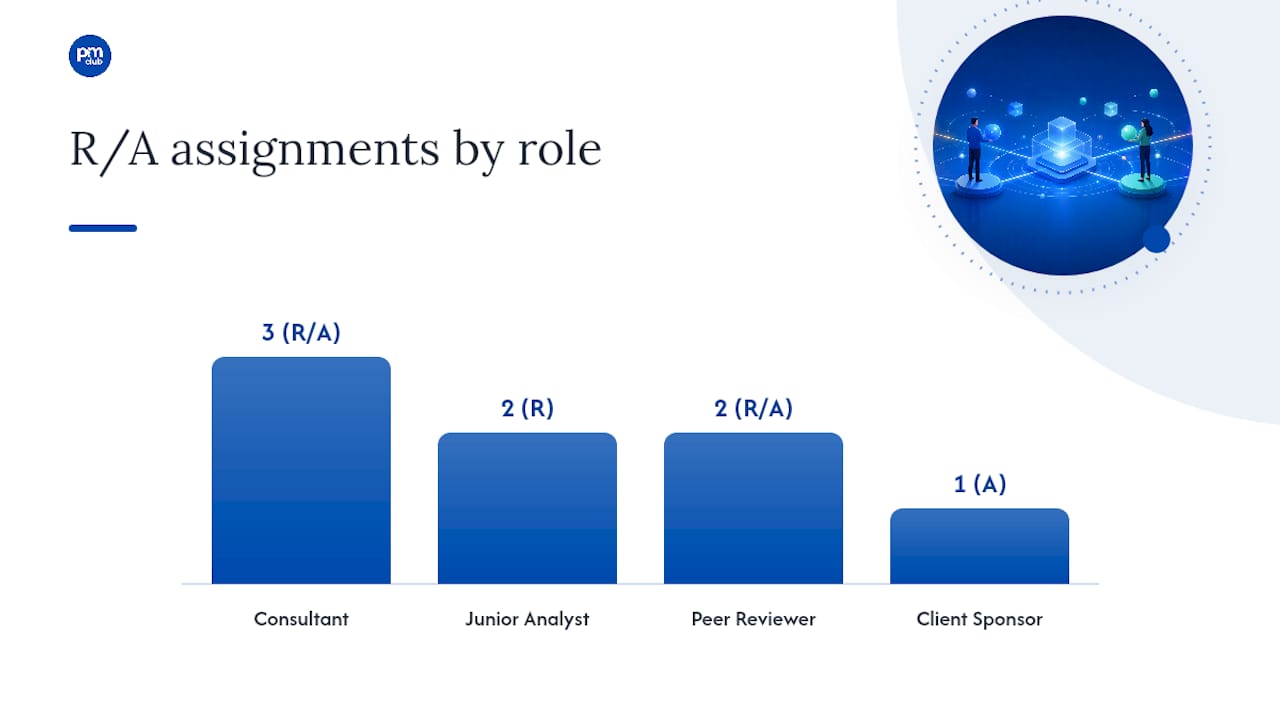
Example 2: Freelance consulting deliverable. A solo consultant is delivering a market analysis report for a client.
| Task | Consultant | Client Sponsor | Junior Analyst | Peer Reviewer |
|---|---|---|---|---|
| Gather market data | R | I | R | I |
| Draft analysis report | R/A | C | R | I |
| Peer review draft | I | I | I | R/A |
| Final client approval | I | A | I | I |
Splitting "gather data" and "draft report" into separate rows instead of lumping them into one "produce report" line matters more than it looks like it does. Combined deliverables hide the fact that different people are Responsible for different pieces, and that ambiguity is exactly what causes handoff failures. Real-world examples across industries consistently show that this kind of row-level specificity reduces duplicated effort on cross-functional work.
To adapt either grid to your own project, start from the task list, not the template. Copy the column structure, delete every row, and rebuild the tasks from your actual project plan. A RACI matrix borrowed wholesale from someone else's project almost always has tasks that don't apply to yours and is missing the ones that do.
Common RACI Mistakes and How to Fix Them
Most RACI failures trace back to a handful of repeat offenders. Here's what to watch for.
Multiple Accountable people on one task. This is the single most common error, and it defeats the entire purpose of the tool. If a row shows two As, you don't have unclear accountability, you have none. The fix is almost always to split the task: separate the decision that needs one owner from the work that might have several contributors.
Over-consulting. Every additional Consulted name adds a review cycle. A task with eight Consulted stakeholders will move slower than one with two, and most of those eight will skim the request without reading it closely. Audit your Consulted columns periodically and ask whether each name has actually changed a deliverable in the last few reviews. If not, move them to Informed.
Letting the matrix go stale. A RACI built during kickoff and never touched again becomes shelf-ware within a few weeks, especially on projects where scope or staffing shifts. Assign an owner for the document itself, someone whose job includes updating it, not just building it once.
Vague role assignments. If someone reads their row and isn't sure whether they're supposed to act or just watch, the matrix has failed at its one job. Fix ambiguous rows by rereading the letter definitions against the actual task and asking the person directly whether the assignment matches what they expect to do.
Pro Tip: When a stakeholder pushes back on their assigned letter, don't just change it to keep the peace. Ask what they think their role should be and why. Often the disagreement reveals a task that needs splitting, not a letter that needs swapping.
RACI Variations: RASCI, RACI-V, and DACI Explained
The four-letter model doesn't fit every situation, and a handful of variants have emerged to cover the gaps.
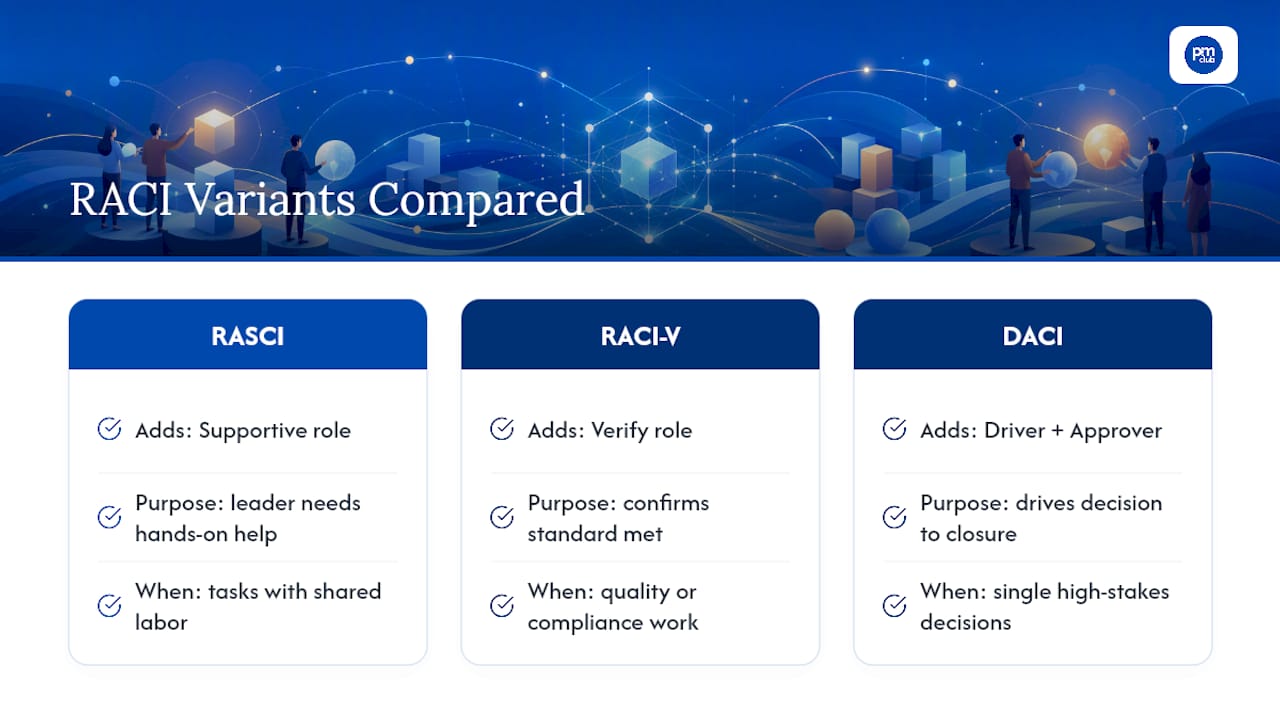
RASCI adds a Supportive role between Responsible and Consulted. Supportive people assist the Responsible party with resources or labor but don't own the outcome the way an R does. This variant works well on tasks where one person leads but needs hands-on help from others who aren't fully accountable for the result.
RACI-V adds Verify, a role for someone who checks the work against a standard before it's considered done. Quality-critical work, like a compliance deliverable or a technical build with regulatory requirements, benefits from separating "did the work" from "confirmed the work meets the standard." As Wrike's breakdown of RACI variants notes, adding a verification role only makes sense when the sign-off itself carries enough risk to warrant a separate check.
DACI (Driver, Approver, Contributor, Informed) takes a different approach entirely: it's built for decisions, not tasks. Instead of mapping who does the work, DACI maps who drives a decision to closure, who has final approval, who contributes input, and who's informed. Teams facing a single high-stakes decision, like choosing a vendor or setting a pricing model, often find DACI clearer than RACI because it's structured around the decision-making process itself rather than deliverable ownership.
Choosing between them comes down to two questions: how complex is the work, and how high are the stakes on any single call? A straightforward project with clear task ownership doesn't need RASCI's extra role. A project with one make-or-break decision and a dozen opinions in the room might do better with DACI than with a RACI row trying to force that decision into a task format it wasn't built for.
Keeping the RACI Matrix Alive Through the Project
A matrix built once and filed away is worse than no matrix at all, because it gives people false confidence in outdated information. Treating it as a living communication tool rather than a one-time document is what separates teams that actually use RACI from teams that built one for a kickoff deck and forgot about it.
Set a review cadence tied to real triggers, not just a calendar date. Phase gates are natural checkpoints. Personnel changes are non-negotiable ones: if an Accountable person leaves the project, that row needs a new owner before the next task in that chain starts. Quarterly reviews work as a baseline for longer engagements even when nothing dramatic has changed, just to catch drift.
Integration matters more than most teams expect. Pinning the matrix to a Slack channel or linking it directly to tasks inside your project management software keeps it visible in the places people already work, instead of buried in a shared drive. A few light-touch automations go a long way here:
- Notification triggers when a task's Accountable owner changes.
- A linked template that updates automatically when a new task type gets added to the project plan.
- A recurring calendar reminder tied to your phase-gate schedule, not a generic monthly ping.
Watch for signals that a revisit is overdue: people asking who owns something the matrix should already answer, tasks getting stuck because no one's sure who signs off, or new team members reading the matrix and immediately hitting a role that no longer exists. Any of those is a sign the document has drifted from reality, and drift compounds fast if it's not caught early.
What RACI Taught Me About Freelance Project Delivery
The place RACI earns its keep fastest is a freelance engagement where you're parachuting into someone else's org chart with no institutional memory of who actually approves what. On one multi-stakeholder deliverable, a missed handoff nearly happened because the client sponsor and the client's internal reviewer both assumed the other held final sign-off. A five-minute RACI conversation at kickoff, just naming one Accountable person for that approval, closed the gap before it became a missed deadline.
What made the difference wasn't the matrix itself. It was revisiting it two weeks in, when a stakeholder change on the client side would have silently orphaned that Accountable role if nobody had checked. Treating the document as something to reopen, not something to file, is the entire value proposition. A RACI matrix that's accurate on day one and wrong by day thirty is actively worse than no matrix, because people keep trusting it after it's stopped being true.
Freelancers and consultants juggling multiple clients rarely have time to build this kind of process documentation from scratch on every engagement, which is exactly why having a reusable template and a second set of eyes on your role assignments matters. That's the gap resources like The Freelance PM Club exist to close, through templates and a community that's already solved this exact problem more than once.
— Ashanti
Get Templates and Coaching to Put RACI Into Practice
Building a RACI matrix from a blank grid every time you land a new client is a waste of the hour you don't have between engagements. There are available resources that provide editable RACI templates you can drop into a new project in minutes instead of building from scratch, plus coaching sessions where you can walk through a tricky stakeholder map with an experienced practitioner.

It fits freelance PMs, consultants, and small cross-functional teams who want the clarity of a formal matrix without reinventing the process every time the client roster changes. Members also get feedback from a working community of other freelance PMs, so a confusing RACI row doesn't have to get solved alone at midnight before a client call. If you're adapting one of the examples above and want a second opinion on whether your Accountable assignments actually hold up, or you want a full template library instead of building tables from scratch, start with The Freelance PM Club and see what's included at your stage.
Sources
For deeper reading on the framework covered here, the RACI matrix entry on Wikipedia lays out the canonical role definitions and the one-Accountable rule. MindTools offers the step-by-step creation checklist referenced throughout this guide. Slack's breakdown covers integrating RACI into collaboration tools so it stays a living document. Wrike explains the RASCI and RACI-V variants in more depth. For sample grids across different industries, PM Study Circle's examples are worth a look, and consultants adapting RACI to client reporting workflows can reference 121 Group's approach to portfolio reporting for a real-world take on responsibility assignment in consulting delivery.
- RACI matrix — Wikipedia
- RACI model: What it is and how to use it with Slack — Slack Blog
- The RACI Matrix — MindTools
- What is a RACI chart? Definition, benefits, and examples — Wrike
FAQ
What is the golden rule of RACI?
One person, and only one person, holds the Accountable letter on any given task. Multiple Rs are fine; multiple As mean the task has no real owner, which defeats the purpose of the matrix.
What are the most common RACI mistakes?
The top three are assigning more than one Accountable person per task, over-consulting people whose input doesn't actually change the outcome, and letting the matrix go stale after the kickoff meeting instead of revisiting it at phase gates or personnel changes.
Is RACI outdated?
No, but it's frequently misapplied as a one-time paperwork exercise instead of an ongoing conversation starter. Its value holds up when teams treat it as a living tool that prompts regular alignment rather than a document built once and forgotten.
Is RACI part of Six Sigma?
RACI is not exclusive to Six Sigma; it's a general project management and organizational tool used across methodologies, including but not limited to process improvement frameworks. Teams running Six Sigma projects often use it alongside their standard tools, but it originated as a broader responsibility assignment framework.
How is a RACI matrix different from a simple task list?
A task list tells you what needs to happen; a RACI matrix tells you who owns each of the four distinct relationships to that task, from doing the work to just needing the final update. The Freelance PM Club's templates build that structure in from the start, so freelance PMs aren't retrofitting accountability onto a plan that was only ever a to-do list.