

A project manager delivers one project on time, on budget, and within scope. A program manager coordinates several related projects to realize a strategic benefit that outlasts any single deliverable. If you're hiring, staff a project manager for a defined initiative with a hard deadline; staff a program manager when you need someone to align multiple workstreams toward a business outcome. If you're choosing a career path, PMI frames program management as a shift from tactical delivery to strategic coordination, while the Bureau of Labor Statistics tracks project management as its own distinct occupational category with its own pay and demand signals.
Three things worth knowing before you read further:
- Project management is scoped to one initiative with a defined end date.
- Program management is ongoing and measured by benefits realized, not just deliverables shipped.
- Resources like The Freelance PM Club can help you figure out which path (or which hire) fits your situation, without guessing.
Key Takeaways
Choosing between a project manager and a program manager comes down to scope and timeframe: one delivers a single initiative, the other coordinates several toward a lasting business outcome.
| Point | Details |
|---|---|
| Scope defines the role | Project managers own one initiative; program managers coordinate multiple related projects toward a shared goal. |
| Metrics differ by altitude | Projects are judged on-time and on-budget; programs are judged on benefits realized, often much later. |
| Certifications map to level | PMP signals project readiness; PgMP signals program-level strategic coordination skills. |
| Career pivot takes practice, not just years | Running a cross-project pilot or benefits workshop predicts program readiness better than tenure alone. |
| The Freelance PM Club supports both stages | Its courses, coaching, and job board serve project managers sharpening delivery skills and PMs pivoting toward program roles. |
Table of Contents
- Project Manager vs Program Manager: A Side-by-Side Comparison
- Project Manager Responsibilities: Daily Work, Tools, and What Success Looks Like
- Program Manager Duties: Governance, Trade-Offs, and Owning the ROI
- Skills and Certifications That Signal Readiness for Each Role
- How to Move From Project Manager to Program Manager
- When to Hire a Project Manager vs a Program Manager
- How The Freelance PM Club Supports Skill-Building and Career Transitions
- Choosing Between Hands-On Delivery and Program Leadership
- Where to Go for Deeper Research
- Ready to Build the Skills for Either Path?
- Frequently Asked Questions
- Sources
Project Manager vs Program Manager: A Side-by-Side Comparison
The two roles diverge on four practical dimensions: scope, success metrics, timeline, and who they answer to.
Scope. A project manager owns a single project with a defined set of deliverables. A program manager oversees multiple, interrelated projects, often run by different project managers, and is accountable for how those pieces fit together. Atlassian's role breakdown puts it plainly: project managers focus on deadlines and deliverables, while program managers make sure each project actually contributes to the wider organizational goal.
Success metrics. Project success gets measured in binary, near-term terms: did it finish on time, on budget, at the agreed quality bar? Program success gets measured in benefits realization and ROI, often months or years after individual projects have wrapped.
Timeline. Projects have a start date and an end date. Programs frequently don't. Elmhurst University's comparison notes that programs often run as continuous, long-term initiatives with no fixed end, which is part of why the two roles require different temperaments.
Reporting lines. A project manager typically reports to a program manager, a functional director, or a department head. A program manager typically reports higher, to a portfolio director, VP, or C-suite sponsor. In flatter organizations, these lines blur. A ten-person startup might have one person doing both jobs, while a large enterprise stacks project managers underneath a program manager underneath a portfolio executive.
- Scope: single initiative vs. a coordinated set of initiatives
- Metrics: on-time/on-budget vs. benefits realized
- Timeline: fixed end date vs. ongoing lifecycle
- Reporting: functional lead vs. portfolio or executive sponsor
Project Manager Responsibilities: Daily Work, Tools, and What Success Looks Like
A project manager's day is tactical and detail heavy. The job centers on four core duties:
- Scope definition. Locking down what's in and out of the project before work starts, then defending that line against creep.
- Scheduling. Building and maintaining the timeline, usually with Gantt-chart based tools, and adjusting it as tasks slip or accelerate.
- Budget control. Tracking spend against the approved budget and flagging variance early.
- Risk management. Identifying project-level risks (a vendor delay, a resource conflict) and building mitigation plans before they become problems.
Most project managers work inside Kanban or Scrum boards, task trackers like Jira, and scheduling software like Microsoft Project. The tool matters less than the discipline behind it: milestones hit, budget variance kept tight, quality maintained without heroics.
If you're hiring, look for candidates who can talk specifically about scope control, vendor negotiation, and a track record of delivery, not vague claims of "leadership."
Pro Tip: Ask candidates to walk through a project that went sideways. How they recovered a slipping schedule tells you more than any certification on their resume.
Program Manager Duties: Governance, Trade-Offs, and Owning the ROI
Program management operates at a higher altitude. Instead of managing tasks, a program manager manages interdependencies between projects, allocates budget across a portfolio, and owns the benefits case for the entire program.

That means constant trade-offs. If two projects inside the same program compete for the same engineering resource, the program manager decides which one gets it and why, often justifying that call to a program board or senior sponsor. Atlassian's guide frames this as the core distinction: program managers exist to make sure individual project wins actually add up to organizational wins, not just isolated successes.
The stakeholder pattern looks different too. A program manager regularly briefs senior executives, negotiates with a program board, and influences decisions across departments that don't report to them directly, a skill set closer to internal consulting than task management.
- Manages interdependency risk across multiple projects, not just risk inside one
- Owns program-level budget and resource allocation, including hard trade-off calls
- Reports to portfolio leaders or C-suite sponsors rather than functional managers
- Is accountable for benefits realization, which can take months or years to prove out
Hiring signals to look for: evidence of coordinating across multiple project teams at once, and stories about aligning senior stakeholders who disagreed on priorities.
Skills and Certifications That Signal Readiness for Each Role
Both roles share a baseline: communication, planning discipline, risk management, and working familiarity with Agile methods. Where they diverge is in depth versus breadth.
Project-specific strength shows up as schedule and budget discipline, plus the ability to manage task-level and vendor-level risk without escalating everything upward. Program-specific strength shows up as stakeholder influence, strategic planning across multiple workstreams, and comfort making resource trade-offs that will upset someone no matter what you decide.
Certifications map cleanly onto this split. A PMP (Project Management Professional) credential, from the Project Management Institute, typically signals project-level readiness: scheduling, budgeting, scope control. A PgMP (Program Management Professional) signals something different, competency in managing multiple related projects toward a strategic outcome, and it's rarer because fewer people reach that career stage. Scrum and other Agile certifications matter for both roles, since most organizations now run projects and programs inside Agile frameworks even when the higher-level structure isn't Agile itself.
- Shared: communication, planning, risk management, Agile fluency
- Project-specific: schedule discipline, vendor management, task-level risk
- Program-specific: stakeholder influence, resource trade-offs, benefits ownership
- Certifications: PMP for project readiness, PgMP for program readiness, Scrum/Agile credentials for both
How to Move From Project Manager to Program Manager
The jump from project to program management isn't automatic, and it isn't just a matter of waiting long enough. Industry guidance from Asana suggests program managers typically bring around five or more years of experience with broader leadership expectations attached.
- Grow scope deliberately. Ask to lead larger, more complex projects, then volunteer to coordinate across two or three related ones before anyone hands you the program manager title.
- Take on sub-program responsibilities. Manage a slice of a program, a subset of interdependent projects, as a proving ground.
- Mentor junior project managers. This builds the people-management muscle program roles require.
- Pursue PgMP or an equivalent credential once you have real cross-project coordination experience to point to, not before.
- Run a small pilot. Owning a cross-project integration effort or a benefits-realization workshop is a better predictor of readiness than years of tenure alone, according to program management practitioners.
The most common pitfall isn't a skills gap, it's a political one: program managers spend far more time managing up and sideways than project managers do, and that takes deliberate practice, not just seniority.
When to Hire a Project Manager vs a Program Manager
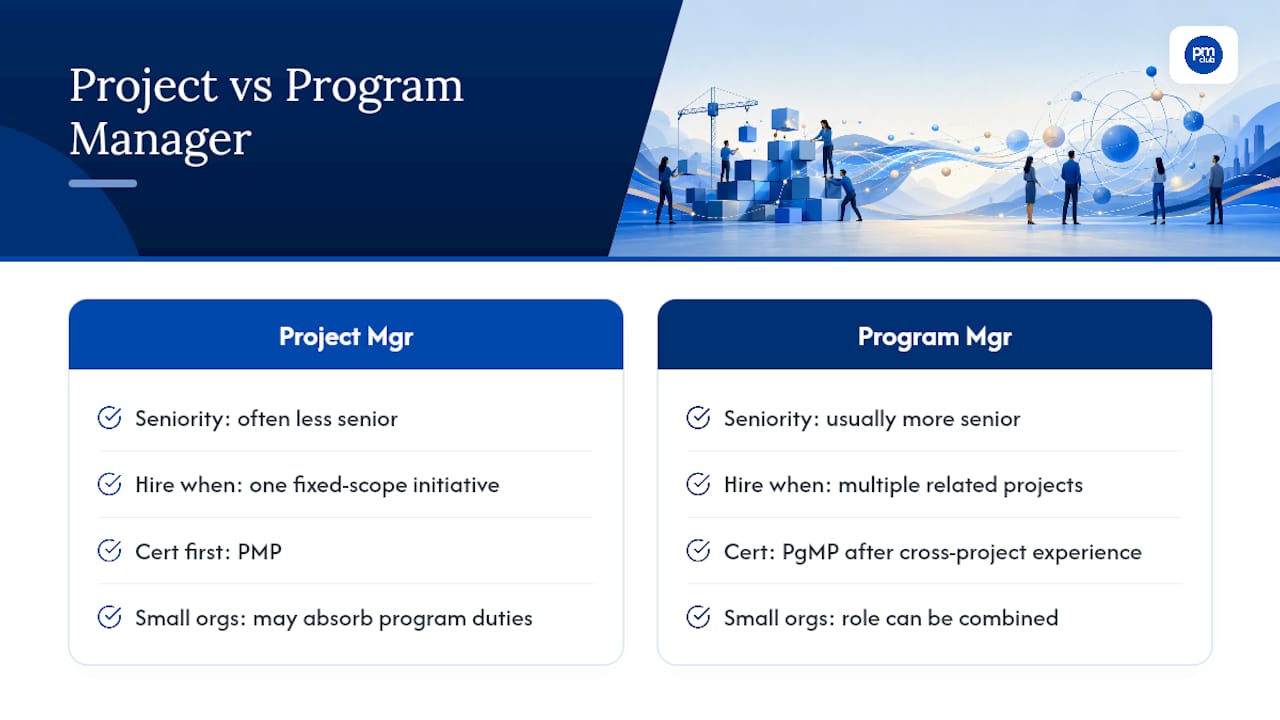
Start with a simple filter: one project with a fixed scope points to a project manager hire; multiple interdependent projects tied to a strategic goal point to a program manager.
- Single project, fixed scope, defined end date → hire a project manager.
- Multiple related projects, ongoing strategic goal, benefits ownership needed → hire a program manager.
- Interview a project manager candidate with scenario questions: how would you recover a schedule that's slipped two weeks? How do you handle a vendor missing a deadline?
- Interview a program manager candidate on trade-offs: how do you decide which project gets a contested resource? How do you report bad news to a board that expected good news?
Reporting structure matters here too. Smaller teams often flatten this, with one senior project manager absorbing light program duties. Larger organizations separate the roles cleanly, and salary and seniority signals from BLS occupational data reflect that separation, program-level roles generally carry a step up in both compensation and required experience.
Pro Tip: If you're not sure which role you need, ask yourself whether success will be judged next month or next year. That answer usually tells you which title belongs on the job posting.
How The Freelance PM Club Supports Skill-Building and Career Transitions
Because effective program management is difficult to fully outsource, most people build that capability through structured experience and mentorship rather than a single course. That's the gap The Freelance PM Club is built to close.
- Courses and templates help project managers sharpen scheduling, budgeting, and risk frameworks.
- Career coaching supports the pivot toward program-level thinking, stakeholder influence, and strategic planning.
- The job board connects freelancers at both levels with businesses hiring for their specific stage.
- The community gives you a place to test program-level decisions against peers before you make them in front of a board.
A PM early in their career typically gets the most from courses and the job board; someone eyeing a program pivot gets more from coaching and the network.
Choosing Between Hands-On Delivery and Program Leadership
Plenty of skilled people stay project managers on purpose. The work is concrete, the wins are visible fast, and you're not spending half your week managing a board's expectations. Program leadership trades that immediacy for wider impact and heavier political weight: more influence, less control over any single outcome, and satisfaction that arrives slower. Neither choice is the lesser path. It's a question of what kind of win keeps you engaged.
Where to Go for Deeper Research
For frameworks and certification details, consult PMI's guide to programs versus projects. For pay and employment trends, BLS's project management specialists page and its occupational employment projections give hard numbers. For practical role writeups grounded in how teams actually work, Atlassian's and Asana's guides cover day-to-day distinctions well, and the Yacht Consulting Group's build management services offer a concrete real-world look at project-level, client-facing delivery work outside a typical office setting.
Ready to Build the Skills for Either Path?
Whether you're sharpening project delivery skills or aiming for a program-level pivot, guessing your way there wastes time you don't have as a freelancer. The Freelance PM Club gives you a structured way to close the gap, courses built for each stage, coaching to work through the political and strategic skills program roles demand, and a job board that matches your actual level instead of a generic listing.

If you're weighing a move from hands-on delivery into program leadership, manager coaching resources can help you build the influence skills that technical training alone won't teach. Start by exploring The Freelance PM Club and checking which membership tier matches where you are right now, project-level sharpening or program-level growth. Sign up to browse the current job board listings and see what a real next step looks like.
Frequently Asked Questions
Is a program manager senior to a project manager? Usually, yes. Program managers typically bring more years of experience and report higher in the organization, but seniority isn't the only factor. Many experienced professionals stay project managers by preference, not because they lack the skills to move up.
Can one person be both a project manager and a program manager? In smaller organizations, yes. A senior project manager often absorbs light program duties, coordinating a handful of related projects without a formal title change, until the workload justifies splitting the roles.
Which certification should I pursue first, PMP or PgMP? Start with PMP if you're early in your project management career. PgMP makes sense once you have real cross-project coordination experience, since the exam and the role both assume that background.
Do program managers need Agile or Scrum certifications? They can help, especially in organizations running Agile at the project level even when the program itself isn't Agile. It's not a substitute for strategic planning and stakeholder skills, but it rounds out a program manager's credibility with delivery teams.
How do I know if I should hire a project manager or a program manager? If you have one initiative with a fixed scope and end date, hire a project manager. If you have multiple related projects that need to add up to a strategic outcome, hire a program manager.
Sources
- Understanding the difference between programs and projects — PMI
- Program vs. project manager: The differences in roles — Atlassian
- Program management vs. project management — Elmhurst University
- Project management specialists — BLS