

Product managers decide what to build and why; project managers make sure it gets built on time and on budget. One owns the vision, the other owns the execution, and most of the confusion between the two comes from how often those jobs overlap on the same team. The rest of this guide breaks down what each role actually does day to day, how they collaborate without stepping on each other, and how to figure out which path fits you.
TL;DR:
- A product's ongoing lifecycle means product managers focus on outcomes and user value, while project managers aim for timely, on-budget delivery within a fixed timeline.
- Product managers prioritize continuous discovery and data analysis, whereas project managers concentrate on scope, schedule, risk mitigation, and budget control.
- Effective collaboration requires explicitly defining scope handoffs, decision rules for scope changes, and regular communication to prevent role friction.
- Career success in product management depends on measurable outcomes like adoption and retention, while project management measures deliverables' timeliness and budget adherence.
- Building targeted portfolios that demonstrate problem-solving and handling failures is crucial for transitioning or advancing in either path.
Table of Contents
- Product Manager vs. Project Manager: The Core Differences at a Glance
- What Does a Product Manager Actually Do Day to Day?
- What Does a Project Manager Actually Do Day to Day?
- How Product and Project Managers Work Together Without Colliding
- Career Paths and Pay: What to Expect on Each Track
- Building the Right Skills for Either Path
- How to Choose Between Product Management and Project Management
- How The Freelance PM Club Helps You Move Between These Paths
- Choosing Your Path: An Editorial Take
- Sources
Product Manager vs. Project Manager: The Core Differences at a Glance
The fastest way to separate these roles is by time horizon. A product has no finish line. It launches, gets used, gets improved, and eventually gets retired years later. A project has a start date and an end date, and once it's delivered, the project manager's job on that specific effort is done. Atlassian frames this as the difference between the "what and why" and the "how and when", and that framing holds up across almost every industry that uses both titles.
Ownership splits the same way. Product managers own the roadmap, the backlog, and metrics like adoption or retention. Project managers own the schedule, the budget, and quality control against a defined scope.
- Focus: Product managers chase outcomes and user value; project managers chase on time, on budget delivery.
- Time horizon: Product management is a continuous lifecycle; project management runs on a fixed timeline with a defined end.
- Success metrics: Product managers get judged on engagement, revenue impact, or retention; project managers get judged on schedule variance, budget adherence, and whether scope held.
- Primary artifact: Roadmaps and PRDs for product; Gantt charts and status reports for project.
- Overlap friction point #1: A scope change mid-sprint. The product manager wants to add a feature based on user feedback; the project manager sees a blown timeline.
- Overlap friction point #2: Prioritization disputes when the roadmap says one thing and the delivery team's capacity says another.
- Overlap friction point #3: Unclear decision rights on who says yes to a client request that touches both the product's direction and the project's deadline.
None of this means the two roles compete. It means they're solving different problems on the same clock, which is exactly why friction shows up when nobody's clarified who decides what.
What Does a Product Manager Actually Do Day to Day?
A product manager's job centers on three things: figuring out what to build, deciding when to build it, and proving it worked. That means running discovery interviews, digging into usage data, and constantly rewriting the backlog as new evidence comes in. The job title implies stability. The actual work is closer to controlled chaos with a roadmap on top.
Daily artifacts look like this: a living roadmap that shifts as priorities change, product requirement documents (PRDs) that spell out the problem and success criteria (not just the feature spec), discovery notes from user interviews, and experiment results from A/B tests. Prioritization frameworks like RICE or MoSCoW show up constantly, mostly because a backlog with fifty "urgent" items needs some kind of forcing function to sort real signal from noise.
- Own the product vision and translate it into a prioritized roadmap.
- Run continuous discovery: interviews, surveys, usability tests, competitive analysis.
- Define success metrics before a feature ships, not after.
- Partner with engineering and design on trade offs, not just handoffs.
- Analyze adoption, engagement, and retention data to decide what ships next.
On tools: most product managers live in an analytics platform (Amplitude, Mixpanel, or similar), a roadmapping tool, and whatever experimentation platform their engineering team supports for A/B testing. Entry paths vary widely. Some product managers come from engineering or design, others from an MBA program, and a growing number break in through targeted product management courses rather than a traditional degree.
Pro Tip: If you're new to product work, spend your first 90 days writing PRDs for features that already shipped. Reverse-engineering the reasoning behind an existing decision teaches you more about prioritization than any framework you'll read about.
What Does a Project Manager Actually Do Day to Day?
A project manager's job is to take a defined scope and deliver it, predictably, without the budget or timeline quietly falling apart. That starts with scope definition, moves into detailed planning, and then becomes a running exercise in risk management for the length of the project. The best project managers aren't the ones who never hit a snag. They're the ones who saw the snag coming three weeks earlier because they were tracking the right risk indicators.
Daily rituals include status reporting, updating the risk register, checking resource allocation against the plan, and running the timeline against actual progress. A project plan and a Gantt chart or timeline view are the backbone of the job. Standups and sprint reviews get added on top when the team runs Agile or Scrum.
- Define scope, deliverables, and success criteria before work starts.
- Build and maintain the project schedule, including dependencies and critical path.
- Track budget against actuals and flag variance early.
- Maintain a risk register and run mitigation plans, not just documentation.
- Facilitate ceremonies under Waterfall, Agile, Scrum, or a hybrid model, depending on the team.
Metrics here are concrete: percent complete, schedule variance, budget variance, and defect rates at handoff. Tools tend to be scheduling and resource management platforms (Microsoft Project, Smartsheet, or similar), plus whatever the team uses for sprint tracking if they run Agile. Certifications carry real weight in this field. A PMP or CAPM from the Project Management Institute is often the fastest credential-based entry point, and a Certified ScrumMaster credential helps for teams running Agile delivery.
Pro Tip: Build your risk register before the project kicks off, not after week two. A risk you identified on day one and mitigated is a non-event. The same risk discovered in week five is a crisis with your name on it.
How Product and Project Managers Work Together Without Colliding
The handoff point is usually clean in theory: the product manager decides what needs to exist, and that becomes a scoped deliverable the project manager plans and executes. In practice, that handoff breaks down when priorities shift mid-project and nobody agreed in advance on who gets to make that call.
- Set the handoff explicitly. Roadmap items become a scoped project brief with agreed deliverables, not a vague direction passed along in a Slack message.
- Build a decision rule for scope changes before they happen. Who approves a mid-sprint addition, and what's the threshold for saying no? ProductPlan calls this a handoff playbook, and teams that write one down argue less.
- Run a shared sync cadence. Weekly is common; the point is a standing checkpoint where both roles see the same status at the same time.
- Use a RACI chart or a decision log for recurring friction points, especially prioritization disputes, so the argument doesn't repeat every sprint.
- If one person holds both roles (common at startups and on lean freelance engagements), block separate time for strategic thinking versus execution tracking. Mixing the two in the same hour is how both suffer.
Built In points out that the most common failure mode is treating product discovery like project delivery: applying a fixed timeline to work that's supposed to stay flexible until the evidence says otherwise.
Career Paths and Pay: What to Expect on Each Track
Product management career ladders typically run associate product manager to product manager to senior product manager, then to director or VP of product. Progression gets measured by the outcomes you can point to: adoption numbers, revenue impact, retention lift. Project management ladders run coordinator to project manager to senior project manager, often landing in a PMO leadership or head of delivery role. Progression there tracks with the complexity of what you've delivered: bigger budgets, more stakeholders, higher-stakes timelines.
- Product management rewards evidence of outcomes over activity; a shipped feature that moved no metric counts for less than a smaller feature that moved a real number.
- Project management rewards a track record of delivering complex, multi-stakeholder work on time and on budget.
- Both roles depend heavily on industry and location for compensation. The BLS tracks project management specialists separately for labor market and outlook data, and figures for related roles like industrial production managers offer useful context on how broad the range gets by sector.
- Freelance and consulting work exists on both sides: project managers often market predictable delivery on fixed-scope engagements, while product-focused freelancers tend to sell discovery and strategy work.
Compensation ranges vary widely enough by industry, company size, and geography that a single number misleads more than it helps. Coursera's comparison of the two roles is a reasonable starting point if you want a broader sense of how responsibilities and pay expectations diverge before you dig into role-specific salary data for your own market.
Building the Right Skills for Either Path
Both roles need strong communication and stakeholder management. That part isn't up for debate. Where they diverge is in the specific muscle you need to build next.
For product work: user research interviewing, basic data analysis (SQL helps more than people expect), and comfort running structured experiments. Learn a prioritization framework cold, get familiar with an analytics tool like Amplitude or Mixpanel, and practice writing PRDs even before you have a job that requires them.
For project work: scheduling and dependency mapping, resource planning under constraints, and risk mitigation that goes beyond a spreadsheet nobody updates. Learn a scheduling tool like Microsoft Project or Smartsheet, and if your team runs Agile, get fluent in sprint planning and backlog grooming as a facilitator, not just a participant.
- Product portfolio piece: a case study walking through a discovery process, the hypothesis you tested, and what the data told you to build next.
- Project portfolio piece: a redlined project plan showing how you handled a real schedule slip or budget variance and what you changed as a result.
Pro Tip: A portfolio piece that shows how you handled failure (a feature that flopped, a timeline that slipped) is more convincing than one that shows a clean win. Hiring managers already know things go wrong. They want to see how you think when they do.
How to Choose Between Product Management and Project Management
Start with five questions. Do you get more energy from ambiguous problems or from clear execution plans? Would you rather be right about what to build or reliable about when it ships? Do you enjoy talking to users, or do you enjoy managing a schedule? Does "success" feel more like a metric moving or a deadline hit? And when a plan changes mid-stream, does that excite you or frustrate you?
- Score your answers: mostly "ambiguity, users, metrics, change is fine" points toward product management.
- Mostly "clarity, schedules, deadlines, change is disruptive" points toward project management.
- A mixed scorecard usually means a hybrid or a team lead role at a small company or startup fits better than either extreme, at least at first.
- If you're switching tracks, pick one micro-project (a discovery exercise or a redlined project plan) that proves the specific skill gap you need to close.
- Revisit the scorecard after six months of deliberate practice. Preferences shift once you've actually done the work, not just imagined it.
- If you're early career and unsure, a hybrid "product owner" or "delivery lead" role at a smaller company is a reasonable low-risk way to test both muscles before committing.
- Asana's guidance on transitioning between roles notes that moving from project into product usually means adopting an outcomes-first mindset, not just learning new tools.
How The Freelance PM Club Helps You Move Between These Paths
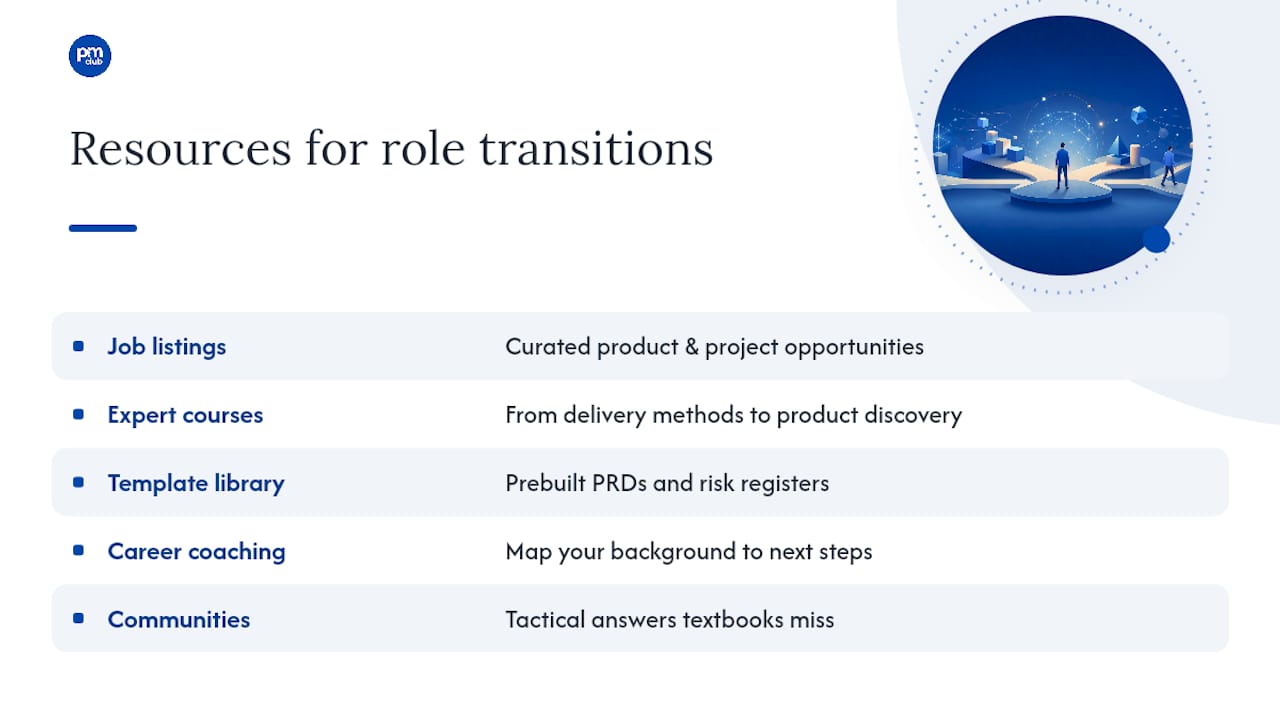
Whichever direction you're headed, having the right resources cuts months off the learning curve. There are platforms offering curated job listings for both project and product-focused freelance work, expert-led courses covering everything from delivery methodology to product discovery, and a template library that saves you from building a risk register or a PRD from scratch. Career coaching can help you map your specific background to a realistic next step, and communities provide a place to ask the kind of tactical questions a textbook can't answer. If you're weighing a transition or building a freelance practice around either role, the Club's resources are built around exactly that decision.
Choosing Your Path: An Editorial Take
The biggest mistake I see people make isn't picking the wrong role. It's picking based on title prestige instead of daily reality. Product management sounds strategic and glamorous; the actual job involves a lot of unglamorous data-wrangling and getting told "no" by engineering. Project management sounds administrative; the best project managers I've studied are sharp negotiators who quietly prevent disasters nobody else saw coming.
If you're on the fence, don't overthink the label. Look at what kind of Tuesday afternoon energizes you: a messy user interview or a clean status update. That instinct tells you more than any framework. Whichever path you land on, build a small, honest portfolio piece before you commit to a job search, and lean on structured resources instead of guessing your way through the first year.
— Ashanti
Sources
- Product manager vs. project manager: Key differences explained | Atlassian
- Product Manager vs. Project Manager: What’s the Difference? | ProductPlan
- Product manager vs. project manager | Asana
- Product Manager vs. Project Manager: What’s the Difference? | Coursera
- Product vs. Project Management: What’s the Difference? | Built In