

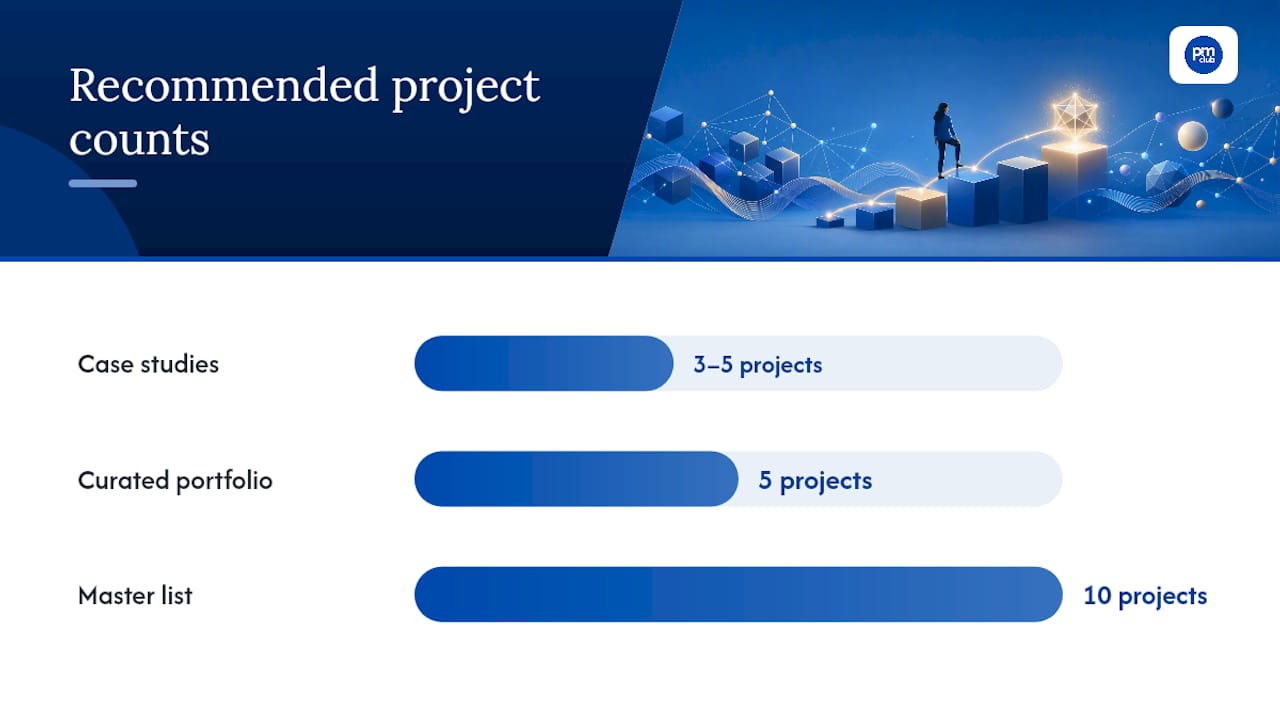
Build a project manager portfolio website with 3 to 5 fully worked case studies and a downloadable slide deck or PDF backup. This format wins interviews and client work because it proves you can show process, not just claim it: the artifacts, the decisions, the measurable outcomes. Your first move is simple. Pick your three strongest projects and draft a CAR outline for each one this week.
TL;DR:
- A project manager portfolio website should feature three to five detailed case studies that clearly separate context, actions, and measurable results, with supporting artifacts.
- Prioritize projects that are most relevant to your target role, and include demonstrable artifacts such as dashboards, timelines, and templates to prove your process.
- Use a consistent structure for each case study and optimize navigation for quick access to content, ensuring technical basics like fast load times and mobile accessibility are met.
- Build your portfolio with formats like full websites, slide decks, or PDFs, and rehearse different versions of your project stories to confidently discuss your work in interviews.
- Even limited experience can be presented effectively through hypothetical projects, volunteer work, or internal improvements, as long as artifacts are real or clearly labeled as simulated.
Table of Contents
- What Is a Project Manager Portfolio Website and Who Needs One?
- How Do You Structure a Project Case Study People Actually Remember?
- Which Design and Platform Choices Actually Matter?
- What Are the Best Formats and Templates to Start With?
- How Should You Use Your Portfolio in Interviews?
- How Do You Build a Portfolio With Limited Experience?
- Publisher Perspective: What Actually Separates a Strong Portfolio From a Weak One
- Get Templates, Coaching, and Job Leads to Build Faster
- Sources
- FAQ
What Is a Project Manager Portfolio Website and Who Needs One?
A project manager portfolio website is a structured digital presentation that showcases your significant projects, the methodologies you ran them with, and the outcomes you drove. It functions as proof of delivery capability, not a fancier resume. Recruiters and hiring managers get a resume from every candidate; they get a working, browsable case study library from almost none.
You need one if you're a freelance PM, an independent consultant pitching new clients, or a full-time PM angling for a promotion or a lateral move. Career changers and early-career PMs need one even more, because it substitutes for the years of title history they don't have yet.
The core components every page needs
Your homepage should state your value proposition in one sentence and route visitors straight to your case studies, not bury them three clicks deep. From there, build out:
- Professional profile: your skills, certifications (a listing like the Google Project Management Professional Certificate gives hiring managers quick context on which frameworks you actually use), methodologies, and tools.
- Project case studies: three to five deep dives, each following a repeatable structure (covered below).
- Artifacts and templates: dashboards, RAID logs, sample timelines, communication plans, anything that proves you built the thing rather than described it.
- Testimonials: short, specific, ideally from a named client or manager.
- Contact and availability: a form or email, plus a line on your current capacity for new work.
A PM portfolio built around an executive summary, profile, case studies, and templates tends to convert better in hiring conversations than a static PDF resume, mainly because it lets the reader self-serve the depth they want.
When you're deciding which projects make the cut, prioritize relevance over prestige. A mid-size project that closely matches your target role beats a flashy enterprise rollout that has nothing to do with the job you're chasing.
Pro Tip: Build one master project list first, then curate down to five. It's much easier to cut from ten strong candidates than to pad out three weak ones.
How Do You Structure a Project Case Study People Actually Remember?
Use the CAR or CARA framework: Context, Action, Result (and Approach, when you want to slow down and explain your method before the outcome). Hiring managers consistently respond better to case studies that clearly separate the operational challenge from the candidate's specific role and the measurable result, because vague project summaries force them to guess at what you actually did.
Here's the sequence that works for almost any project, regardless of methodology:
- Context. One paragraph: the organization, the stakes, the constraint (budget, timeline, a broken process).
- Action (or Approach). What you personally did. Name the framework, the tools, the stakeholder cadence. This is where you separate yourself from "was on the team."
- Result. Metrics wherever you have them: schedule variance, budget adherence, adoption rate, defect reduction. If a number is proprietary, anonymize it. Say "reduced onboarding time by roughly a third" instead of naming the client's actual headcount or dollar figures.
- Artifacts. A screenshot of a dashboard, a redacted Gantt chart, a RAID log excerpt. Caption every image with what it shows and why it mattered, not just "project timeline."
The most common failure isn't lack of experience. It's vagueness: "led cross-functional team to deliver project on time" tells a hiring manager nothing. Equally common is the opposite mistake: burying the result under jargon-heavy process description. Balance the two, and skip acronyms your reader might not know.
Pro Tip: If a metric is confidential, keep the shape of the number and blur the scale. "Cut vendor costs by 18 percent" is fine even if you can't say the vendor's name or the total contract value.
Which Design and Platform Choices Actually Matter?
Your homepage should get a visitor to a case study in one click, not force them through an "About Me" wall of text first. Navigation matters more than visual flourish here.
For each project page, follow a consistent layout: a one-line summary, a short timeline graphic, your role, the metrics, and links or thumbnails of artifacts. Consistency across pages lets a scanning recruiter compare projects quickly instead of relearning your format every time.
On visual proof, screenshot dashboards, kanban boards, or status reports, then caption and anonymize them: blur client names, swap real dollar figures for percentages, and note "sample data" where relevant. This keeps you honest while still showing real work.
Platform choice matters less than people think. WordPress, Squarespace, Wix, and even a well-organized Notion page all work; a slide-deck-hosted portfolio works too, provided it's easy to skim. Pick whichever platform you'll actually maintain, since an abandoned site hurts you more than a slightly-less-polished one.
A few technical basics do matter regardless of platform:
- Make sure the site loads fast and renders cleanly on mobile. A recruiter often opens your link on a phone between meetings.
- Host PDFs as viewable pages, not forced downloads, so mobile visitors don't bounce.
- Use real heading structure and alt text on images for accessibility and basic search visibility.
Independent consultants pitching new clients should treat this site the same way any small business treats SEO for consultants: as a discoverable asset, not just a link you send after a call.
Portfolios that pair a live site with downloadable artifacts and a short "how I work" section make it noticeably easier for interviewers to verify your claims on the spot, rather than taking your word for it.
What Are the Best Formats and Templates to Start With?
Three formats cover almost every use case, and you don't have to pick just one.
- Full website. Best for ongoing visibility and SEO. Slower to build, but it's the version you send cold and let do the work while you sleep.
- Selectable slide deck. Fast to build, easy to walk through live on a screen share. Weaker for passive discovery since nobody's googling their way into a PDF.
- Single-page PDF. The leave-behind. Good as a backup attachment after an interview, not a substitute for the full site.
Copy this outline for every project page, regardless of format:
- Headline (project name plus a one-line outcome).
- Five-line summary (context, your role, the challenge, the approach, the result).
- Timeline graphic (start, key milestones, delivery date).
- Role and methodology used (Agile, Waterfall, hybrid).
- Metrics (two to three numbers max).
- Artifact links or thumbnails (dashboard, RAID log, retro notes).
Publish three to five projects to start, and rotate in a new one every quarter or two as fresher work replaces your weakest current entry. Host heavier artifacts (full dashboards, detailed RAID logs) on Google Drive or Notion and embed or link them, rather than crowding your main pages.
How Should You Use Your Portfolio in Interviews?
Treat the portfolio as your source of truth during the conversation, not a leave-behind nobody opens. Pull it up on screen share and let it anchor your answers instead of reciting them from memory.
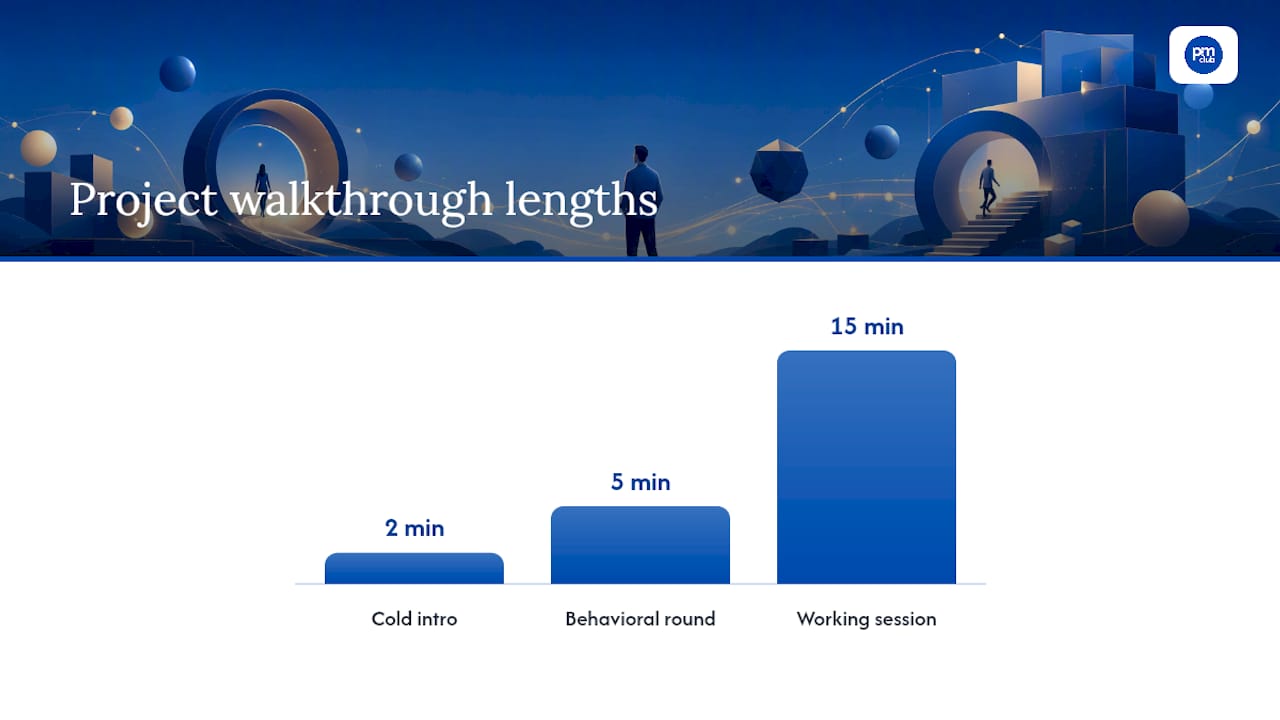
Prepare three versions of the same project story:
- A 2-minute version for when someone asks "walk me through a recent project" cold.
- A 5-minute version for a deeper behavioral round, with one artifact pulled up.
- A 15-minute version for a working session or case-study round, walking through multiple artifacts and decision points.
Tie every narrative back to a measurable outcome and a specific stakeholder impact. "The client's leadership team approved the rollout a week early" lands harder than "the project went well."
Pro Tip: Rehearse with a mock question like "tell me about a time a project went off track." Pull up your dashboard live and narrate the exact moment you noticed the risk. It's far more convincing than describing it from memory.
Practicing these walkthroughs out loud, even alone, exposes the gaps in your artifact captions faster than any amount of silent editing.
How Do You Build a Portfolio With Limited Experience?
Limited project history doesn't disqualify you from a strong portfolio. It just changes your source material.
- Use what you actually have. Volunteer coordination, a course capstone project, or an internal process you personally optimized at your current job all count, as long as you label them clearly ("academic project," "volunteer initiative," "internal improvement, sanitized").
- Build demonstrable artifacts even without a real client. Create a process map, a sample dashboard, and a master tracker for a hypothetical or personal project, then demo it live. A dashboard you built yourself proves tool fluency even if the project was small.
- Never misrepresent simulated data as real. Label anonymized or hypothetical figures honestly. Credibility, once lost in an interview, doesn't come back.
- Update on a quick cadence. Swap in a real project the moment you complete one, and retire your weakest placeholder first.
Publisher Perspective: What Actually Separates a Strong Portfolio From a Weak One
The gap in most freelance PM portfolios isn't talent. It's packaging. We consistently see freelancers who have run genuinely complex projects but present them as a bulleted resume line, which wastes the strongest evidence they have.
What closes that gap, in our experience helping members build these sites, is rarely more content. It's structure: a repeatable case-study template, someone reviewing your artifact captions for clarity, and a coach asking "what did the client actually feel differently after this?" That last question does more work than any design tweak.
The templates and coaching inside The Freelance PM Club exist specifically because most PMs don't need more projects to showcase. They need a framework that forces the story out of the project they already ran. Try one template exercise on your strongest project this week and see how much sharper the story gets.
— Ashanti
Get Templates, Coaching, and Job Leads to Build Faster
Membership options often provide pre-built case-study templates, coaching feedback on your artifacts, and job boards where a sharper portfolio can translate into more client conversations. Instead of guessing at formatting or writing your first CAR outline from scratch, you can start from a structure others have used to land work.

Membership can include downloadable case-study and slide-deck templates, career coaching to review project selection and metrics, access to job boards connecting you with businesses hiring PM talent, and a community for feedback before client presentations. New members often start with a template review session, mapping project history onto a CAR outline before design.
This fits freelancers building a client-facing site from zero, consultants refreshing a stale portfolio, and early-career PMs trying to compete against candidates with more years but weaker documentation. Explore membership at The Freelance PM Club and get your first case study outlined this week.
Sources
- What Is A Project Manager Portfolio? + Easy To Use Template (The Digital Project Manager)
- Project Manager Portfolio Example: Building a Career-Winning Portfolio
- How to Build a Creative Project Manager Portfolio That Actually Wins Roles
- Google Project Management Professional Certificate (Coursera)
FAQ
What Is a Good Portfolio for a Project Manager?
A good portfolio pairs a clean website with three to five detailed case studies structured around context, action, and results, backed by real (or clearly labeled sanitized) artifacts like dashboards and timelines.
What Is the 80/20 Rule for Project Managers?
In portfolio terms, it means spending more time refining how you tell each story than selecting the right handful of projects, rather than trying to document everything you've ever worked on.
What Are Some Good Websites for Project Managers?
Beyond your own portfolio site, resources like The Freelance PM Club offer templates, coaching, and a job board specifically for freelance and independent PMs building their online presence.
What Are the 5 C's in Project Management?
Definitions vary by source, but versions commonly include Clarity, Communication, Coordination, Control, and Closure. Treat this as a mnemonic for good practice rather than a fixed industry standard.