

The fastest path to a real professional network is joining The Freelance PM Club for structured coaching and curated job leads, then adding one free forum like the Project Management Forum for candid, wide-ranging peer advice. Set up your profile and post an introduction within 48 hours of joining. That single habit determines whether a membership pays off or quietly gets ignored.
TL;DR:
- Joining a paid project management community offers curated learning, vetted job leads, and structured coaching, which significantly accelerates skill development and career growth.
- Free forums provide diverse peer advice and quick tactical answers but lack structured resources and outcome-focused support found in paid memberships.
- Before joining any platform, verify recent activity, member diversity, available resources, networking tools, clear policies, and conduct a trial to ensure it meets your specific career needs.
- Consistent engagement over at least three months, including setting clear goals and actively contributing, is crucial for transforming community participation into tangible opportunities.
- The Freelance PM Club combines curated freelance opportunities, personalized coaching, and a tiered membership model tailored to independent project managers seeking structured career support.
Table of Contents
- What Makes a Project Management Community Worth Your Time
- Where to Find Project Management Communities Online
- How to Evaluate a Project Management Community Before You Join
- A 90-Day Plan to Get Real Value From a New Community
- Why The Freelance PM Club Fits Independent Project Managers
- How to Start Your Own Project Management Community
- Common Pitfalls in Online Communities and How to Avoid Them
- Real Career Shifts Built on Community Involvement
- Author perspective: what actually moves the needle in month one vs. month three
- Start With The Freelance PM Club: Where to Begin
- Where to Learn More
- Sources
- FAQ
What Makes a Project Management Community Worth Your Time
Paid memberships and free forums solve different problems, and confusing the two wastes both your money and your time. A structured membership platform is built around outcomes: it wants you employed, certified, or promoted, so it packages coaching, job boards, and courses into one paid path. A free forum has no such agenda. It exists because people showed up to argue, vent, and answer each other's questions, and the value you get depends entirely on how much signal you can pull out of the noise.
Paid communities typically bundle a few consistent things:
- Curated learning paths tied to certifications or specific skill gaps
- Job boards or freelance opportunity feeds vetted for relevance
- One-on-one or group coaching access
- Structured networking, like guided introductions or matched mentorship
- Templates, tools, and resource libraries you would otherwise build yourself
Free forums and open platforms give you something different:
- Broad, unfiltered peer advice from people in wildly different situations
- Zero cost, which matters if you are testing the waters before committing to a niche
- Variable moderation, meaning quality swings from thread to thread
- Faster answers to tactical questions, since volume of members means someone has likely faced your exact problem
If your goal is rapid skill-building with a support system attached, a paid membership does more of the heavy lifting. If you want to troubleshoot a scheduling conflict at 11 p.m. or hear five different opinions on a certification choice, a forum like MPUG's community forum gets you there faster. Most freelance PMs end up using both, just for different jobs.
Where to Find Project Management Communities Online
Project management communities live across five distinct platform categories, and each one rewards a different kind of member. Knowing which type you are looking at before you join saves you from expecting a Slack channel to behave like a certification body.
LinkedIn groups are the loosest category. They are easy to join, free, and often dormant. A handful stay active with weekly discussion prompts and job shares, but many are ghost towns with a member count that hasn't reflected real activity in years. Check the "posts" tab before joining. If the most recent post is months old, treat the group as a directory, not a community.
Membership platforms sit at the other end of the spectrum. These are paid, curated, and usually organized around a career outcome rather than open conversation. Communities like The PM Playbook combine cohort-based training with curated job boards, which mirrors how most serious membership models now operate. Expect application steps, onboarding sequences, and a noticeably higher signal-to-noise ratio because members have skin in the game.
Forums remain the best home for technical troubleshooting. The Project Management Forum runs dedicated subforums for PMP exam prep, agile methodology debates, leadership questions, and risk management, which makes it easy to search a specific problem rather than scroll a generic feed. Tool-specific forums go even deeper. MPUG's forum threads cover scheduling realism and hybrid delivery questions inside Microsoft Project specifically, the kind of granular help you won't get from a general career community.
Slack and Discord communities trade searchability for immediacy. Conversations happen in real time across dozens of channels, which is great for quick answers but terrible for anyone trying to find something from three weeks ago. These tend to skew toward younger, tech-adjacent PMs and often form around a specific course, newsletter, or influencer rather than a formal organization.
Reddit and other public social platforms are the wild card. Subreddits like r/projectmanagement host genuinely candid discussions about where PMs find real community, including complaints about LinkedIn groups feeling hollow and forums feeling too niche. The upside is honesty. The downside is that anyone can post anything, so you are doing your own quality control on every thread.
When you're sizing up any platform in these categories, check three things fast: how recently people posted, whether an events calendar or a recurring cadence exists, and whether the member mix matches your career stage. A membership full of directors won't help a PM two years into their career the way a mixed-seniority group will.
How to Evaluate a Project Management Community Before You Join
You can judge most communities in about 10 minutes if you know what to check. Here's the sequence that actually works:
- Scan the last seven days of activity. Look for posts, comments, and replies from actual members, not just admin announcements. A community with three posts a week from 500 "members" is a graveyard with a good landing page.
- Check the events calendar. Live workshops, webinars, or coaching calls signal a platform investing in retention, not just sign-ups. No events, no real programming behind the membership fee.
- Look at member composition. A useful community mixes seniority levels and industries. All-senior groups intimidate newcomers; all-junior groups can't answer harder questions. You want both.
- Verify learning resources actually exist. Don't take "courses included" at face value. Ask whether content ties to real credential maintenance. PMI membership gives access to local chapters and resources tied directly to certification upkeep, and platforms like PM Happy Hour go further by automatically uploading PDUs to PMI after workshops, which saves you the manual logging.
- Test the networking mechanics. Does the platform have an actual job board, mentorship matching, or introduction system, or is "networking" just a Slack channel called #introductions that nobody uses?
- Read the pricing and refund policy before paying. Tiered models are common. Project Managers Movement runs a free community layer alongside a paid inner circle with facilitated leadership sessions, which is a fair structure. Be wary of platforms that only offer one expensive tier with no trial option.
- Check moderation and privacy terms. A community with no visible code of conduct or unclear data handling is a community that will eventually have a spam problem, or worse.
Watch for red flags: constant self-promotion with no real discussion, admins who never respond, member counts that don't match visible activity, and pressure to upgrade before you've had a chance to see the free tier in action.
Pro Tip: Before paying for anything, join the free tier or trial period first and count how many genuinely useful replies you get to one real question within a week. That single test tells you more than any testimonial page.
A 90-Day Plan to Get Real Value From a New Community
Membership only pays off if you treat the first three months like an onboarding project, not a passive subscription. Here's a week-by-week structure that turns a sign-up into actual career traction.
- Week 1: Set up and introduce yourself. Complete your profile fully, including your specialty and current availability. Post an introduction that names one specific problem you're trying to solve. A vague "hi, excited to be here" gets ignored. "I'm transitioning from construction PM to SaaS implementation and I'm looking for advice on translating my certifications" gets replies.
- Weeks 2 to 4: Ask one focused question per week. Pick something concrete, like how other freelancers structure retainer contracts or which certification actually moved the needle for their rates. Specific questions get specific, useful answers.
- Weeks 5 to 8: Start contributing, not just asking. Answer a question in your area of strength. Comment on someone else's post with a real perspective. Communities remember contributors, not lurkers, when opportunities come up.
- Weeks 9 to 12: Request one direct connection. Message someone whose experience matches where you want to go and ask for a 15-minute call, not a favor. Most people say yes to a specific, time-boxed ask.
Track three numbers as you go: how many people you've had a real conversation with, how many problems the community helped you solve, and how many opportunities (job leads, referrals, mentorship offers) surfaced because you showed up consistently. Networking research consistently ties active engagement to career growth, and the pattern holds inside professional communities specifically: the members who post, comment, and follow up are the ones who get tagged when a lead comes through.
Why The Freelance PM Club Fits Independent Project Managers
Independent PMs face a specific problem that generic communities don't solve well: you're managing your own pipeline, your own skill development, and your own client relationships with no employer backing any of it. The Freelance PM Club is built around that exact gap.
Run the checklist from the section above against it and the fit becomes clear:
- Job board access addresses the networking and opportunity criterion by providing a curated feed rather than a generic listings site.
- Career coaching supports learning and credential maintenance, with guidance suited to independent work.
- Membership tiers allow starting with a lighter option and scaling up as needs grow, following a tiered membership model.
- A dedicated networking environment supports a mix of freelancers and consultants navigating independent-work questions.
The platform positions itself around providing independent project managers a structured pathway, personalized coaching, and access tailored specifically to freelance careers rather than traditional employment. For those deciding between paid memberships and free forums, such specialization can be a differentiator. Testimonials on the platform mention career shifts and clarity gained through a structured approach, which prospective members may find worth exploring.
How to Start Your Own Project Management Community
Sometimes the right move isn't joining. It's building the thing that doesn't exist yet. Starting a project management community works best when it solves a narrow problem instead of trying to be everything to everyone.
Pick a specific niche first: freelance PMs in a particular industry, agile coaches at a certain career stage, or PMs using one specific tool. The tighter the focus, the easier it is to attract the right first members and keep conversations useful instead of scattered.
Choose your platform based on your resources, not ambition. A Slack workspace or Discord server costs nothing and launches in an afternoon. A membership site with courses and coaching takes months and real investment. Start with the free version, prove people show up, then build structure around what they actually ask for.

Seed the first 20 to 30 members personally. Invite people you already know from past projects, LinkedIn connections, or forum threads where you've had good exchanges. A community with zero activity dies in its first week, so manufacture the first few conversations yourself if you have to.
Set light moderation rules early, even if it's just one sentence about no unsolicited self-promotion. Communities that skip this step spend their first year fighting spam instead of building trust.
Common Pitfalls in Online Communities and How to Avoid Them
The most common failure mode isn't picking a bad community. It's joining a good one and never showing up. Lurking feels safe, but it produces zero networking value, and most members who quit a paid platform within the first month never posted a single time.
Information overload is the second trap, especially in large forums with dozens of active subforums. Trying to read everything guarantees you read nothing well. Pick two or three topics that match your actual goals and ignore the rest.
Low-quality or spammy subgroups exist even inside otherwise solid platforms. If a channel or subforum has turned into recycled promotional posts, mute it and move to where the real conversation lives.
Mismatched expectations cause a lot of quiet disappointment. Someone joins a certification-focused association like PMI expecting fast freelance job leads and comes away frustrated, when that group was never built for that purpose. Match the platform to the goal before you pay for anything, using the evaluation checklist earlier in this guide.
Finally, burnout from over-networking is real. Trying to be active in five communities at once spreads your attention too thin to build any real relationships in any of them. One paid membership plus one forum, engaged consistently, beats five platforms touched occasionally.
Real Career Shifts Built on Community Involvement
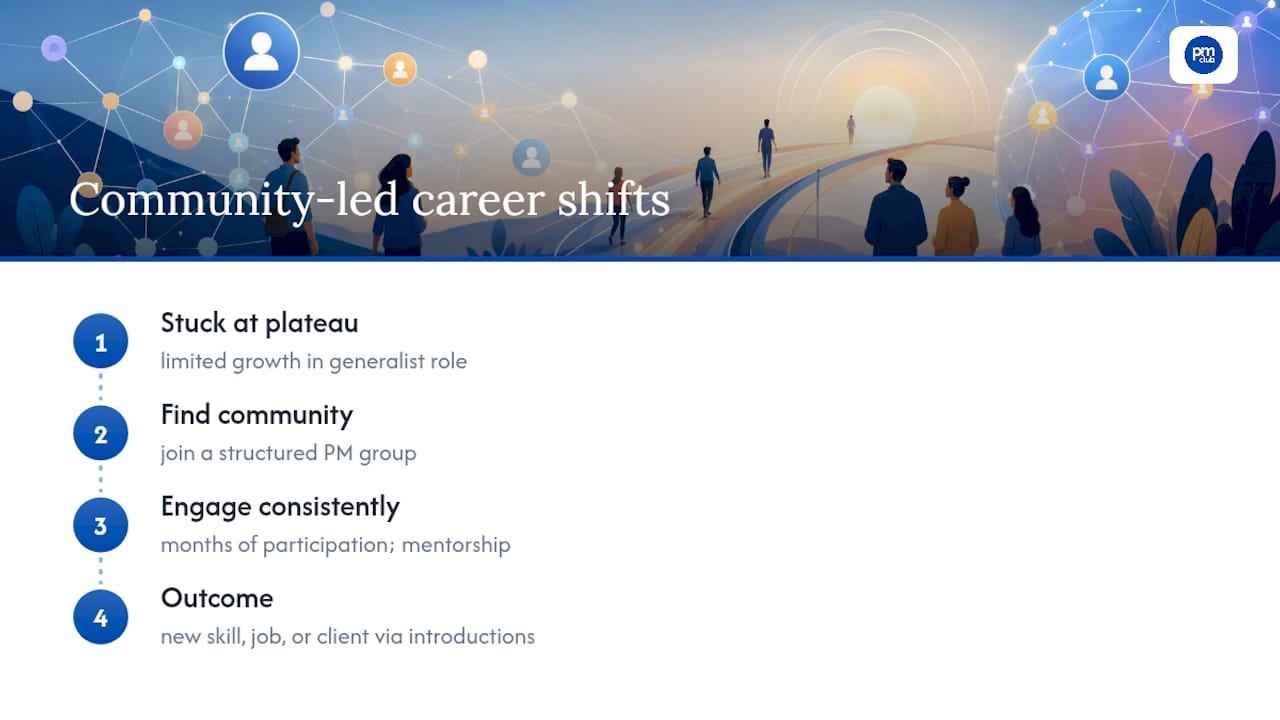
The clearest impact stories from project management communities follow a similar shape: someone stuck at a plateau finds a structured group, engages consistently for a few months, and comes out the other side with either a new skill, a new job, or a new client.
Freelancers who move from generalist project work into a specialized niche, like SaaS implementation or construction PMO support, often credit a mentor or peer they met inside a community for pointing them toward the shift. That kind of guidance rarely comes from a course. It comes from a specific person answering a specific question at the right time.
Certification stories follow the same pattern. PMs who felt overwhelmed studying for the PMP alone often describe forum-based study groups, like the exam-prep subforums on the Project Management Forum, as the difference between quitting and finishing. Structured accountability from people going through the same exam turns a solitary slog into something manageable.
For freelancers specifically, the career shift usually traces back to one introduction. A coach flags a job opportunity that isn't publicly posted. A peer connects them with a client who needs exactly their skill set. None of that happens passively. It happens because someone showed up, contributed, and became visible inside a community built to make those connections possible.
Author perspective: what actually moves the needle in month one vs. month three
Most people over-index on month one. They join, post an introduction, and expect momentum immediately. It doesn't work that way. In month one, the only signal that matters is whether real humans reply to what you post. Ignore member counts, ignore how polished the platform looks. By month three, the signal shifts entirely to relationships: how many people would recognize your name if you messaged them cold.
My honest advice on upgrading to paid tiers: do it the moment a free tier stops answering your actual questions, not before. If you're a freelance PM and the coaching or job-matching gap is what's holding you back, that's worth paying for immediately rather than waiting for a "perfect time" that never arrives.
— Ashanti
Start With The Freelance PM Club: Where to Begin
Most freelance PMs cobble together career support from scattered sources: a Facebook group here, a coaching call there, a job board that never quite matches their niche. The Freelance PM Club puts curated jobs, coaching, and an active peer network under one membership instead of three unrelated subscriptions.

The starter path is straightforward. Begin with the entry-level paid option to see the caliber of freelance opportunities coming through. If the coaching and skill-building side is your bigger gap, a mid-level tier adds that layer. For the full structured pathway, including deeper networking and resource access, the top tier is available. A Freelancer Lite option is also available for those wanting a lighter entry point, with pricing available on the site.
Head to the subscriptions page to compare tiers, or start at the main site if you want the full picture of coaching and community features before you pick a plan. Either way, the next concrete step is the same: pick a tier, join, and post your introduction this week.
Where to Learn More
For certification-focused community support, PMI membership connects you to local chapters and PDU resources. Agile practitioners can explore Scrum Alliance member benefits for community groups and events. For active peer troubleshooting, browse the Project Management Forum or the tool-specific MPUG forum.
Sources
- PMI membership
- Scrum Alliance member benefits
- Project Management Forum – Agile, PMP Certification & Leadership
- MPUG community forum
FAQ
Will AI replace project managers with a PMP certification?
No single tool is expected to replace PMP-certified project managers, since the role depends heavily on judgment, stakeholder relationships, and risk decisions that automated tools can't fully own. AI is more likely to absorb routine scheduling and reporting tasks, shifting the certification's value toward the strategic and communication skills that remain distinctly human.
What is the 80/20 rule for project managers?
The 80/20 rule, or the Pareto Principle, suggests that roughly 80% of a project's results or problems trace back to 20% of the causes or tasks involved. In practice, project managers use it to focus energy on the small number of high-impact activities, like key stakeholder relationships or critical-path tasks, rather than spreading effort evenly across everything on the plan.
What does a project manager typically earn?
Project manager salaries vary widely by industry, region, certification, and experience level, so there's no single figure that applies universally. Freelance and independent PMs in particular see compensation shift based on niche specialization and client base, which is part of why building the right professional network through communities matters for rate negotiation.
What makes up most of a project manager's actual workload?
Most of a project manager's time goes into communication: status updates, stakeholder alignment, and coordinating between teams rather than the technical planning work people often picture. That's a big reason peer communities matter so much, since a large share of the job is judgment calls and people-management that benefit from outside perspective.
How much does The Freelance PM Club cost to join?
The Freelance PM Club offers tiered pricing with multiple membership options. Full current pricing and tier details are listed on the subscriptions page.