

A project kickoff agenda has one job: turn a room full of assumptions into a shared purpose and a set of first committed decisions. That means every strong agenda covers seven elements: welcome and sponsor context, purpose and vision, scope, roles and RACI, timeline and milestones, communication and governance, and risks and assumptions. Most kickoffs run 45 to 90 minutes depending on complexity, and none are finished until an updated brief and action items with owners land in the project workspace within a day.
TL;DR:
- The agenda should focus on defining clear scope boundaries by explicitly listing out what is out of scope to prevent scope creep later.
- Send a minimal pre-read package at least 48 hours in advance, including the project brief, scope summary, timeline, and draft RACI to ensure productive discussions.
- Facilitate decisions during the kickoff by enforcing time limits, conducting goal re-reads, and voting on the most critical first decisions with assigned owners.
- Ensure post-meeting documentation of decisions, risks, and action items within 24 hours to avoid losing alignment and to seed the project plan effectively.
- Prioritize establishing a concise project goal, a working agreement, and initial decisions to measure success over completing a polished slide deck.
Table of Contents
- What Goes in a Project Kickoff Agenda?
- Sample Timeboxed Kickoff Agendas (45, 60, 90 Minutes)
- What to Send Before a Project Kickoff Meeting
- Who Should Attend a Kickoff Meeting?
- How to Facilitate a Kickoff That Produces Real Decisions
- What Happens After the Kickoff Meeting?
- Adapting the Kickoff Agenda for Freelance PMs and Consultants
- How to Get Remote Teams Engaged During Kickoff
- Icebreaker Activities That Actually Build Collaboration
- Aligning the Kickoff With Organizational Goals
- Customizing the Agenda by Industry
- Why Decision Density Beats a Pretty Agenda
- Kickoff Templates and Coaching for Freelance PMs
- Sources
- FAQ
What Goes in a Project Kickoff Agenda?
Each of the seven elements needs a specific output attached to it. Otherwise you get a meeting where everyone nods along and nothing changes.
Welcome and sponsor opening. The sponsor or executive spends five minutes stating why this project matters now and how it ranks against other priorities. The output isn't a warm feeling. It's a stated priority level the team can point back to when scope fights start in week six.
Purpose and vision. This is where you run what some facilitators call a mission test: can everyone in the room repeat the project's goal in one sentence without looking at a slide? If not, you're not ready to move on. The output is a single sentence and two or three measurable success criteria.
Scope, including what's explicitly out. Most teams write the in-scope list and skip the out-of-scope list. That's backwards. The out-of-scope list is what stops a stakeholder from adding "just one more thing" in month three. The output is a short, specific non-goals list everyone has seen and no one has quietly vetoed.
Roles and responsibilities. Draft a RACI (Responsible, Accountable, Consulted, Informed) before the meeting, then use the meeting to test it out loud. According to Atlassian's kickoff framework, roles and responsibilities sit among the seven non-negotiable elements of any solid kickoff agenda. The output is a corrected RACI with gaps filled in real time.
Timeline and milestones. Not a Gantt chart walkthrough. A short list of the dates that matter and the decisions that have to be made by those dates. The output is agreement on key dates, not agreement on every task.
Communication plan and governance. Meeting cadence, which channel gets used for what, and who gets escalated to when something stalls. The output is a written cadence: who meets when, and where blockers go.
Risks, assumptions, and RAID. Ask the room what could sink this before it starts. The output is a starter RAID log (Risks, Assumptions, Issues, Dependencies) with two or three entries and tentative owners, not a finished risk register.
Sample Timeboxed Kickoff Agendas (45, 60, 90 Minutes)
Kickoff length should track project complexity, not calendar availability. Effective kickoffs typically run 45 minutes for small projects, 60 minutes for most projects, and up to 90 minutes (or two split sessions) for complex, multi-team initiatives, according to research on kickoff meeting structure.
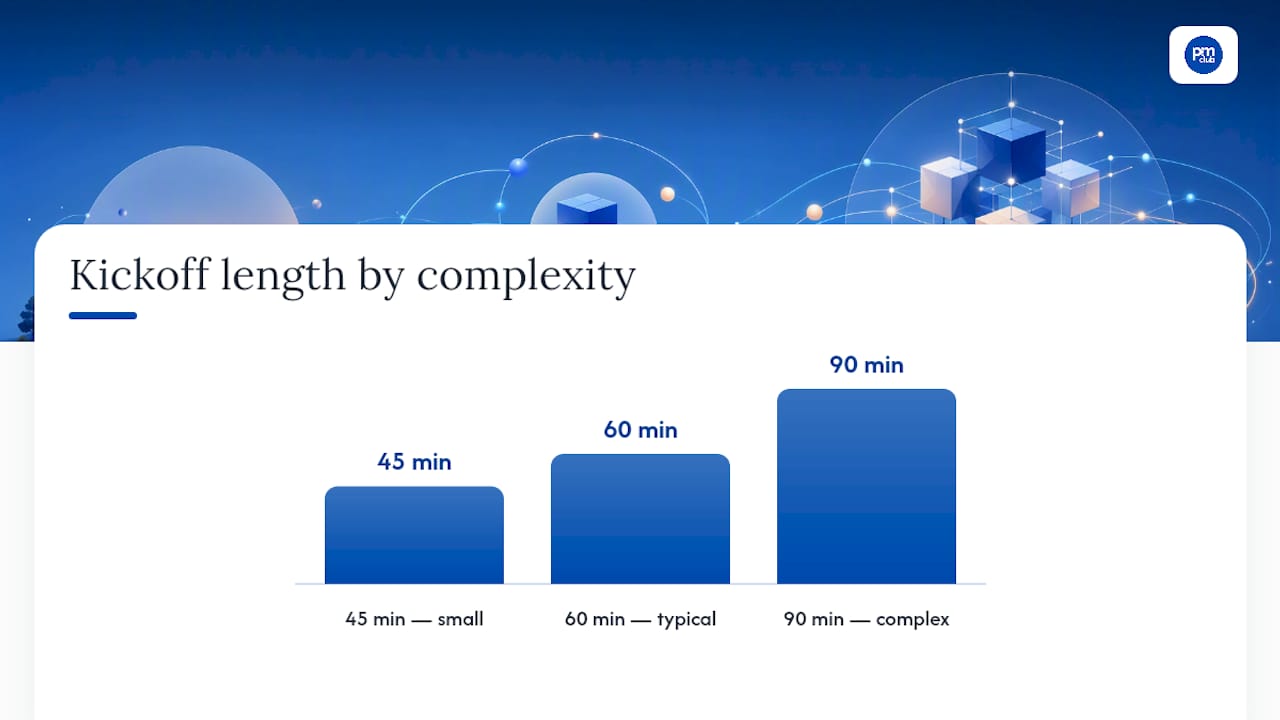
The 45-minute agenda works for small, single-team projects where the group already knows each other and the scope is narrow. Compress introductions to two minutes and push the full risk discussion to a pre-read rather than a live discussion.
The 60-minute agenda is the default for most projects. It gives every core element enough air time without letting any one topic run long.
The 90-minute agenda fits complex, multi-team, or multi-stakeholder programs. For these, one kickoff playbook recommends splitting into a leadership session covering strategy and major decisions, followed by a team session focused on working agreements and operational detail.
Here's a sample 60-minute agenda you can copy directly:
- Welcome and sponsor context (5 minutes)
- Purpose, vision, and success criteria (10 minutes)
- Scope: in and out (10 minutes)
- Roles and RACI review (10 minutes)
- Timeline and key milestones (10 minutes)
- Communication plan and governance (5 minutes)
- Risks, assumptions, and open questions (5 minutes)
- Recap of decisions and next steps (5 minutes)
| Agenda item | 45 minutes | 60 minutes | 90 minutes |
|---|---|---|---|
| Welcome and sponsor context | 3 min | 5 min | 10 min |
| Purpose and vision | 8 min | 10 min | 15 min |
| Scope (in/out) | 8 min | 10 min | 15 min |
| Roles and RACI | 7 min | 10 min | 15 min |
| Timeline and milestones | 8 min | 10 min | 15 min |
| Communication and governance | 5 min | 5 min | 10 min |
| Risks and assumptions | 3 min | 5 min | 10 min |
| Recap and next steps | 3 min | 5 min | 10 min |
To scale any agenda item up, give scope and timeline more room on multi-team projects where dependencies between groups need untangling live. To scale down, fold roles and communication into a single block for small teams that already share a workspace and a Slack channel.
What to Send Before a Project Kickoff Meeting
The meeting only works if people arrive having already read the material. A kickoff that spends its first 20 minutes narrating a slide deck has already failed.
Send a minimal pre-read package that includes:
- The project brief or charter, stating the goal in plain language
- A one-page scope summary, including a draft out-of-scope list
- A draft timeline with tentative milestones
- A draft RACI, even an incomplete one, for people to react to
Send the package at least 48 hours before the meeting. That window gives a strong pre-read time to shift the meeting from presentation to alignment, according to research on kickoff timing, and it increases how many real decisions the group can make once everyone's actually in the room.
Assign a facilitator and a note taker before the invite goes out, not during the meeting. Tell attendees explicitly what they're expected to review and which decisions they'll be asked to weigh in on. "Please read the attached brief" gets ignored. "Come ready to confirm the launch date on page two" gets read.
Pro Tip: Put the single hardest decision at the top of the pre-read email, not buried in an attachment. People skim attachments. They read the first line of an email.
Who Should Attend a Kickoff Meeting?
Invite the people who can make decisions or who own a piece of delivery. Brief everyone else afterward with the meeting notes.
The core list usually includes the project sponsor, the project manager, a facilitator (sometimes the same person as the PM), the core delivery team, and any stakeholder whose sign-off the project genuinely needs. If someone's role is purely informational, they don't need a seat. A 12-person kickoff where four people talk and eight people check email is a scheduling failure, not a collaboration win.
Role clarity matters more than headcount:
- The sponsor sets priority and unlocks budget or resourcing decisions.
- The project manager owns the agenda, the timeline, and the follow-up artifacts.
- The facilitator keeps time and pulls quieter voices into the conversation.
- The core team owns delivery and flags feasibility concerns early, when they're cheap to fix.
- Stakeholders confirm requirements and approve scope boundaries.
Run the RACI live rather than just distributing it. Read each major deliverable out loud and ask who's Accountable. Gaps surface fast this way, usually within the first two or three items, because someone in the room always notices when a task has no clear owner.
Close the roles discussion with three quick questions: Who signs off on scope changes? Who can move a deadline? Who gets escalated to when the first two people disagree? If the room can't answer those, you haven't finished the roles conversation yet.
How to Facilitate a Kickoff That Produces Real Decisions
A kickoff succeeds or fails based on facilitation, not content. The best-prepared agenda still falls flat if the facilitator lets it turn into a read-through.
- Enforce the timebox out loud. Say "we have five minutes left on scope" rather than letting the clock slide silently. Silent slippage is how a 60-minute meeting becomes 90 minutes of frustration.
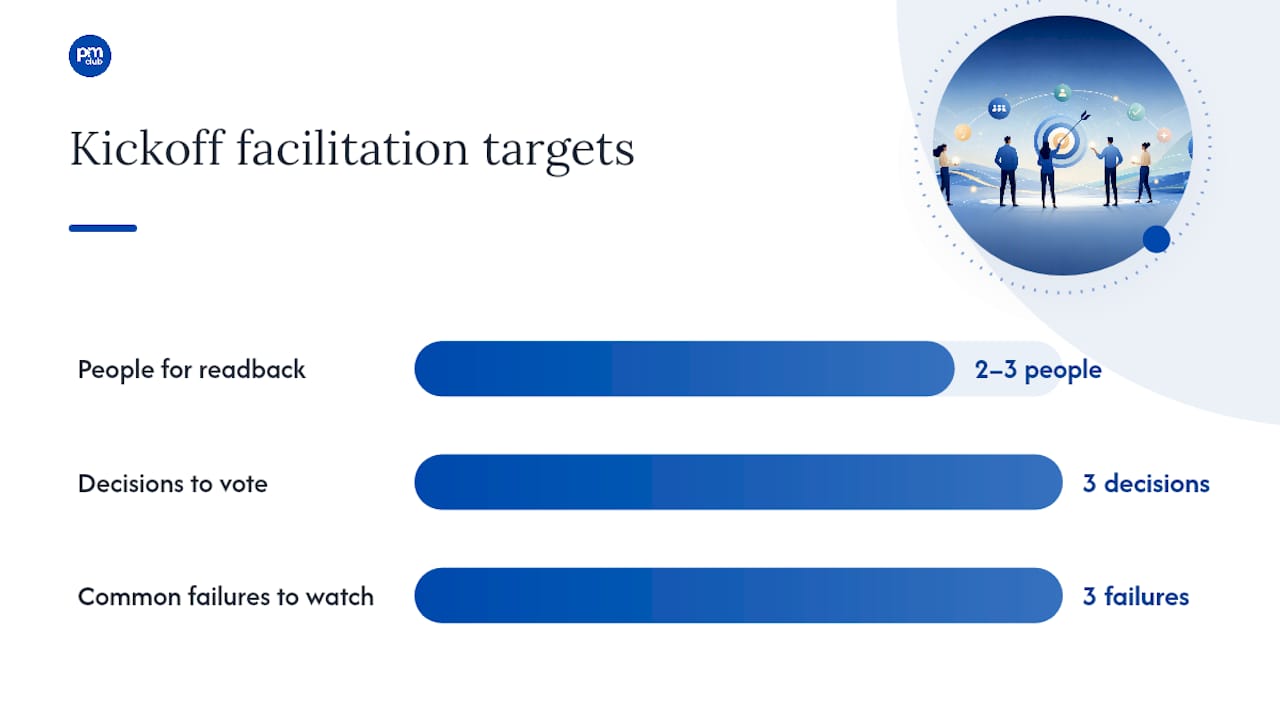
- Run the one-sentence goal readback. Ask two or three people, cold, to state the project's purpose in one sentence. Differences in their answers are the most useful five minutes of the meeting.
- Build the out-of-scope list live. Ask "what are we explicitly NOT doing?" and write answers on a shared doc as people say them. This single exercise prevents more scope creep than any governance document.
- Vote on the first three decisions. Pick the three decisions that most need to be locked before the meeting ends, and get a visible yes from the room on each, not a nod.
- Capture the working agreement live. Meeting cadence, decision rights, definition of done, and escalation path get written into a shared doc as they're agreed, not reconstructed from memory afterward.
Kickoffs should surface disagreement, not paper over it. Structuring the meeting around a stated goal, a working agreement, and a short list of first decisions turns the session into actual alignment work rather than a status readout, based on guidance on running effective kickoffs.
Watch for the three most common failures: slides that narrate instead of prompt discussion, skipping the out-of-scope conversation because it feels uncomfortable, and ending the meeting without assigning a named owner to every action item.
Pro Tip: If nobody in the room disagrees with anything during the kickoff, that's not alignment. That's a sign people are saving their objections for a side conversation after the meeting, where they're much harder to resolve.
What Happens After the Kickoff Meeting?
A kickoff isn't complete when the meeting ends. It's complete when the artifacts it produced get published and someone starts acting on them. Failing to document decisions is one of the most common kickoff mistakes, and the fix is simple: nothing leaves the meeting undocumented.
Within 24 hours, publish:
- An updated project brief reflecting any changes made live in the meeting
- An action item tracker listing every commitment with a named owner and a due date
- A RAID log capturing the risks and assumptions raised, even the half-formed ones
Schedule the first status check-in before people leave the room, not in a follow-up email three days later. Brief any stakeholder who missed the meeting using the same document, not a summarized recap that drops nuance.
Seed the project plan directly from the decisions made in the kickoff rather than starting a separate planning exercise from scratch. The milestones, owners, and risks discussed live should become the first entries in your project workspace, not a second draft written later. A practical resource on risk documentation and decision tracking is worth reviewing if your RAID log tends to get created once and never touched again.
Adapting the Kickoff Agenda for Freelance PMs and Consultants
When you're the external PM, the kickoff carries extra weight: it's where you define the relationship, not just the project. Frame the sponsor's goals and success criteria explicitly in writing, because you won't have months of shared context to fall back on later.
Commit to specific deliverables during the kickoff itself: handoff points, acceptance criteria, and billing milestones tied to actual outputs, not vague phases. This is also where you flag change-order triggers. If scope shifts later, you want the kickoff notes showing exactly what was agreed, so a scope conversation doesn't turn into unpaid extra work.
Templates and coaching turn these outputs into repeatable, billable structure across clients rather than a one-off effort you rebuild from scratch every engagement.
How to Get Remote Teams Engaged During Kickoff
Remote kickoffs fail for a predictable reason: it's easy to disappear into a muted box while someone else talks. Cameras on for the first ten minutes, minimum, changes the dynamic more than any icebreaker.
Assign speaking turns rather than opening the floor. On a video call, "does anyone have thoughts?" produces silence. "Maria, what's your read on the timeline?" produces an answer. Use a shared document, not just slides, so remote attendees can type reactions in real time instead of waiting for a pause that never comes.
Split the RACI and scope discussions into breakout pairs if the group is larger than six or seven people across multiple time zones. Full-group discussion on video tends to flatten into one or two dominant voices, and breakouts force wider participation.
Record the session, but don't let recording replace live engagement. A recording is for the person who genuinely couldn't attend, not a substitute for asking distributed team members to actually show up and talk. Post the recording alongside the written notes within the same 24-hour window as the rest of your follow-up artifacts, so time zone differences don't turn into information gaps.
Icebreaker Activities That Actually Build Collaboration
Skip generic icebreakers that have nothing to do with the work. A two-minute "one thing you're bringing to this project" round does more than "share a fun fact," because it surfaces context the team can actually use.
A few that hold up across project types:
- "What worries you most about this project?" goes around the room fast and surfaces risks nobody wanted to say first.
- "What's one project you've worked on that went sideways, and why?" builds trust through shared experience rather than small talk.
- Two-minute pair introductions where partners introduce each other to the group, which forces active listening instead of rehearsed self-introductions.
Keep any icebreaker under five minutes total. The goal is to loosen the room enough that people speak up during the scope and risk discussions, not to turn the kickoff into a team-building session with an agenda squeezed in around it.
Aligning the Kickoff With Organizational Goals
A kickoff agenda that ignores how the project connects to company strategy produces a team that executes tasks without understanding why they matter. The sponsor's opening should tie the project directly to a stated organizational priority, not a generic "this is important" statement.
Before the meeting, check the project's success criteria against any existing strategic goals, OKRs, or departmental priorities the organization already tracks. If the connection isn't obvious, that's worth surfacing in the meeting itself rather than assuming everyone already sees it.
Stakeholder expectations deserve the same scrutiny. Ask each key stakeholder, ideally during pre-read outreach, what success looks like from their seat. Differences between stakeholders' definitions of success are exactly the kind of disagreement a kickoff should surface early, while it's still cheap to reconcile, rather than three months in when it's expensive.
Customizing the Agenda by Industry
The seven core elements stay constant. What changes by industry is which element needs the most weight and what specific language gets used.
Software and product teams typically need more time on scope and technical dependencies, since features tend to touch multiple systems and teams simultaneously. Construction and physical infrastructure projects need more time on timeline and milestones, tied to regulatory approvals and material lead times that don't move regardless of how the meeting goes. Marketing and creative engagements often benefit from spending extra time on communication and governance, since approval chains and revision rounds cause more friction than scope disagreements. Consulting and professional services kickoffs, particularly for freelance PMs, need extra emphasis on roles and billing milestones, since the relationship itself is being defined alongside the project.
Adjust vocabulary too. A construction team responds to "milestones" and "critical path." A software team responds to "sprints" and "dependencies." Same agenda skeleton, different language wrapped around it.
Why Decision Density Beats a Pretty Agenda
The best kickoff agenda in the world is worthless if the meeting ends without three specific things: a one-sentence goal everyone can repeat, a written working agreement, and a handful of first decisions with real owners attached. That's the actual success metric, not attendance or how polished the slides looked.
I keep coming back to this because it's the detail most agenda templates skip. They list topics to cover. They rarely force the question of what you're supposed to walk out holding in your hand. Try running your next 60-minute kickoff around those three artifacts instead of around the slide deck, and see what changes.
— Ashanti
Kickoff Templates and Coaching for Freelance PMs
Running a strong kickoff repeatedly, across different clients, is where most freelance PMs lose time reinventing the wheel. The Freelance PM Club gives independent project managers a library of ready-to-use kickoff templates and RACI builders, plus coaching sessions to work through client-specific complications, so you're not rebuilding your agenda from scratch every time a new contract starts.

Membership tiers give you different levels of access. Job Board Access runs $5 per month, Freelancer Pro runs $10 per month, and Freelancer Elite runs $20 per month, each unlocking more of the template library, coaching access, and networking community. The kickoff outputs you walk away with, RACI, timeline, first decisions, become the backbone of a billable delivery plan, and the templates cut the setup time on your next engagement significantly. If you want direct feedback on how you're running client kickoffs, coaching is available through the platform. Review the subscription options and pick the tier that matches how many clients you're juggling right now.
Sources
- Project kickoff meeting: Agenda, checklist, and template
- How to Nail Your Project Kickoff Meeting | The Workstream
- How to Run Effective Project Kickoff Meetings That Drive Results
FAQ
What Are Three Key Components of a Project Kickoff Meeting?
Purpose and vision, scope (including what's explicitly out), and roles and responsibilities are three of the seven core components every kickoff agenda should cover. Together with timeline, communication, and risk discussion, these form the foundational structure most effective kickoffs follow.
What Are Some Good Ideas for a Kickoff Meeting?
Run a one-sentence goal readback, build the out-of-scope list live with the whole group, and vote on the first three decisions before ending the meeting. These exercises turn a passive briefing into a working session that surfaces disagreement early, when it's still cheap to fix.
What Are the Goals of a Project Kickoff Meeting?
The core goal is shared understanding: everyone leaves able to state the project's purpose, its scope boundaries, who owns what, and what happens next. A kickoff also aims to produce the first few committed decisions with named owners, not just alignment on general direction.
What Are the 5 P's of a Meeting Agenda?
Definitions of the "5 P's" vary by source, but a common version covers Purpose, Participants, Process, Payoff, and Preparation. For a project kickoff specifically, the seven-element structure covering purpose, scope, roles, timeline, communication, and risk is the more widely used framework.
How Long Should a Project Kickoff Meeting Run?
Most kickoffs run 45 minutes for small projects, 60 minutes as the default for typical projects, and up to 90 minutes, sometimes split into two sessions, for complex or multi-team initiatives. The right length depends on project complexity, not on how much content you feel obligated to cover.
Does The Freelance PM Club Offer Kickoff Templates?
Yes, membership includes a library of templates and tools freelance PMs can use for kickoff agendas, RACI builders, and follow-up tracking. Current pricing and tier details are listed on the subscriptions page.