

Scrum works best when your team can commit to a batch of planned work and deliver it on a fixed cadence. Kanban works best when work arrives unpredictably and needs to flow continuously without waiting for a sprint boundary. Most teams that thrive don't pick a side forever. They start with one, borrow from the other, and land on a hybrid once they understand their own work patterns.
TL;DR:
- Teams with unpredictable work should adopt Kanban to visualize flow, limit WIP, and track cycle time and throughput for continuous delivery.
- Teams with planned, predictable work benefit from Scrum’s fixed sprints, clear roles, ceremonies, and metrics like velocity and burndown to maintain focus.
- Comparing metrics reveals that Kanban's cycle time and throughput are best tracked weekly, while Scrum's velocity is more team-specific and less comparable across teams.
- Hybrid Scrumban suits teams facing variable work patterns by combining Scrum’s planning with Kanban’s flow management for flexibility.
- The choice between frameworks depends on work arrival pattern, team stability, stakeholder needs, and regulatory requirements, with experiments over 4 to 8 weeks guiding the decision.
Table of Contents
- Kanban vs Scrum: What Kanban Actually Is
- Kanban vs Scrum: What Scrum Actually Is
- Side-by-Side: Cadence, Roles, and Change Policy
- Reading the Metrics: What the Numbers Actually Tell You
- Kanban vs Scrum: Matching the Framework to Your Work
- How to Choose: A Practical Checklist
- A Freelance PM's Take on Picking Sides
- Where to Go Deeper
- Sources
Kanban vs Scrum: What Kanban Actually Is
Kanban started as a factory scheduling system at Toyota and later became a software delivery method built around one idea: visualize the work, then limit how much of it is happening at once. There's no sprint. There's no fixed backlog you commit to for two weeks. Work moves through a board, one card pulled at a time, only when there's room for it.
The mechanics are simple on paper and demanding in practice:
- A visual board with columns representing stages of work (to do, in progress, review, done)
- Explicit work-in-progress (WIP) limits capping how many items sit in each column
- Written policies for what "done" means at each stage, so the pull isn't arbitrary
- A pull system, where new work enters only when capacity opens up, not on a schedule
Kanban tends to fit support desks, DevOps, maintenance queues, and any team fielding requests they can't forecast a week out. The primary signals worth tracking are cycle time and throughput, plus work item age, which flags cards that have been sitting untouched longer than they should. None of these require a sprint to calculate. They're measured continuously, which is the point.
Kanban vs Scrum: What Scrum Actually Is
Scrum is a framework, not a philosophy you loosely interpret. It runs on fixed-length iterations, called sprints, typically lasting a few weeks, and it assigns specific accountabilities so nobody's guessing who owns what.
The Scrum Guide defines three roles: the Product Owner (owns the backlog and priorities), the Scrum Master (coaches the team and removes obstacles), and the Developers (build the increment). Around those roles sit a fixed set of artifacts and ceremonies:
- Product backlog: the full list of everything that might get built
- Sprint backlog: the slice committed to for the current sprint
- Increment: the working output delivered at the end of the sprint
- Sprint planning, daily scrum, sprint review, and retrospective as the four recurring events
Teams track velocity (story points completed per sprint), sprint burndown (remaining work against time left), and sprint goal completion (did the team hit what it promised). Coursera's comparison notes Scrum fits product development well specifically because stakeholders get a predictable rhythm for feedback and reprioritization, sprint by sprint rather than day by day.
Side-by-Side: Cadence, Roles, and Change Policy
The clearest way to see where these two diverge is to line them up on the dimensions that actually change how a team operates day to day.
| Dimension | Scrum | Kanban |
|---|---|---|
| Cadence and structure | Fixed sprints (1 to 4 weeks) with a defined start and end | Continuous flow, no fixed iteration |
| Roles and responsibilities | Prescribed: Product Owner, Scrum Master, Developers | Flexible; existing roles keep their titles |
| Artifacts and ceremonies | Product backlog, sprint backlog, increment, four core events | Board, WIP limits, policies; no mandated meetings |
| Handling changes | New work waits for the next sprint; mid-sprint changes are discouraged | New work enters anytime, as soon as WIP capacity frees up |
| Typical use cases | Product development, planned feature delivery | Support, operations, maintenance, ad-hoc requests |
| Key metrics | Velocity, sprint burndown, sprint goal completion | Cycle time, throughput, work item age |
A few things worth pulling out of that table:
- Scrum's sprint boundary is a forcing function. It creates a predictable checkpoint for stakeholders, but it also means a Tuesday-morning fire either waits until next sprint or blows up the current one.
- Kanban surfaces bottlenecks visually, through WIP limits that block new work from entering a clogged column, rather than through a retrospective conversation two weeks later.
- Neither framework is more "agile" than the other. The Agile Manifesto never mandates sprints or boards. It just asks for iterative delivery and responsiveness to change, and both frameworks satisfy that in different ways.
Atlassian's comparison sums up the practical trade-off well: Scrum's structure buys predictability at the cost of flexibility mid-cycle, while Kanban buys flexibility at the cost of the built-in cadence that keeps less disciplined teams honest.
Reading the Metrics: What the Numbers Actually Tell You
Numbers only help if you know what they're measuring and where they lie to you.
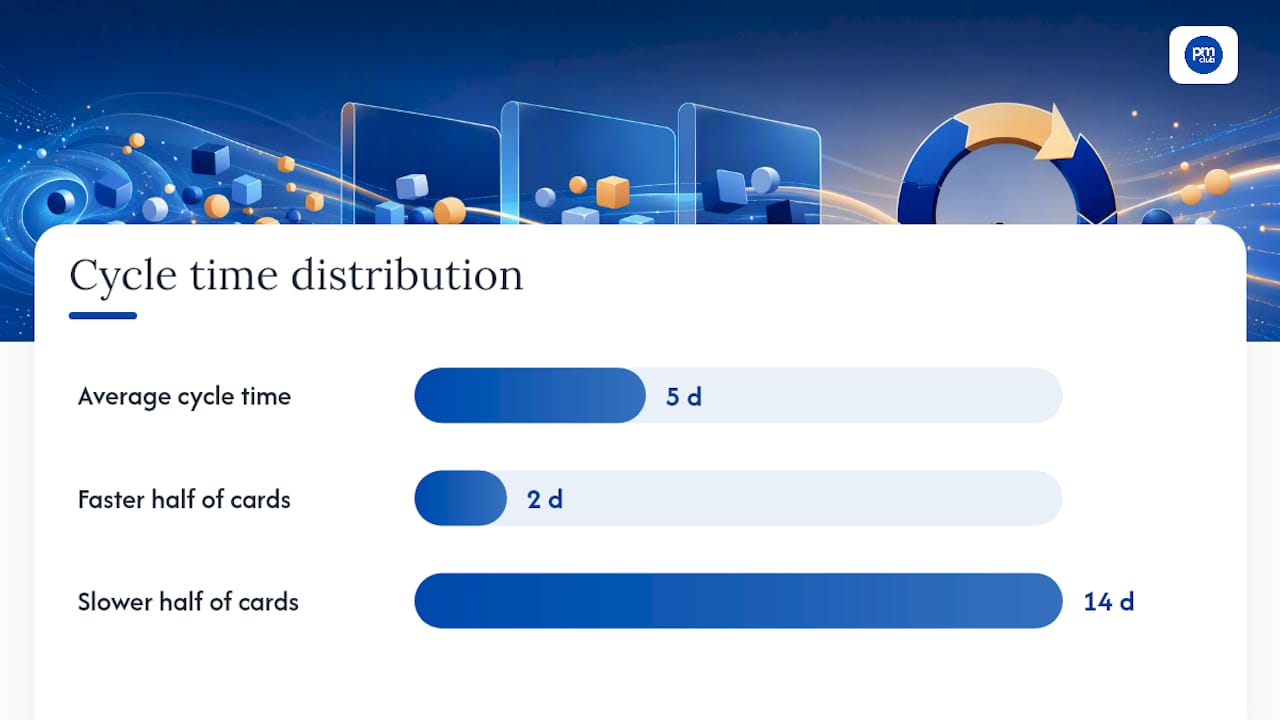
Kanban's core metrics are cycle time (how long a card takes from "in progress" to "done") and throughput (how many cards finish in a given period). Track both weekly, and watch the distribution, not just the average. A cycle time average of five days hides a lot if half your cards finish in two days and the other half drag on for two weeks.
Scrum's core metrics are velocity, burndown, and sprint goal completion. Velocity is useful for forecasting future sprints, but it's a relative number specific to one team's estimation habits. Comparing velocity across teams is close to meaningless.
Common pitfalls that skew both:
- Small sample sizes: three sprints of data isn't enough to spot a trend, it's noise.
- Team size changes: a new hire or a departure resets your velocity baseline; don't compare across that boundary.
- Cherry-picked averages: a single stuck card can distort a short-window cycle time chart badly.
Pro Tip: Run a flow review every two weeks even if you're on Scrum. Overlaying a cumulative flow diagram on top of your sprint burndown often reveals a bottleneck your retrospective conversation missed entirely.
Kanban vs Scrum: Matching the Framework to Your Work
The decision usually comes down to one question: does your work arrive in predictable batches, or does it show up whenever it wants?
- Predictable, batchable work → Scrum. Product teams building a defined feature set over weeks, with a Product Owner who can commit to a backlog slice, do well here.
- Unpredictable, continuous work → Kanban. Platform teams, support desks, and infrastructure groups fielding tickets on no fixed schedule are the classic fit.
- Both, depending on the week → Scrumban. Many teams start on Scrum, then find sprint boundaries adding overhead without adding value, so they keep retrospectives and planning but layer in WIP limits for the unplanned work that keeps interrupting sprints.
Red flags worth watching for: forcing Scrum onto a support queue just produces sprint after sprint of unmet goals, because urgent tickets keep jumping the line. Forcing Kanban onto a team that needs stakeholder-facing commitment dates often produces the opposite problem, endless flow with no forecast anyone can hold you to.
How to Choose: A Practical Checklist
Score your team against these before picking a framework, not after:
- Arrival pattern. Does work show up in planned batches, or does it trickle in unpredictably all week?
- Team stability. Is the team's composition fixed sprint to sprint, or does it fluctuate with contractor availability?
- Regulatory or audit needs. Do you need a documented, repeatable cadence for compliance reporting?
- Stakeholder cadence. Do stakeholders expect a fixed review rhythm, or are they fine with continuous updates?
Ask your team and stakeholders directly:
- How often does urgent, unplanned work interrupt what we're already committed to?
- Can we realistically forecast two weeks of work right now?
- Who needs a fixed checkpoint, and who's fine with a live dashboard?
- Are we tracking cycle time or velocity today, and does anyone actually look at it?
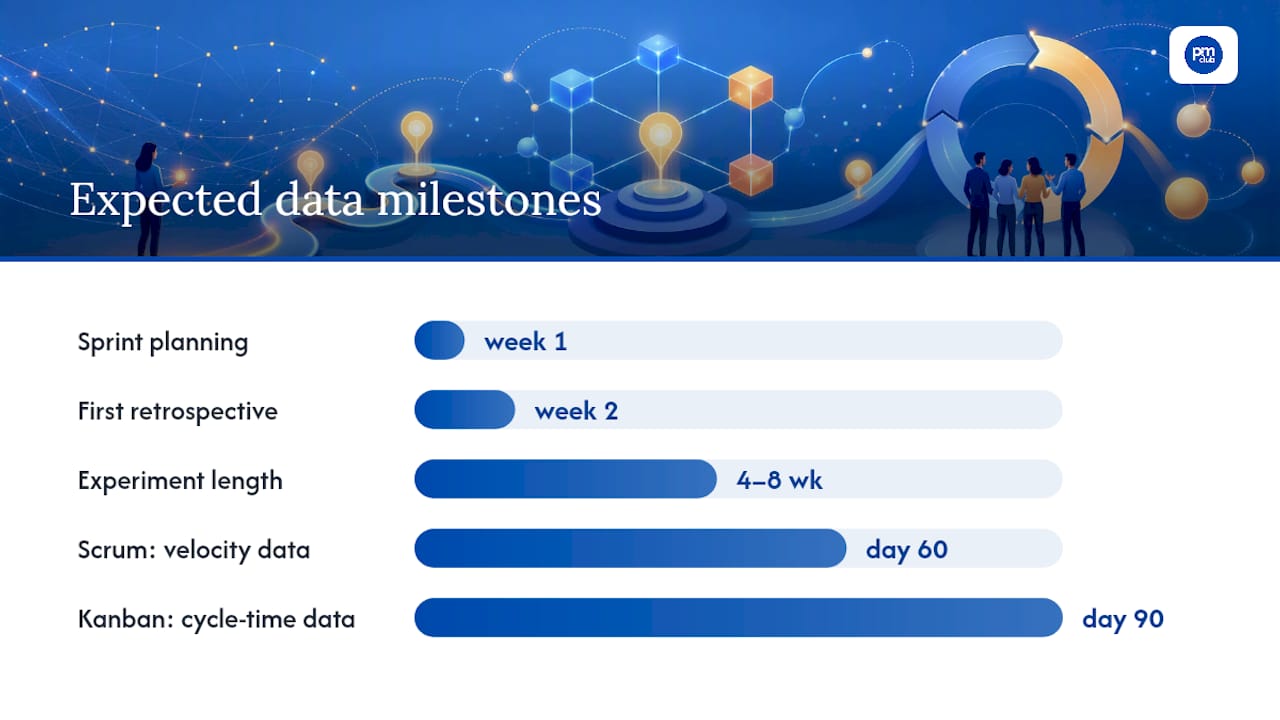
For a Scrum start: run sprint planning in week one, hold your first retrospective by week two, and have real velocity data by day 60. For a Kanban start: map your board and set WIP limits in week one, and by day 90 you should have enough cycle time data to spot your actual bottleneck.
Pro Tip: Pick a 4 to 8 week timeboxed experiment, track cycle time under Kanban rules or sprint goal completion under Scrum rules, and let that data decide rather than a debate.
A Freelance PM's Take on Picking Sides
Clients rarely ask "Kanban or Scrum" directly. They ask why deadlines keep slipping, or why the team feels busy but nothing ships. Answering that question usually reveals which framework actually fits, faster than a formal assessment would.
The tell is arrival pattern. If a client's backlog gets rewritten every three days by a founder chasing the latest fire, sprint commitments become theater. Kanban, with visible WIP limits, ends that argument fast because the board shows exactly why nothing new can start. If the backlog holds steady for two weeks at a stretch, Scrum's cadence gives the client something to hold onto: a review, a demo, a number.
Freelance engagements run short and need fast proof. A four-week trial with clear before/after cycle time or sprint completion data does more to earn trust than a long framework pitch ever will. That's also the gap conceptual thinking skills tend to close for independent consultants: spotting which pattern a client's work actually follows before recommending a fix.
Templates for both starter plans, along with coaching support for freelancers running these exact 30/60/90 experiments with clients, are available.
— Ashanti
Where to Go Deeper
Start with the Scrum Guide itself for the official definitions of every role, event, and artifact discussed here. It's short, free, and the only source that matters when a client disputes what Scrum "officially" requires.
The Agile Manifesto is worth reading once in full. It's four values and twelve principles, none of which mention sprints or boards, and it explains why both frameworks can legitimately call themselves agile.
Scrum Alliance's Scrum vs Kanban comparison and its piece on the difference between project managers and Scrum Masters both help clarify role confusion, especially for anyone weighing a Certified ScrumMaster (CSM) credential against a Professional Scrum Master (PSM) one, or wondering how a PMP compares to either.
For historical grounding, HBR's 1986 piece on iterative product development predates Scrum by years and explains where the cross-functional team idea actually came from.
Ready to put this into practice with real clients? The Freelance PM Club has starter templates, coaching, and a job board built for freelance PMs running exactly these kinds of framework decisions on billable engagements.