

Hire contract when the project has a fixed scope and an urgent deadline. Hire permanent when the work spans multiple years, touches five or more stakeholder groups, or carries executive visibility. That single decision shapes everything else about how to hire a project manager, so make it before you write a single line of the job posting.
Once you know which type you need, the process breaks into five moves you can start today.
- Define the role in five fields: project type, methodology (Agile, waterfall, hybrid), team size, decision authority, and the two or three KPIs that define success.
- Pick your channels: start with internal referrals, then niche job boards for your industry, then a vetted freelance pool if you need speed.
- Screen in three steps: a 15-minute phone screen for baseline fit, a structured behavioral and situational interview scored against a rubric, then a paid final exercise.
- Check references against a short list of outcome-based questions, not a rubber-stamp call.
- Set your timeline: two to three weeks from posting to offer for a direct hire, and four to seven business days for a contract placement.
- Write the first 90 days into the offer, not just the job description, so both sides know what "good" looks like by day 30, 60, and 90.
| Point | Details |
|---|---|
| Decide employment type first | Contract for short, urgent scope; permanent for multi-year or high-visibility work. |
| Score interviews the same way for everyone | A fixed rubric across candidates beats "gut feel" and reduces charisma bias. |
| Use a paid exercise as the final filter | A short, real task exposes practical skill that talk alone cannot. |
| Move fast once you find the right fit | Target 2 to 3 weeks to offer for permanent roles, days for contract roles. |
| Write the 90-day plan into the offer | Set day 30/60/90 milestones so fit issues surface early, not six months in. |
Key Takeaways
Hiring a qualified project manager fast and reliably comes down to defining the role precisely, screening with a consistent rubric, and validating skill with a paid exercise before you sign an offer.
| Point | Details |
|---|---|
| Define the role in five fields | Project type, methodology, team size, decision authority, and measurable KPIs before posting. |
| Match employment type to project shape | Contract for short urgent scope, permanent for long-duration or high-visibility work. |
| Score every candidate the same way | Use a fixed rubric across behavioral, situational, and outcome-based questions. |
| Verify skill with a paid exercise | A short real task before the offer catches gaps interviews miss. |
| Use vetted talent pools to move faster | The Freelance PM Club connects hiring managers to pre-screened PMs with ready onboarding templates. |
Table of Contents
- How to Hire a Project Manager: Defining the Role and Knowing When You Need One
- Should You Hire a Permanent PM or a Contractor?
- How to Write a Job Description That Attracts Qualified Project Managers
- Where to Find Qualified Project Managers Fast
- What Should You Ask in a Project Manager Interview?
- Red Flags, Reference Checks, and the First 90 Days
- Evaluating Freelance Candidates Versus In-House Hires
- How to Make an Offer That Wins Top Project Manager Candidates
- Common Mistakes Hiring Managers Make When Hiring a Project Manager
- What I've Learned Hiring Project Managers
- How The Freelance PM Club Speeds Up Your Hire
- Frequently Asked Questions
- Sources
How to Hire a Project Manager: Defining the Role and Knowing When You Need One
A project manager's job changes shape depending on what you're actually building. An IT delivery PM spends most of their time on release schedules, technical dependencies, and vendor coordination. A transformation PM spends it on change management and executive alignment. A product launch PM lives in cross-functional syncs between engineering, marketing, and sales. A construction PM manages permits, subcontractors, and physical timelines that don't forgive slippage. Naming the type before you post the role is the single biggest predictor of whether you'll attract the right applicants.
You don't always need a dedicated PM. But certain patterns are a clear signal you do: milestones keep slipping despite everyone "being on it," one person is fielding requests from five or more stakeholder groups, you're coordinating multiple vendors with conflicting timelines, or a project has enough executive visibility that a missed date becomes a political problem instead of just a scheduling one.
Before you write the job description, work through a short role-definition checklist:
- Scale: Is this a $50,000 initiative or a multi-year, multi-million-dollar program?
- Methodology: Agile sprints, waterfall phases, or a hybrid model?
- Decision authority: Can this person reprioritize the backlog and reassign budget, or do they escalate everything?
- Reporting line: Do they report to you, to a steering committee, or to a program director?
- Success criteria: What KPIs define a win — on-time delivery rate, budget variance, stakeholder satisfaction score?
PMI's industry benchmarking data consistently shows that organizations investing in project management capability see stronger delivery outcomes, which is exactly why getting this definition right up front matters more than it seems to at posting time.
Pro Tip: If you can't answer the "decision authority" question in one sentence, your job description will attract the wrong candidates. Overqualified PMs will decline once they realize the role has no teeth; underqualified ones won't know to ask.
The PM type you choose also changes what to screen for. A technical PM needs fluency in your stack and delivery methodology, often backed by a PMP certification through the Project Management Institute (PMI). A delivery PM needs proof of on-time, on-budget track records across similar-scale projects. A product PM needs demonstrated influence without authority, since they rarely control the engineers or designers they're coordinating.
Should You Hire a Permanent PM or a Contractor?
The decision rule is simpler than most hiring managers make it. Pick a contractor when the scope is short and contained or when you need capacity fast. Pick a permanent hire when the project runs long, depends on internal relationships that take months to build, or carries enough political weight that continuity matters more than flexibility.
Cost and speed pull in opposite directions depending on which model you choose. A contract PM typically starts faster: industry benchmarks put contract placements at four to seven business days from first contact to start date, because there's no lengthy offer negotiation or notice period to manage. A permanent hire takes longer to land but costs less per hour worked over a multi-year timeline once you account for the premium contractors charge for flexibility and lack of benefits.
Three factors push the decision toward a full-time hire even when a project looks short on paper:
- Stakeholder span. Once a PM needs standing relationships with six or more departments, continuity starts to matter more than speed of placement.
- Institutional knowledge. If the role requires deep familiarity with internal systems that take months to learn, a revolving cast of contractors becomes its own risk.
- Succession planning. If this project is the first of several, a permanent hire builds capability you keep; a contractor's expertise walks out the door at contract end.
Best-practice hiring timelines target two to three weeks from job posting to signed offer for direct hires, and pushing past that window is one of the fastest ways to lose a strong candidate to a competing offer. If you've found the right person and negotiations are dragging, a faster, slightly higher offer almost always costs less than restarting the search. Candidates who are good enough to hire fast are usually good enough that someone else is also trying to hire them fast.
How to Write a Job Description That Attracts Qualified Project Managers
Specificity in the job title does more work than most hiring managers give it credit for. "Project Manager" pulls in hundreds of mismatched applicants. "IT Project Manager, Infrastructure Migration" or "Senior Delivery PM, SaaS Product Launch" pulls in fewer applicants but a much higher percentage of qualified ones.
A job description that actually converts needs five sections, and most postings are missing at least two of them:
- What success looks like. State the KPIs directly: "95% on-time milestone delivery" or "budget variance under 5% across the program."
- Project context. Name the actual initiative, its scale, and its timeline. Vague context reads as a red flag to experienced PMs who've been burned by undefined scope before.
- Required experience and tools. List the methodology (Scrum, PRINCE2, hybrid), the software stack (Jira, Asana, Microsoft Project), and the minimum years of comparable delivery experience.
- Reporting relationships. Who does this person report to, and who reports to them, if anyone?
- Compensation range. Posting a real range, even a wide one, filters out mismatched applicants before they apply and signals you respect their time.
Here's a template you can adapt directly:
"We're hiring a Senior IT Project Manager to lead our cloud infrastructure migration, a 9-month initiative spanning three engineering teams and two external vendors. You'll own the delivery roadmap, report directly to the VP of Engineering, and be measured on on-time milestone completion and stakeholder satisfaction scores. We use a hybrid Agile/waterfall approach and Jira for tracking. Compensation: $95,000 to $120,000 based on experience, or $75 to $95/hour for contract engagements."
Post it where the audience actually looks: general job boards for volume, PMI-affiliated boards and chapters for methodology-fluent candidates, and specialized freelance marketplaces when you need someone who's delivered similar projects before, not just someone who's certified. A listing optimized for the right applicants beats one optimized for the most applicants every time.
Where to Find Qualified Project Managers Fast
Sourcing channels aren't interchangeable, and treating them that way is how hiring managers end up drowning in resumes that don't match the role. Rank them by what you actually need: speed, specialization, or volume.
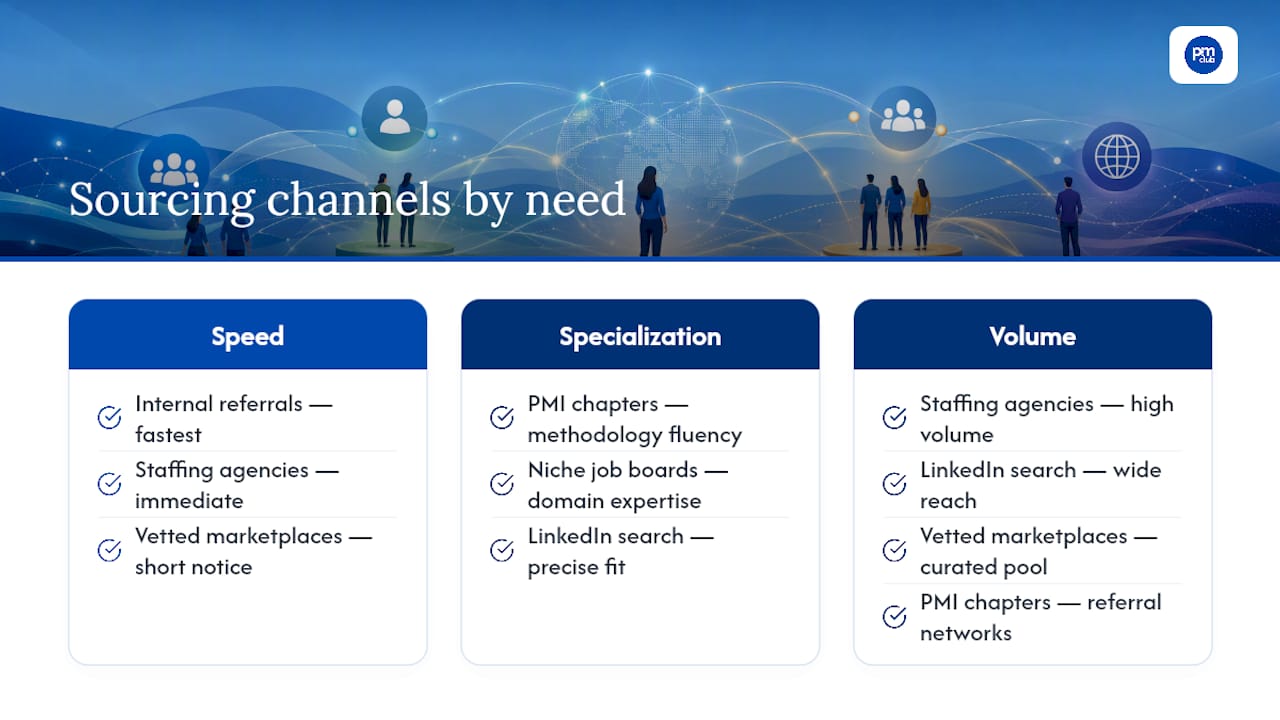
Internal referrals convert fastest and carry the lowest risk, because someone inside your organization is vouching for both skill and cultural fit. Ask your existing PMs, department leads, and even finance or ops staff who's worked cross-functionally with strong project talent before.
PMI chapters and communities are worth tapping when methodology fluency matters more than industry-specific experience. Members are self-selected for taking the profession seriously, and many chapters run active job boards or referral networks.
Niche job boards built around your industry (construction, healthcare IT, SaaS) outperform general boards when domain knowledge is non-negotiable. A construction PM who's never managed a permit timeline is a liability no matter how strong their Agile credentials look on paper.
LinkedIn targeted search works well when you know exactly what track record you're looking for and have time to reach out directly rather than wait for applications.
Vetted freelance marketplaces, including platforms like The Freelance PM Club, work best when you need someone pre-screened for delivery experience and available on short notice, without running a full recruitment cycle yourself.

Staffing agencies earn their premium when you need someone on a bench immediately, typically for contract coverage during a crunch.
A short outreach email converts better than a generic InMail blast. Try something close to: "Saw your work leading the [specific type] rollout at [company] — we're running something similar and I think your background is a strong fit. Fifteen minutes this week to talk through it?" Naming the specific project type in the subject line, not just "Project Manager Opportunity," measurably improves reply rates because it signals you've actually read their profile.
If you're working with a recruiter or internal hiring manager, structure the intake call around the same five fields from your role definition — project type, methodology, team size, authority, KPIs — so the candidates they surface actually match, instead of a generic "senior PM" search that returns forty resumes and three real fits.
What Should You Ask in a Project Manager Interview?
Most PM hiring failures trace back to one root cause: interviews that reward good talkers instead of good project managers. A structured process fixes this, and it isn't complicated to build.
Step 1: Run a 15 to 30 minute phone screen first. Confirm compensation alignment, validate the core experience claims on the resume, and ask one pointed question: "Walk me through the most complex project you've delivered in the last two years." You're not scoring depth here. You're eliminating mismatches before you invest panel time.
Step 2: Use the same structured interview for every candidate. Firms that define a scorecard before the search cuts time-to-hire substantially and reduces the "good interviewer" bias that lets charismatic but weak candidates slip through. Ask the same situational and behavioral questions to everyone, and score each answer against a numeric rubric, typically 1 to 5, across these five categories:
- Delivery outcomes — Can they cite specific projects with measurable on-time and on-budget results?
- Stakeholder management — How do they describe navigating conflicting priorities between departments?
- Risk and budget judgment — What's their process when a project starts drifting off track?
- Methodology fluency — Do they actually understand the framework they claim to use, or just the vocabulary?
- Distributed-team coordination — How have they managed remote or cross-timezone teams?
Step 3: Ask scenario-based questions instead of generic behavioral ones. Practitioners recommend a fixed set of scenario questions scored against a rubric, because it reveals how a candidate handles a realistic crisis rather than how well they've rehearsed a story. A strong example: "You're eight weeks into a twelve-week project and the client just added a scope change that would blow the deadline. Walk me through exactly what you do in the next 48 hours." Watch for candidates who immediately jump to blame or vague reassurance versus those who lay out a concrete triage plan.
Step 4: Design a paid final exercise before you make an offer. A short, representative task, like drafting a project-plan response to that same simulated scope change, or producing a client-facing status update from a messy set of inputs, exposes practical ability that interview talk simply can't fake. Pay candidates fairly for this step. It typically takes two to four hours and should mirror real work, not a hypothetical brain teaser.
Step 5: Assemble a cross-functional panel for the final round. Include someone the PM would report to, someone from a department they'd coordinate with, and one peer PM if you have one. Each panelist scores independently using the same rubric before the group discusses, which prevents the loudest voice in the room from anchoring everyone else's opinion.
Interview length and format do vary by company size. Smaller organizations often compress the process into two calls, while enterprises run more formal loops with panels and take-home assignments. Neither approach is wrong, but whichever you pick, keep the scoring consistent across every candidate you see.
Pro Tip: Coach yourself, not just the candidate, to expect STAR-format answers: Situation, Task, Action, Result. If a candidate can't get to a concrete result with a number attached, treat that as data, not a fluke.
Red Flags, Reference Checks, and the First 90 Days
Some warning signs show up in the interview itself, and they're worth naming explicitly because they're easy to talk yourself past when a candidate is otherwise likeable. Common red flags include an inability to quantify past outcomes, heavy reliance on buzzwords instead of specifics, and the absence of any real failure story — every experienced PM has had a project go sideways, and someone who can't discuss one honestly is either inexperienced or not being straight with you. Weak escalation judgment is another tell: ask how they'd handle a stakeholder who keeps blowing past deadlines, and listen for whether they have an actual process or just a vague "I'd talk to them."
The fix is simple to apply. Ask every candidate to quantify results with a percentage, a dollar figure, or a specific efficiency gain, and treat a candidate who can't do this for any project as a real concern, not an oversight.
Reference checks fail most often because hiring managers ask questions the reference can answer in one word. A better template digs for context:
- "What was the biggest challenge this person faced on your project, and how did they handle it?"
- "Describe a time this person had to push back on a stakeholder or executive. What happened?"
- "If you were hiring again for a similar role, would you hire this person again, and why or why not?"
- "What's one thing this person could have done better?"
That last question, asked plainly and without apology, surfaces more useful signal than the first three combined.
Once you've made the hire, a structured 30-60-90 onboarding plan turns the first quarter into a measurable ramp instead of a hope-it-works-out period:
- Days 1 to 30: Shadow existing processes, document what they observe, and meet every key stakeholder one-on-one.
- Days 31 to 60: Take ownership of execution on a defined piece of the project, with you or a sponsor checking in weekly.
- Days 61 to 90: Build or improve systems, meaning they're no longer just executing your existing process, they're strengthening it.
If a new PM can't operate independently by day 60, that's a warning sign worth acting on rather than waiting out.
Vague expectations produce vague performance reviews.
Pro Tip: Send the reference-check questions to the reference in advance by email, then follow up with a live call. People give more candid answers when they've had a minute to think, and the live call catches nuance the written response misses.
Evaluating Freelance Candidates Versus In-House Hires
The evaluation lens shifts depending on which model you're testing. For a contractor, you're scoring immediate delivery capability: can this person hit the ground running with minimal ramp-up? For a permanent hire, you're scoring something harder to measure in an interview: their capacity to build internal relationships and influence decisions over years, not weeks.
A pilot engagement is the cleanest way to de-risk a contractor hire before committing to something longer. Structure it with a short, defined scope (two to four weeks), clear success criteria agreed on up front, and an explicit conversion trigger, meaning you both know in advance what performance would justify extending or converting the engagement.
Before any contractor starts, run through a short legal checklist so you're not solving these questions mid-project:
- IP ownership — Confirm in writing that deliverables and work product belong to your company, not the contractor.
- Non-disclosure agreements — Standard for any PM who'll see internal financials, roadmaps, or client data.
- Deliverable definitions — Spell out exactly what "done" means for each milestone to avoid scope disputes later.
- Escalation paths — Name who the contractor contacts if something goes wrong, and who on your side owns the relationship.
- Work eligibility and classification — Confirm the engagement is structured correctly for the worker's status and your jurisdiction's contractor classification rules before you sign anything.
How to Make an Offer That Wins Top Project Manager Candidates
A competitive offer for a PM role covers more than base salary. Build the offer around four components: base compensation, any bonus and the specific triggers that unlock it, a professional development budget (even a modest one signals investment), and clear start-date and notice-period terms.
Speed matters more than most hiring managers assume. A signing bonus or a compressed interview-to-offer timeline can be the deciding factor for a strong candidate weighing multiple offers, especially since the best PMs rarely stay unclaimed for long.
Retention starts before day one, not after the ninety-day mark. Practices centered on early clarity of expectations, real development opportunities, and connecting work to something meaningful measurably reduce turnover. Translate that into concrete moves:
- Give them a clear mandate on day one, not a vague "figure it out" onboarding.
- Assign a quick, visible win in the first two to three weeks to build momentum and credibility with the team.
- Introduce them to their executive sponsor early, not after a crisis forces the introduction.
- Lay out a real development path, whether that's a certification budget, a mentorship track, or a clear route to larger scope.
Common Mistakes Hiring Managers Make When Hiring a Project Manager
The same handful of mistakes show up across almost every failed PM search, and every one of them is avoidable.
- Writing a vague role spec. "Manage projects" as a job description invites mismatched applicants and wastes everyone's time in the first screen.
- Running an interview loop that's too long. Five or six rounds signals indecision, and strong candidates drop out of overlong processes to take faster offers elsewhere.
- Hiring at the crisis point. Bringing a PM in to triage a project that's already 60% behind schedule is expensive to recover from, and the PM you hire under those conditions is unlikely to stick around once the fire's out. Hire at kickoff, not after things have already gone wrong.
- Over-valuing certifications without checking outcomes. A PMP credential from PMI demonstrates knowledge of methodology, not proof of delivery. Weigh it alongside track record, not instead of it.
- Running unstructured reference calls. A five-minute "were they good to work with?" call misses everything useful a reference could tell you.
The corrective steps are just as short. Build the scorecard before you post the role, set a firm interview-to-offer timeline (and hold yourself to it), require a paid final assignment for every finalist, and use outcome-focused reference questions instead of yes-or-no ones.
What I've Learned Hiring Project Managers
Most hiring managers over-optimize for finding the "perfect" candidate and under-optimize for speed, and it costs them the actual best candidate more often than it protects them from a bad one. Analysis paralysis in PM hiring is its own kind of project failure: the search itself becomes the unmanaged risk.
The single change that improved outcomes most consistently across the approach in this article was adding a paid test assignment as the final gate and cutting a round out of the interview loop to make room for it. Talk is cheap in interviews. A real deliverable, even a small one, tells you in two hours what six conversations can't.
How The Freelance PM Club Speeds Up Your Hire
Sourcing and screening a project manager from scratch takes weeks you may not have, especially when every channel from job boards to staffing agencies means starting the vetting process over from zero. The Freelance PM Club shortens that path by giving you access to a pool of project managers who've already been vetted for delivery experience, not just resume keywords.

Membership connects you to curated project management and consulting talent alongside the templates this article walks through: job description frameworks, interview scorecards, and the 30-60-90 onboarding structure you can hand a new hire on day one instead of building it yourself. Consultants and freelancers on the platform arrive with a support structure already in place, including coaching and a resource library, which cuts down the ramp-up time you'd otherwise spend getting a new PM oriented.
If you're ready to shorten your time-to-fill instead of running another six-week search from scratch, post a role or explore vetted PM talent on The Freelance PM Club and see who's available this week.
Frequently Asked Questions
How long should it take to hire a project manager? Direct hires typically run two to three weeks from job posting to signed offer when the role is well defined and the interview loop is structured. Contract placements move faster, often four to seven business days, since there's no lengthy negotiation or notice period involved.
What certifications should I look for in a project manager? A PMP certification from PMI signals methodology knowledge and is worth weighing, but it shouldn't replace checking actual delivery outcomes. Pair certification with quantified results from past projects rather than treating it as a stand-alone qualifier.
Should I use a staffing agency or hire directly? Use a staffing agency when you need someone on a bench immediately for contract coverage. Hire directly, or through a vetted freelance platform, when you have time to run a structured screening process and want more control over fit.
What's the biggest mistake companies make hiring project managers? Waiting until a project is already in trouble. Bringing a PM in to fix a project that's already significantly behind schedule is expensive and the hire rarely sticks around once the crisis passes. Hire at project kickoff whenever you can.
How do I know if I need a project manager at all? Look for repeated missed milestones, one person fielding requests from five or more stakeholder groups, multiple vendors with conflicting timelines, or a project visible enough to executives that a missed date becomes a political issue. Any one of these is a reasonable trigger to start the search.
Sources
Deeper reading on the frameworks referenced throughout this guide:
- How to hire a project manager — Alex Berman
- PMI Pulse — 2020
- Project-management
- How one fast-food chain keeps its turnover rates absurdly low — HBR