

Your cover letter has one job: prove in the first two lines that you can deliver a measurable result for this specific client, right now. State your role and availability, lead with one hard number from a past project, connect it to something in the job post, and close by asking for a conversation. Everything else is decoration.
TL;DR:
- Highlight relevant metrics and specific project outcomes to immediately demonstrate your ability to solve the client's pressing problem.
- Align your background directly with one or two main priorities from the job post to prove you're a perfect fit.
- Use concise STAR stories that quantify your results to turn vague experience into compelling proof points.
- Emphasize your remote work setup and communication methods with concrete examples to assure clients of your independence and reliability.
- Focus on delivering a sharp, tailored pitch as a sales document rather than a generic career summary to maximize response likelihood.
Table of Contents
- What Goes Into A Freelance Project Manager Cover Letter?
- How Should You Format The Header And Greeting?
- What Should Your Opening Paragraph Say?
- How Do You Show You Understand The Client's Priorities?
- How Do You Write A STAR Story With Real Numbers?
- What Is A Quick-Fit Map And Why Use One?
- A Ready-To-Edit Freelance Project Manager Cover Letter Template
- Three Cover Letter Examples For Common Freelance PM Roles
- Freelance Vs. Full-Time: What Changes In The Letter?
- How Do You Highlight Remote Work Skills And Client Communication?
- How Do You Handle Gaps Or A Mixed Project History?
- Why Your Cover Letter Is Actually A Sales Document
- Get Your Cover Letter Reviewed Before You Send It
- Sources
What Goes Into A Freelance Project Manager Cover Letter?
A freelance project manager cover letter has six working parts, and each one earns its place by answering a question the hiring manager is silently asking. Skip a part, and you leave that question unanswered.
- Header: name, role label, contact info, and availability
- Greeting: addressed to a real person whenever possible
- Opening: one to two sentences leading with your best metric
- Company fit: one sentence tying your background to their stated priority
- STAR body: a short proof story with a number attached
- Closing CTA: a direct ask for a call or interview
Hiring managers scanning freelance applications aren't reading for your career history. They're checking whether you can solve their problem this quarter, which is why a chronological summary reads as noise. Keep the whole letter to one page, roughly 300 to 450 words. Freelance-specific cover letter examples consistently land in that range, and freelancers often do better going shorter rather than longer since clients are usually comparing several pitches in one sitting.
How Should You Format The Header And Greeting?
Your header needs to look like it belongs next to your resume, not like a leftover Word template from 2015. Put your name, "Freelance Project Manager," email, portfolio or LinkedIn link, and your timezone or general availability window on one line or in a tight block.
- Name and role label (e.g., "Jordan Reyes, Freelance Project Manager")
- Email and one link (portfolio, LinkedIn, or case study page)
- Timezone or availability (e.g., "EST, available 20+ hrs/week")
For the greeting, use the hiring manager's actual name whenever the job post, LinkedIn, or company site gives you one. If you truly can't find it, "Dear Hiring Team" reads better than the stiffer "Dear Hiring Manager" for agencies and startups, while more formal enterprise clients still expect the traditional phrasing.
Pro Tip: If a job post lists a company email domain, search that domain plus "project manager" on LinkedIn before you default to a generic greeting. Ten seconds of digging usually surfaces a name.
What Should Your Opening Paragraph Say?
Your opening has to do three things in one or two sentences: name your role and availability, land one sharp metric, and hint at fit. Hiring managers spend only seconds on a first read, according to the University of Michigan Career Center, so this paragraph is the whole pitch if nothing else gets read.
Structure it as: who you are and how you work, then the number that proves you're worth the next paragraph.
- Retainer work: "I'm a freelance project manager available for a 15 hour/week retainer, and in my last engagement I cut client onboarding time by 40% across three product launches."
- Short contract: "As a freelance PM available for short-term engagements, I recently delivered a 12-week software rollout two weeks ahead of schedule and $8,000 under budget."
- Hourly/project-based: "I run freelance project management on an hourly basis and most recently brought a stalled marketing campaign back on track, hitting 100% of deliverables within a revised 6-week timeline."
Avoid openings that repeat your resume summary word for word or lean on vague enthusiasm like "I'm excited about this opportunity." Treating the letter as marketing copy rather than a career recap is what separates a letter that gets read from one that gets skimmed and filed.
How Do You Show You Understand The Client's Priorities?
One sentence of genuine company fit does more work than three paragraphs of generic praise. Read the job post twice and pull out the one or two priorities they actually state, then pull one more from the company's site or recent announcements.
The pattern is: what you noticed, how your background answers it, what result they can expect.
- "Your posting emphasizes scaling a remote team past 20 contributors. I've managed distributed teams of 25+ across four time zones and kept sprint velocity steady through that growth."
- Startup: "Since you're pre-Series A and moving fast, I bring the same lean-process instinct I used to launch three MVPs in under 90 days each."
- Agency: "Given your roster of retainer clients, I've run parallel projects for up to six accounts at once without missing a deliverable."
- Enterprise: "Because your team runs on Jira and Agile at scale, I've led Scrum ceremonies across 40-person departments for the past three years."
Matching your background to stated requirements like specific methodologies or tools is what turns a generic pitch into one that reads as researched.
How Do You Write A STAR Story With Real Numbers?
The STAR method, Situation, Task, Action, Result, exists because it forces you to compress a messy project into a clean proof point. Amherst College Career Services frames it as the standard way to turn vague experience into a measurable anecdote, and for freelancers it's especially useful because it replaces a job title with evidence.
Here's how to build one in three sentences or fewer:
- Situation and Task in one clause: name the problem and your assignment without background noise the client doesn't need.
- Action in one sentence: what you specifically did, using "I" and an active verb, not "the team."
- Result with a number: percent change, time saved, or budget variance, whichever the client will care about most.
Pick the project that matches the job's primary pain point. If they need speed, lead with a story about hitting a deadline. If they need cost control, lead with budget recovery.
Two model rewrites:
Raw notes: "Worked on a website redesign that was behind schedule. Reorganized the team's workflow. Project finished." Cover letter version: "When a client's website redesign fell six weeks behind, I restructured the team's sprint cadence and introduced daily standups, bringing the project to launch just two weeks late instead of the projected two months."
Raw notes: "Managed a software rollout with a tight budget."
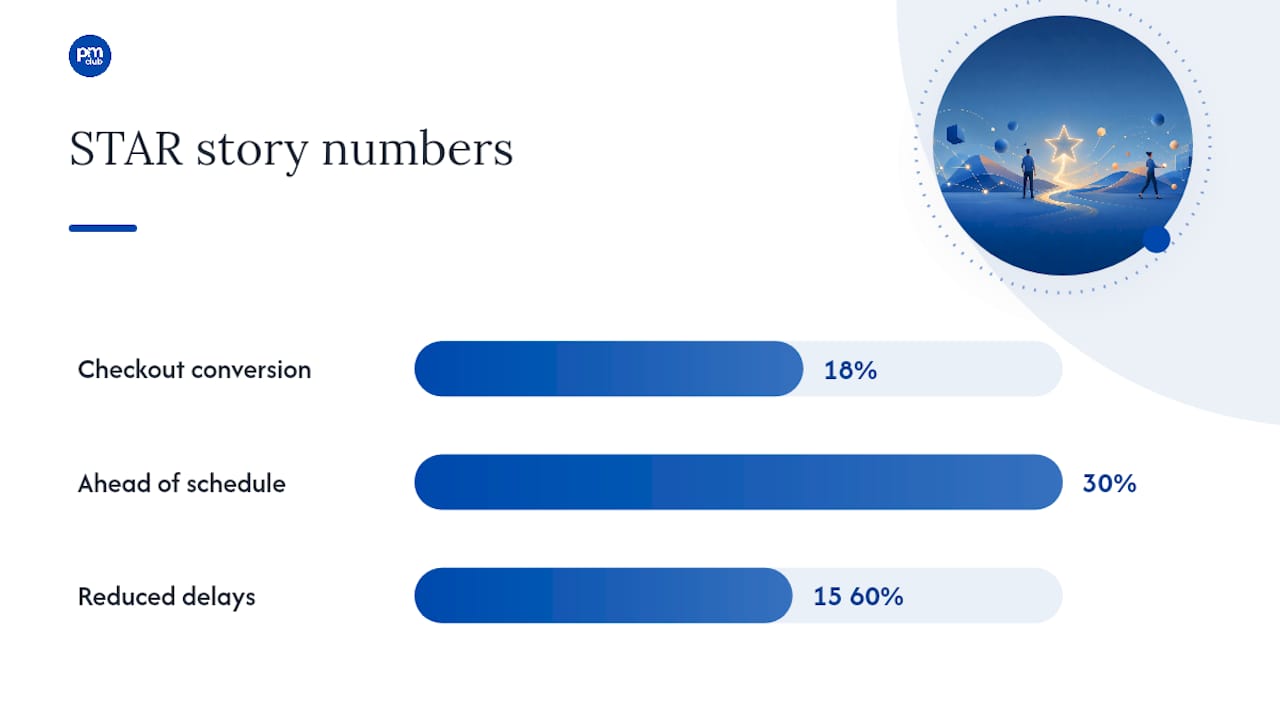
Including specific quantitative results, like an 18% increase in checkout conversion or finishing 30% ahead of schedule, is what separates a forgettable STAR story from one that gets a callback.
When you don't have a clean percentage, use a range rather than inventing false precision, something like "reduced delays by roughly 15 to 20% across two sprints" reads as honest, not vague.
What Is A Quick-Fit Map And Why Use One?
A quick-fit map is a three-line cheat sheet that mirrors the job post back at the hiring manager in language they can scan in five seconds. Recruiters skimming a stack of freelance pitches respond well to this kind of obvious alignment, since it removes the friction of hunting for relevance inside a paragraph.
Build it this way before you write the letter:
- Pull the top three requirements straight from the ad (a tool, a methodology, an outcome)
- Write one line of evidence for each, naming the specific tool, method, or metric you used
- Save your rate and exact availability for the interview unless the post explicitly asks for it upfront
You can weave this map into your body paragraph as three tight clauses, or drop it as a compact aside right before your closing line. Either way, it should never replace the STAR story, it supports it.
A Ready-To-Edit Freelance Project Manager Cover Letter Template
Copy this, then replace every bracket. Keep your finished letter under 450 words and matched, font and header style, to your resume.
[Your Name], Freelance Project Manager [Email] | [Portfolio/LinkedIn link] | [Timezone/Availability]
Dear [Hiring Manager Name / Hiring Team],
I'm a freelance project manager available for [engagement type], and in my most recent project I [one headline metric, e.g., "cut delivery time by 25% across a 10-week rollout"]. (Keep this to 1 to 2 sentences, under 40 words.)
Your posting highlights [one priority from the job ad]. I bring [specific matching skill or experience], which has consistently delivered [expected outcome type]. (One sentence, roughly 30 words.)
When [situation/problem], I was responsible for [task]. I [specific action taken], resulting in [quantified result, e.g., percent, time, or budget figure]. (Two to three sentences, 50 to 70 words.)
I'd welcome the chance to talk through how I can bring similar results to [company name]. I'm available for a call [this week/your availability window].
Best, [Your Name]
Keep paragraphs short, use a clean standard font like Calibri or Arial, and never let the letter run past one page.
Three Cover Letter Examples For Common Freelance PM Roles
Adapt these rather than copying them outright, the specifics are what make each one land.
- Marketing operations PM: "I'm a freelance project manager available for 20 hours/week, and my last client saw a 35% drop in campaign turnaround time after I restructured their approval workflow. Your job post mentions scaling paid campaigns across three regions. When a previous client launched in five markets simultaneously, I built a single tracking system that kept every regional team on the same deadline, and we hit 100% of launch dates. I'd welcome a call to discuss your Q1 campaign calendar."
- IT/SaaS delivery PM: "As a freelance PM specializing in Agile software delivery, I recently led a 12-sprint SaaS rollout using Jira and ran ceremonies for a 15-person cross-functional team. Since your team is scaling a new feature set, I bring direct experience shipping under similar sprint pressure; my last client's release went out one full sprint early. Happy to walk through my sprint retrospective process on a call."
- Construction/field PM: "I'm a freelance project manager with a background coordinating multi-trade construction schedules, and my last project finished 10 days ahead of a 90-day timeline with zero safety incidents. Your posting emphasizes on-time delivery across multiple job sites, which mirrors the four concurrent sites I managed last quarter. I'm available to discuss your upcoming project scope this week."
Freelance Vs. Full-Time: What Changes In The Letter?
A full-time project manager cover letter sells stability, growth potential, and cultural fit over years. A freelance project manager cover letter sells speed, availability, and proof of a specific outcome you can deliver on a defined engagement. That's the entire difference, and it changes almost every sentence.
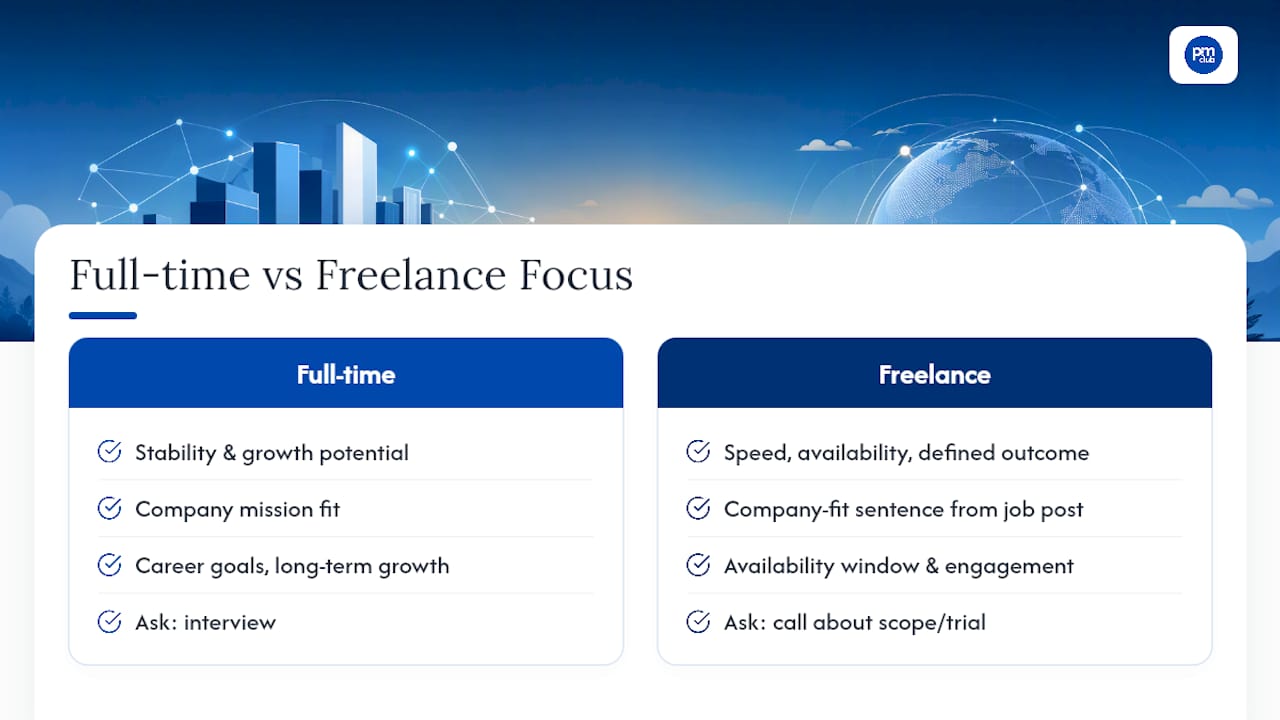
Drop any language about "career goals" or "long-term growth within your organization." A freelance client isn't hiring your five-year plan, they're hiring a solution to a problem they have this month or this quarter. Replace it with your availability window, your engagement type (retainer, project-based, hourly), and how fast you can start.
Full-time letters often spend a paragraph on why the company's mission resonates with you personally. Freelance letters spend that same space on a company-fit sentence built from the job post itself, because the client cares more about whether you understand their immediate priority than whether you share their values.
The closing ask changes too. A full-time candidate asks for an interview to discuss the role. A freelance candidate asks for a call to discuss scope, timeline, or a trial project, something concrete and time-bound rather than open-ended.
One more shift: full-time cover letters can lean on a single employer's track record. Freelance letters need to prove range across multiple clients, which is exactly why the STAR story and quick-fit map carry so much more weight here than they would in a traditional application.
How Do You Highlight Remote Work Skills And Client Communication?
Clients hiring a freelance project manager are quietly worried about one thing: can this person operate without daily supervision. Your letter needs to answer that directly, not just imply it.
Name your remote-work setup in concrete terms rather than claiming you're "great at working independently." Mention the specific tools you run projects through, Asana, Monday.com, Slack, whatever fits, and the cadence you use to keep clients informed, weekly check-ins, async status updates, a shared dashboard. Specifics read as proof; adjectives read as filler.
Client communication deserves its own mention if you have a metric behind it. A line like "I send a weekly one-page status update that cut client check-in meetings from three per week to one" does more than any sentence claiming you're "a strong communicator." If you've managed stakeholders across time zones, say how many and how you kept them aligned, that's the kind of detail that separates a freelancer who's actually done distributed work from one who's guessing at what clients want to hear.
If the job post specifically mentions remote or hybrid teams, this is one of the one or two priorities worth building your company-fit sentence around. It's rarely buried in the posting.
How Do You Handle Gaps Or A Mixed Project History?
Freelancers rarely have a clean, linear resume, and that's fine. The mistake is treating a gap or a scattered project history as something to apologize for instead of something to frame.
If you had a slow stretch between contracts, don't mention it unless directly asked. A cover letter isn't an explanation document, it's a pitch, and drawing attention to downtime does more damage than the downtime itself. Fill the space instead with your most relevant win, regardless of when it happened.
When your background spans different industries, marketing one quarter, construction the next, pick the one or two examples closest to the job you're applying for and let the rest stay on your resume. Trying to prove range in the cover letter itself usually dilutes your strongest story. One sharp, specific STAR example beats three thin ones every time.
If the roles genuinely vary in scope, from small three-week projects to six-month engagements, frame that range as adaptability tied to a number: "I've managed engagements from two-week sprints to six-month builds, consistently delivering within 5% of the original timeline." That converts a potentially confusing pattern into evidence you can operate at multiple scales, which is precisely what most clients hiring freelance PMs actually need.
Why Your Cover Letter Is Actually A Sales Document
Most freelance project managers write their cover letter like a formality, something to get through before the "real" work of interviewing starts. That's backward. The letter is the first deliverable a client sees from you, and if it's vague or generic, you've already answered their biggest unspoken question: can this person write clearly and sell an outcome without hand-holding? A rambling letter says no before you ever get on a call.
The freelancers who land retainers consistently treat every application like a tiny business development exercise. They research the client the way they'd research a project scope, they lead with the number that matters to that specific client, and they stop writing the moment the point is made. That discipline is the whole skill, and it's the same discipline the job itself requires.
If you want a fast way to test this, write two different openings for your next application, one leading with a metric, one leading with a fit statement, and track which gets a faster response. Small experiments like that teach you more about your own positioning than any generic advice ever will. Coaching resources are built around exactly this kind of iteration for members figuring out what actually lands with clients.
— Ashanti
Get Your Cover Letter Reviewed Before You Send It
Support is available for the moment right after you write a draft and start second-guessing every sentence. Instead of guessing whether your opening lands or your STAR story is too vague, some offer cover letter templates built specifically for freelance pitches, career coaching to sharpen the fit paragraph, and curated job boards with vetted roles for freelance-friendly clients.

That combination matters more than it sounds: a strong letter matched to the wrong job board still goes nowhere, and a great job board with a weak letter gets the same result. Some use support to get a second set of eyes on their draft before it goes out, then apply that same letter, tightened, to curated freelance project manager roles instead of scrolling generic listings. If you're rewriting the same cover letter for the fifth time this month, check out The Freelance PM Club and get your next draft reviewed before you hit send.