

A fractional project manager is a senior project leader you hire part-time or on retainer to own delivery, not just support it. The verdict: this model works best for episodic projects, sudden capacity gaps, and any situation where you need real project management expertise without a full-time salary attached. If that sounds like your situation, here's what to weigh before you post the job or, if you're the one considering the leap, before you pitch yourself as one.
- Best fit: short-to-mid-length projects, one-off launches, PMO coverage gaps
- Not a fit: continuous, high-touch programs needing daily on-site presence
- Where to start: browse vetted talent through The Freelance PM Club or draft a trial-engagement brief today
Key Takeaways
A fractional project manager delivers senior-level planning, risk management, and stakeholder communication on a part-time or retainer basis, and the engagement succeeds only when scope and authority are defined in writing before day one.
| Point | Details |
|---|---|
| Match the model to the need | Fractional works for episodic projects and capacity gaps, not continuous full-time programs. |
| Lock authority in writing | Define what the PM can decide versus escalate before the engagement starts. |
| Budget on total cost | Compare loaded full-time cost, not just day rate, against a fractional retainer or project fee. |
| Run a real trial | Use a 30 to 60 day trial with explicit milestones before committing to a longer retainer. |
| Start with The Freelance PM Club | Its job board, courses, and coaching support both hiring businesses and PMs building a fractional practice. |
Table of Contents
- What Is a Fractional Project Manager, Exactly?
- Who Actually Needs a Fractional PM?
- What Does a Fractional PM Own Day to Day?
- How Much Does a Fractional Project Manager Cost?
- How Do You Hire and Screen a Fractional Project Manager?
- What Does a Good 30–60–90 Onboarding Plan Look Like?
- How Do You Build a Fractional Project Management Career?
- Why Trust This Guide on Fractional Project Management?
- Why the "Just Hire a Freelancer" Advice Misses the Point
- Where to Find or Become a Fractional Project Manager
- Frequently Asked Questions
- Sources
What Is a Fractional Project Manager, Exactly?
A fractional project manager handles the same core work as a full-time PM: planning, risk tracking, stakeholder communication, and delivery ownership. The difference is scope, not skill. They're brought in for a defined slice of time, a specific outcome, or a fixed number of hours per week, then they move on.
This isn't the same as a generic freelancer or an interim hire. A freelancer might execute tasks you assign; a fractional PM owns outcomes and makes calls. An interim PM usually fills a full-time seat temporarily, at full-time hours, until you backfill it. A fractional PM never expects that seat. TechTribe's breakdown of the model frames it as senior leadership delivered part-time or on demand, usually at a lower total cost than a permanent hire.
Engagements typically take one of three shapes:
- Retainer: a set number of hours or days each month
- Hourly: billed as work happens, common for shorter or unpredictable scopes
- Project-based: a flat fee tied to a defined deliverable or milestone
Who Actually Needs a Fractional PM?
You probably need one if any of these describe your situation right now:
- You run projects infrequently. A startup launching one big product a year doesn't need a full-time PM sitting idle between cycles.
- Your team is overloaded. If founders or department heads are managing timelines on top of their real jobs, deadlines start slipping quietly, then loudly.
- You have a PMO gap. Mid-size companies often lose a PM to attrition and can't justify an immediate full-time replacement while they figure out the role's real scope.
- You're testing whether PM discipline even helps. Rather than commit to a headcount, you want proof first.
Fractional project management fits organizations that run large projects infrequently or lack the capacity for a dedicated hire, according to a breakdown of the fractional PM role. If you need someone embedded five days a week for the next two years managing a single sprawling initiative, a full-time or interim PM is the better call. Fractional works best when the need is real but not constant.
What Does a Fractional PM Own Day to Day?
Scope clarity is the single biggest predictor of whether this engagement succeeds. A fractional PM typically owns:
- Project scoping and timeline construction
- Weekly or biweekly status reporting to stakeholders
- Risk and issue tracking, with early escalation
- Resource coordination across teams or vendors
- Meeting facilitation and decision documentation
Where it gets murky is authority. Can they approve a scope change? Reallocate budget? Fire an underperforming vendor? Decide this upfront, in writing, or you'll spend the engagement renegotiating boundaries instead of shipping work. The general rule: administrative and coordination decisions stay with the PM; anything touching budget, headcount, or client relationships gets escalated, based on how fractional PM role scope tends to break down in practice.
Watch bandwidth closely, too. A fractional PM juggling four clients at 10 hours each isn't the same as one dedicated to your account for 40.

Pro Tip: Put the authority matrix in the contract, not just the kickoff deck, and consider partnering with a specialized App Development Agency - iOS & Android Experts | fractional product dev teams to complement your project management infrastructure. Verbal agreements about "who decides what" evaporate by week three.
How Much Does a Fractional Project Manager Cost?
Pricing usually lands in one of three buckets: day rates, monthly retainers, or fixed project fees. Rate depends heavily on seniority, industry complexity, and how much decision authority you're handing over. A PM overseeing a $50,000 marketing campaign charges differently than one steering a multi-vendor ERP rollout.
The comparison that matters isn't day rate versus day rate. It's total loaded cost. A full-time PM comes with salary, benefits, payroll tax, equipment, and the sunk cost of onboarding someone you might not need in eight months. Organizations often see 30 to 50 percent cost savings versus a fully loaded full-time hire for project-based or seasonal work.
- Day rates scale with seniority and domain expertise
- Retainers work best when the workload is predictable month to month
- Project fees suit clearly bounded deliverables with defined end states
That savings figure assumes you're comparing apples to apples. If the fractional PM's scope quietly balloons to full-time hours, the discount disappears fast.
How Do You Hire and Screen a Fractional Project Manager?
Start with a brief, not a job post. Spell out weekly hours, specific deliverables, decision authority, and how long the engagement runs. Vague briefs attract vague candidates.
- Write the scoping document first. Include hours, deliverables, escalation paths, and the tools you already use.
- Ask scenario questions, not resume questions. "A vendor missed a deadline three days before launch. Walk me through what you do." tells you more than years of experience.
- Run a paid trial before committing to a retainer. A short 30 to 60 day stretch with explicit milestones is the lowest-risk way to validate fit before signing anything longer.
- Check references for delivery, not just personality. Ask former clients specifically what shipped and what slipped.
Red flags worth walking away from:
- Can't describe how they'd handle conflicting stakeholder priorities
- No clear system for tracking risk or reporting status
- Overcommitted to too many concurrent clients for the hours you need
- Resistance to a defined trial period
Job boards like LinkedIn show a growing volume of fractional PM listings, which means more competition for good candidates and more reason to move fast once you find one who screens well.
What Does a Good 30–60–90 Onboarding Plan Look Like?
The first 90 days determine whether this relationship works. Structure it deliberately.
- Days 1 to 30: discovery. The PM interviews stakeholders, audits existing documentation, and maps where things currently stall.
- Days 31 to 60: ownership. They take over active deliverables and aim for one or two visible quick wins, something the team can point to and say "that's better now."
- Days 61 to 90: stabilization. Templates get built, handoff documents get written, and the PM's role either graduates to a longer retainer or wraps cleanly.
Measure success with concrete markers: deadlines hit, stakeholder satisfaction, and whether the documentation would survive the PM leaving tomorrow.
Pro Tip: If your fractional PM can't show you a repeatable status-reporting template by day 30, that's a sign the collaboration infrastructure isn't there yet, on either side.
How Do You Build a Fractional Project Management Career?
If you're the PM considering this path rather than the buyer, credentials still matter. A PMP or a Scrum Alliance certification signals baseline competence, but what actually gets you hired repeatedly is domain depth: healthcare compliance, SaaS launches, construction logistics. Fractional clients pay for judgment they don't have to train from scratch.
- Package your services as retainers, fixed slots (say, two clients at 15 hours weekly), or advisory-plus-delivery hybrids
- Build a portfolio around outcomes, not job titles
- Find early clients through referrals, niche job boards, and communities built specifically for independent PMs
Fractional PMs tend to bring more senior-level experience than typical freelance hires, because clients are buying leadership judgment, not just task execution. That's the pitch you should be making, too.
Why Trust This Guide on Fractional Project Management?
This guide draws on established hiring frameworks and documented fractional PM practices rather than theory. The Freelance PM Club built its resources specifically for independent project managers and the businesses that hire them, combining a curated job board, expert-led courses, and structured career coaching so both sides of this hiring equation get real support.
- Curated job listings connect vetted fractional PMs with businesses that need them
- Expert-led courses cover both PM fundamentals and fractional-specific skills like scoping and client management
- A networking community gives practitioners a place to compare rates, trade referrals, and troubleshoot tricky engagements
Members describe the Club as the turning point where an unclear freelance path became a structured career, crediting the coaching and community for giving them clarity on positioning and pricing.
That kind of documented shift, from scattered freelancing to a defined fractional practice, is the entire premise behind the platform.
Why the "Just Hire a Freelancer" Advice Misses the Point
Most hiring advice treats fractional PMs as interchangeable with any contract worker you can find on a general freelance marketplace. That's the mistake. The data on this model is consistent: it works when role definition is airtight and falls apart when it isn't, based on the cultural acceptance and role-clarity factors documented in research on the fractional PM role.
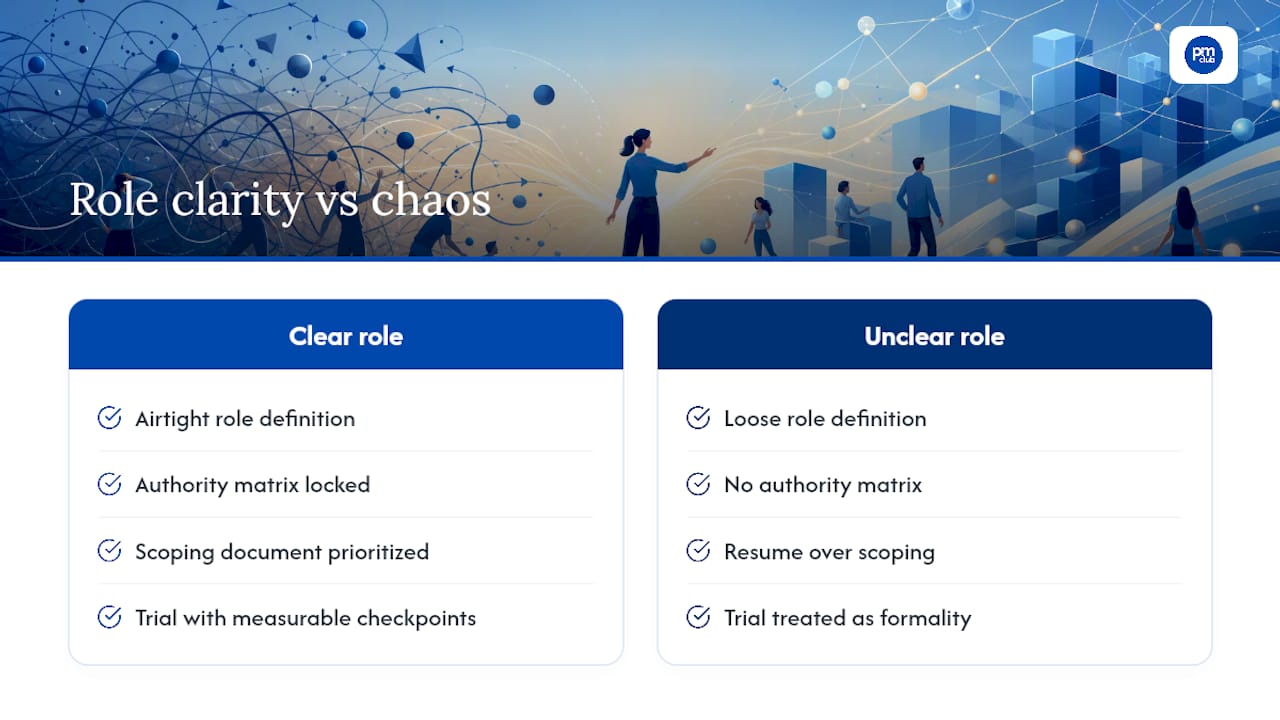
The overrated piece of conventional advice is "just find someone experienced." Experience without a locked-down authority matrix produces exactly the chaos you hired a PM to prevent. What matters more is the boring paperwork: who decides what, how many hours actually get billed, and whether the trial period has real, measurable checkpoints.
If you're a hiring manager, prioritize the scoping document over the resume. If you're a PM building a fractional practice, prioritize proof of outcomes over certifications, though the certifications still open doors. Both sides underestimate how much the first 30 days determine everything that follows. Treat that window as the real audition, not a formality before the "real" work starts.
Where to Find or Become a Fractional Project Manager
If you're hiring, stop scanning generic freelance sites where PM listings sit next to logo design gigs. The Freelance PM Club runs a job board built specifically for project management talent, so the candidates you see already understand scoping, retainers, and delivery ownership instead of needing that explained in a first call.

Membership gives businesses direct access to vetted fractional PMs and gives practitioners a structured path forward: expert-led courses on scoping and client management, personalized career coaching, a template library that shortcuts the onboarding busywork covered earlier, and a community where pricing and positioning questions get real answers instead of guesses. Whether you're writing your first fractional brief or building your fifth client relationship, the resources sit in one place instead of scattered across ten browser tabs. Visit The Freelance PM Club to browse the job board or start a membership today.
Frequently Asked Questions
What is a fractional project manager? A fractional project manager is a senior PM hired part-time or on retainer to own project planning, risk management, and delivery, rather than working full-time for a single employer.
How is a fractional project manager different from a freelance project manager? Freelance implies task-based or project-based work generally; fractional specifically means ongoing, part-time leadership with real decision authority, often structured as a retainer.
How much does a fractional project manager typically cost? Rates vary by seniority and complexity, billed as day rates, monthly retainers, or project fees. Many buyers see meaningful savings compared to a fully loaded full-time PM salary for project-based work.
How long does a typical fractional PM engagement last? Engagements often start with a 30 to 60 day trial, then extend into longer retainers of three to twelve months depending on project scope and ongoing need.
Can a fractional project manager become a full-time hire later? Yes. Many engagements start fractional specifically to test fit before either side commits to a permanent role, and successful trials often convert into either extended retainers or full-time offers.
What certifications should I look for in a fractional PM? A PMP or an agile certification like CSM signals baseline competence, but domain-specific experience in your industry usually matters more for complex engagements.
Sources
- Fractional Project Managers and the PM Role - Project Management Articles, Webinars, Templates and Jobs
- What Is a Fractional Project Manager? Complete Guide
- How to Hire a Project Manager (The Right Way)