

Run discovery calls by asking open, process-first questions, and reserve 11 to 15 of them for live conversation. That range consistently correlates with the highest win rates in call-analysis research, while calls with fewer than six questions tend to underperform. Aim for roughly an 80/20 split between open and closed questions, sequence them situation first and budget last, and push factual questions into a pre-call form so the live 30 minutes goes toward implication and priority. The full question bank and a sample script follow below.
TL;DR:
- Asking 11 to 15 well-selected open questions, especially early in the call, significantly increases win rates compared to fewer or more closed questions.
- Sequencing questions from understanding the current process to exploring pain, goals, decision-making, and budget creates a natural flow that encourages honest answers.
- Listening time should be under 57 percent of the call, and asking more than 15 questions can lead to superficial insights and lower deal success.
- Save detailed stakeholder, decision process, and budget questions for the latter part of the call after establishing rapport and understanding problems.
- Pre-call research and async forms help gather factual information, freeing up live call time for implication and priority questions that require real-time conversation.
Table of Contents
- What Makes a Discovery Question Actually Work
- Six Categories Every Discovery Call Should Cover
- The Discovery Question Bank: 30 Ready-to-Use Questions
- Structuring Your 30 Minutes: When to Ask What
- A Script and Timing Table You Can Paste Into a Meeting Invite
- What to Research Before the Call, and What to Ask Async
- Mistakes That Sink Discovery Calls
- Measuring Whether Your Discovery Calls Are Actually Working
- Adapting These Questions for Freelance Project Managers and Consultants
- The Judgment Call Most Advice Gets Wrong
- Build Discovery Skills That Compound Across Every Client Call
- Where These Numbers Came From
- Sources
What Makes a Discovery Question Actually Work
Most reps think discovery is about coverage. Ask enough questions, check enough boxes, move to the demo. That mindset produces calls that feel like an intake form, and prospects tune out somewhere around question four.
The better model treats discovery as a controlled unfolding. You're not collecting facts, you're helping the buyer articulate a problem they haven't fully named yet. That requires a different ratio of talking to listening, a specific order of operations, and restraint about which questions actually need to happen live.
Open questions do the heavy lifting. HubSpot recommends roughly an 80% open-ended to 20% closed-ended split, and the logic holds up under scrutiny: closed questions confirm what you already suspect, open questions surface what you don't know to ask. "Walk me through how your team handles this today" produces a narrative. "Do you use a CRM?" produces a word.
Sequence beats question quality in isolation. A SPIN-style flow, moving from situation to problem to implication to need-payoff, keeps the conversation from feeling like an interrogation. Jump straight to "what's your budget" before establishing pain, and you'll get a guarded answer or a stall. Earn the right to ask about money by first quantifying what the problem is costing them.
Listening ratio is the tell. Top performers keep their own talk time under half the call, often close to a 43:57 split favoring the prospect. Silence after a question is not dead air to fill. It's the pause where a buyer decides whether to give you the easy answer or the real one.
Question budgeting matters more than most reps realize. A 30-minute call, once you subtract framing, transitions, and next-step logistics, physically allows for about 14 questions. Every minute spent asking something a prospect could have answered in a pre-call form is a minute stolen from implication questions that only work in real-time conversation.
Here's what that means for how you structure the call itself:
- Front-load open, process-first questions before pain questions
- Save budget, procurement, and formal decision-criteria questions for the second half
- Use a follow-up phrase like "tell me more about that" whenever an answer feels thin, since it routinely doubles response length
- Let silence sit for two to three seconds after a big question instead of rushing to fill it
Pro Tip: Replace "what challenges are you facing?" with "walk me through how you handle X today." The first question invites a defensive, rehearsed answer. The second hands the floor back to the buyer and usually surfaces the real process gaps without them feeling interrogated.
Six Categories Every Discovery Call Should Cover
Every strong discovery call touches six territories, whether the rep names them explicitly or not. Missing any one of them is how deals stall in "let me check with my team" purgatory three weeks later.
Current state. What does the workflow look like right now, who touches it, and what tools are already in play? This is your baseline. Skip it and every later question lacks context.
Problem and pain. What triggered this conversation, how often does the problem show up, and what does it actually cost when it happens? Frequency and impact separate a real problem from a mild annoyance someone mentioned once in a meeting.
Goals and future state. What does success look like in concrete terms, and what's personally at stake for the person you're talking to? A VP protecting a budget line has different motivations than a director trying to get promoted.
Decision process and criteria. Who else needs to weigh in, what does the approval chain look like, and how did they evaluate similar purchases before? Mapping this early improves forecast accuracy and keeps you from getting blind sided by a procurement step nobody mentioned.
Budget and timing. Is there funding allocated, or does this need to get built into next year's plan? What's forcing a decision now rather than in six months?
Closing and next steps. Who needs to be in the next meeting, and what does that person need to see to move forward? This category is less about a question and more about securing a specific, calendared commitment.
Here's how those six categories map to the questions you'll actually ask:
- Current state questions establish the baseline workflow and tools already in use
- Problem and pain questions quantify frequency, trigger events, and business impact
- Goals and future state questions uncover both the company outcome and the personal stake
- Decision process questions identify stakeholders, approval gates, and past buying patterns
- Budget and timing questions surface funding reality and the forcing function behind urgency
- Closing questions convert insight into a specific, attended next meeting
Reps who skip the goals category tend to pitch features instead of outcomes. Reps who skip decision process tend to lose deals to a stakeholder they never met. The category that gets skipped most often, though, is closing. Reps ask great questions, get great answers, and then end the call with "I'll follow up by email" instead of a booked meeting with a named second stakeholder attached.
The Discovery Question Bank: 30 Ready-to-Use Questions
Pick nine to fourteen of these for any single call, weighted toward current state and pain early, and decision process and budget later. Treat this as a menu, not a script you read top to bottom.
Current state (ask 2 to 3 live)
- "Walk me through how your team handles this today." This is your best opener. It's open-ended, non-threatening, and produces a narrative you can mine for follow-ups.
- "What tools or systems are involved in that process right now?" Useful for spotting integration risk and incumbent competitors early.
- "Who's involved when this process runs, from start to finish?" Often the first hint at stakeholders you'll need later.
- "How long has it worked this way?" A process that's five years old and unquestioned is a different sales motion than one adopted eight months ago and already creaking.
- "What made you decide to explore something different now?" This single question often reveals the trigger event before you have to ask for one directly.
Problem and pain (ask 2 to 3 live)
- "How often does this issue come up?" Frequency turns a vague complaint into a quantifiable problem.
- "What happens when it does? Walk me through the downstream effect." Follow with "tell me more about that" if the answer feels surface-level. It almost always doubles the detail you get back.
- "What have you already tried to fix this?" Reveals prior investment, sunk cost, and what didn't work, which tells you what to avoid pitching.
- "If nothing changes, what does this cost you over the next year?" This is the quantification question that earns you the right to eventually talk budget.
- "Who else feels this pain besides you?" A great bridge into stakeholder mapping without asking directly about the org chart yet.
Goals and future state (ask 2 live)
- "What does a fixed version of this actually look like six months from now?" Vague answers here are a signal the prospect hasn't thought it through, which is useful diagnostic information on its own.
- "What's the business outcome you're personally accountable for here?" Separates the company's stated goal from the individual's real motivation.
- "If this project goes well, what changes for you personally?" Uncomfortable to ask bluntly, but a softer version of this question surfaces political stakes that predict urgency better than almost anything else.
- "What would make this a clear win in your leadership's eyes?" Gives you the language to use later when building a business case.
Decision process and criteria (ask 2 to 3 live, later in the call)
- "Who else needs to be involved in a decision like this?" Salesforce's guidance is direct here: map this early, not after a proposal is already on the table.
- "How did your team evaluate the last purchase like this?" Past process predicts future process almost every time.
- "What criteria matter most when comparing options?" Get this explicitly rather than guessing, so you know what to emphasize.
- "Is there a procurement or legal step we should plan for?" Asking this early prevents a surprise six-week delay after verbal agreement.
Budget and timing (ask 1 to 2 live, only after pain is quantified)
- "Is there budget already allocated, or would this need to get built into a future plan?" Direct but fair once you've already quantified cost of inaction.
- "What's driving the timing on this, specifically?" Distinguishes a real deadline from a soft "sometime this year."
- "What happens if this doesn't get solved by that date?" Tests whether the timeline is real or aspirational.
Closing and next steps (always ask, every call)
- "Based on what we've covered, does this feel worth a deeper look?" A direct check for buy-in before you propose a next step.
- "Who else should be in the next conversation?" Converts a vague "I'll talk to my team" into a named, invited person.
- "What would you need to see in our next meeting to feel confident moving forward?" Sets a clear agenda for the follow-up and surfaces any remaining objections.
- "Can we grab time on the calendar now, before we hang up?" Booking live beats "I'll send a link" nearly every time.
Pro Tip: The remaining questions in a full 40-question checklist, things like company size, tech stack details, and existing vendor names, belong in a pre-call form, not on the live call. Save your limited live minutes for questions a form can't answer: implication, priority, and political risk.
The five extra slots beyond these 25 depend on your specific product and industry: compliance requirements, integration needs, or team size thresholds that change your pricing tier. Build those into your own version of this bank, but keep the same discipline: current state and pain early, decision process and budget only after trust is established.
Structuring Your 30 Minutes: When to Ask What
Sequencing isn't just about which questions come first. It's about protecting the minutes where a prospect is most willing to be honest, and not wasting them on things you could learn another way.
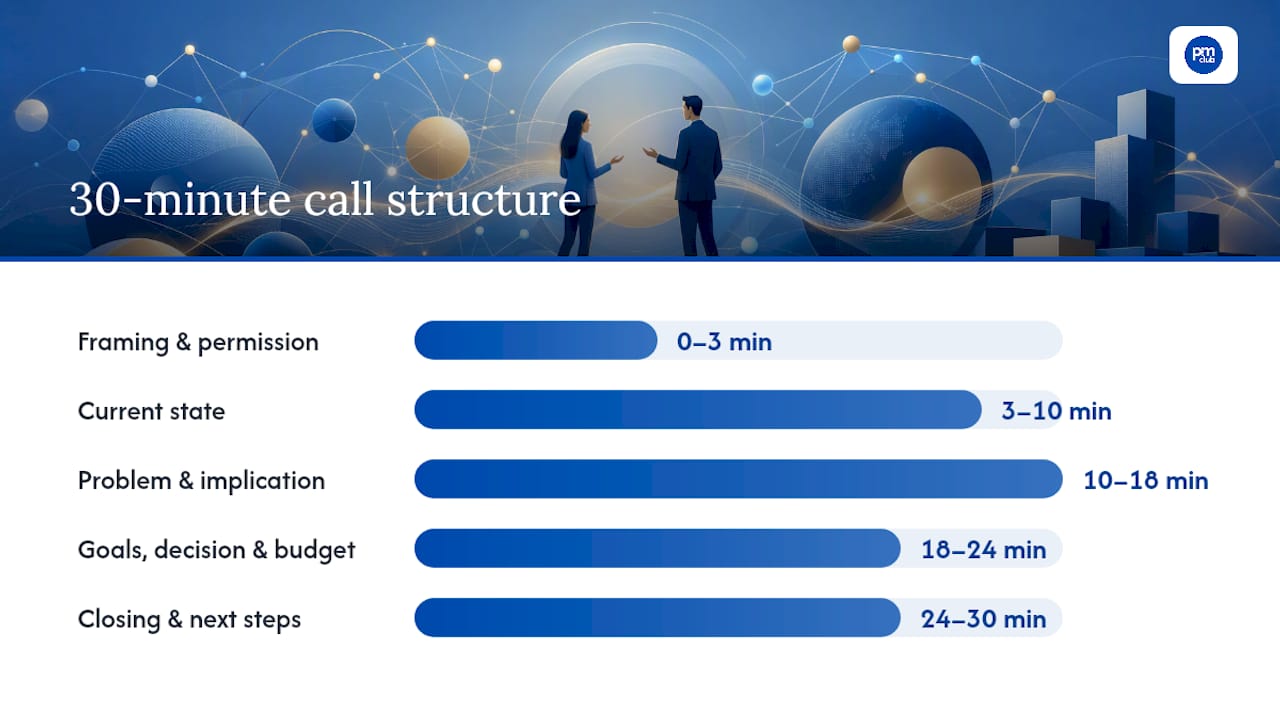
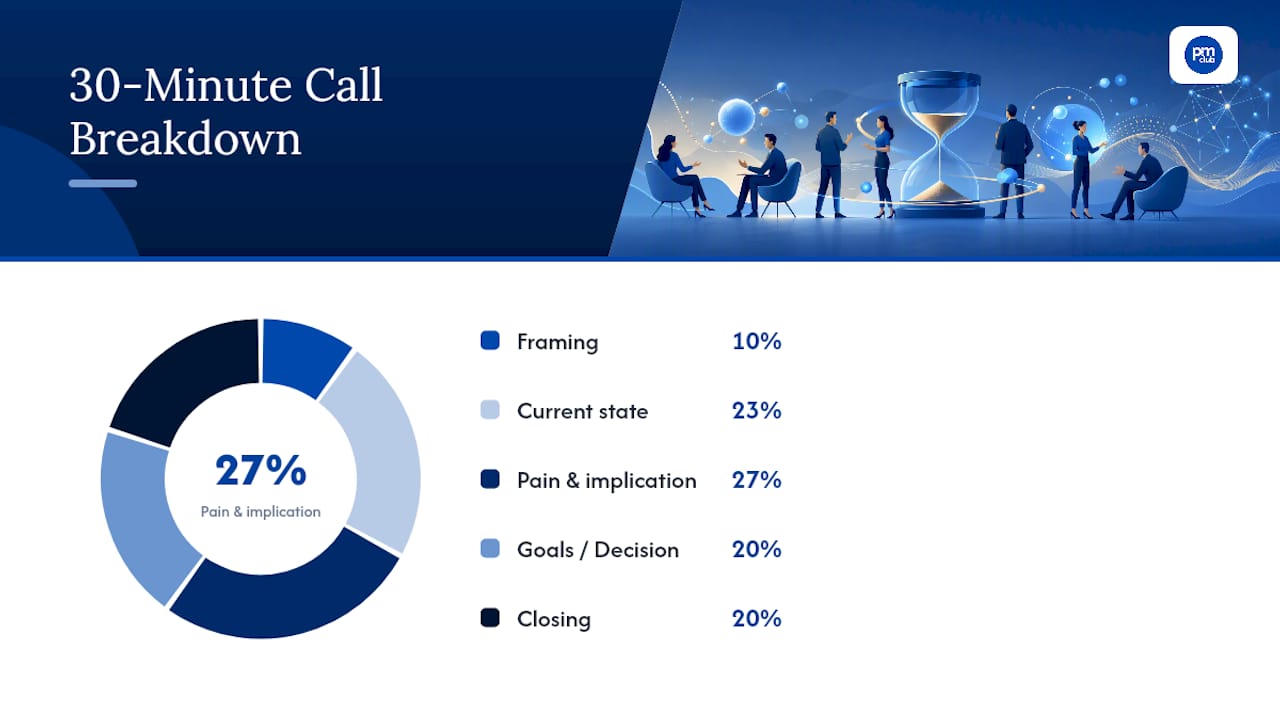
A 30-minute call breaks cleanly into five blocks:
- Minutes 0 to 3: Framing and permission. Set the agenda, confirm time, and get explicit buy-in to ask direct questions.
- Minutes 3 to 10: Current state questions. Low-stakes, easy to answer, builds rapport while you gather context.
- Minutes 10 to 18: Problem, pain, and implication questions. This is where the real diagnostic work happens, and where silence after a big question pays off most.
- Minutes 18 to 24: Goals, decision process, and budget. Save these for after pain is established, because a prospect who has just quantified their own cost of inaction is far more forthcoming about money and stakeholders.
- Minutes 24 to 30: Closing and next steps. Lock the calendar before the call ends.
The reason budget and decision-process questions belong later isn't etiquette. It's leverage. A SalesTap analysis makes the case that top reps deliberately delay these questions until they've quantified cost of inaction and identified who else is affected. Ask about budget in minute two and you're guessing in the dark. Ask it in minute twenty, right after the prospect just told you the problem costs them real money every month, and the question lands as a natural next step rather than an interrogation.
Follow-ups should layer, not restart. If a prospect gives a thin answer to a pain question, don't jump to the next item on your list. Stay one more beat: "Tell me more about that," then pause. That single follow-up phrase does more to surface hidden detail than three new questions would.
A Script and Timing Table You Can Paste Into a Meeting Invite
Here's a runnable structure for a 30-minute call, plus the exact lines to open and transition with.
Opener (sets agenda and gets permission): "Thanks for making time. Here's what I'd like to cover in the next 30 minutes: I want to understand how things work today, what's driving the change, and figure out together whether this is worth exploring further. Sound good? I'll probably ask some direct questions, feel free to push back if anything feels off-base."
Transition from current state to pain: "That's helpful context. Now, when that process breaks down, what does that actually look like day-to-day?"
Transition from pain to decision process: "Given what this is costing you, who else in the organization would need to weigh in before you could move forward?"
| Minutes | Focus | Sample line |
|---|---|---|
| 0 to 3 | Framing | "What would make this call valuable for you?" |
| 3 to 10 | Current state | "Walk me through how this works today." |
| 10 to 18 | Pain and implication | "What happens downstream when this issue hits?" |
| 18 to 24 | Goals, decision, budget | "Who else needs to be part of this decision?" |
| 24 to 30 | Closing | "Can we get the next meeting on the calendar now?" |
Copy this table into a calendar invite template and you've got a repeatable structure any rep on the team can run without memorizing 30 questions cold.
What to Research Before the Call, and What to Ask Async
The best discovery calls start before the call. Spend ten minutes checking recent company news, leadership changes, and any public signals of a trigger event, funding rounds, new hires in relevant roles, or a competitor's recent move are the easiest wins here.
Then send a short pre-call form instead of relying on the live 30 minutes to gather facts:
- Company size and team structure relevant to the problem area
- Current tools and systems in use
- Rough timeline for solving this problem
- Names and roles of anyone else likely to be involved
- Any prior attempts to solve this internally
Async conversation gets higher completion rates than a generic contact form because it feels like a natural continuation of the outreach, not a gate. Of a full 40-question checklist, roughly 31 can be answered this way, leaving about nine genuinely live questions, the ones about implication, priority, and internal politics, for the call itself. If you're mapping how a prospect currently handles client-facing reporting or delivery expectations, a structured reporting workflow guide can help you frame those async questions more precisely.
Mistakes That Sink Discovery Calls
The same handful of errors show up on almost every underperforming call, and most of them are fixable mid-conversation if you catch them fast enough.
- Talking more than the prospect, usually because silence after a question feels uncomfortable so the rep fills it
- Asking about budget or contract terms before pain has been quantified, which reads as presumptuous
- Skipping stakeholder mapping entirely and finding out about a blocker three weeks into the deal
- Accepting a vague answer without a follow-up, leaving real problems undiscovered
- Ending the call with "I'll follow up by email" instead of a booked next meeting
Red flags worth watching for: a prospect who can't name a specific trigger event, one who deflects every budget question with "that's not my department," or one who won't commit to a next meeting on the spot. Any of these suggests the deal isn't real yet, not that your questions were wrong.
Pro Tip: If a call is going flat, one line resets it fast: "Can I ask a slightly more direct question?" It signals a shift in gear, gets permission, and almost always produces a more honest answer than whatever came before it.
Measuring Whether Your Discovery Calls Are Actually Working
Track four numbers, and review one recorded call per rep each week against them.
- Talk-to-listen ratio: aim for the rep talking less than half the time, closer to the 43:57 split that top performers hit
- Questions asked per call: the 11 to 15 range correlates with the strongest win rates
- Next-step conversion rate: what percentage of calls end with a booked, attended follow-up rather than an email promise
- Decision-process mapping rate: how often the rep identifies all relevant stakeholders before the proposal stage
Score one call per rep weekly against these four benchmarks. A rep consistently over 15 questions or under 40% listen time isn't running discovery, they're running an interview, and that gap shows up in win rates before it shows up in a coaching conversation.
Adapting These Questions for Freelance Project Managers and Consultants
Discovery works differently when you're the one being hired to run the project, not sell a product. The questions that matter most shift toward scope clarity: "What does done look like for this engagement?" and "Who has final sign-off on deliverables?" reveal more about client fit than any pain-point question borrowed from a SaaS sales script.
Freelance PMs also need to probe delivery expectations early. "How involved do you expect to be week to week?" and "What's happened with past consultants or contractors on similar work?" surface scope creep risks and communication mismatches before a contract gets signed.
Discovery templates specifically for this context, alongside coaching and role-play sessions where independent PMs practice these exact conversations before they matter, can help shrink ramp time on new client relationships. Ramp time on a new client relationship shrinks considerably when the scoping questions are already sharp.
The Judgment Call Most Advice Gets Wrong
Most sales content treats discovery questions as a checklist problem: ask enough of the right ones and the deal takes care of itself. That's backwards. The rep who asks 20 competent questions in a flat monotone will lose to the rep who asks 12 sharp ones and knows when to shut up.
The conventional wisdom oversells question count and undersells sequencing. A perfectly good pain question, asked before rapport exists, produces a guarded non-answer. The same question, asked ten minutes later after the prospect has already described their process out loud, produces the real story. Order does more work than most training programs admit.
If you take one thing from this, prioritize the listening ratio over the question list. Reps obsess over finding the perfect 15 questions, then talk over half the call anyway and never find out. Fix the ratio first. The right questions matter less than most people think, if you can't stop talking long enough to hear the answer.
— Ashanti
Build Discovery Skills That Compound Across Every Client Call
Reading a question bank gets you through one call. Building the habit that makes every call sharper takes practice, feedback, and someone telling you honestly when you talked too much. That's the gap between a checklist and an actual skill, and it's the gap The Freelance PM Club is built to close for independent project managers and consultants.

Membership may include discovery templates for scoping consulting engagements, career coaching that reviews call recordings, and a community where freelance PMs provide direct feedback on calls. Role-play sessions can help practice handling challenging questions like those about budget and decision process before real client conversations.
If discovery calls are where your pipeline stalls, start with the membership landing page and see which coaching track fits your current client mix.
Where These Numbers Came From
The question ratios, sequencing logic, and benchmarks in this piece pull from a handful of sources worth reading in full if you want to go deeper.
- HubSpot's discovery call questions guide covers the 80/20 open-to-closed ratio and process-first phrasing
- Sendspark's breakdown of 30 B2B discovery questions explains the 11 to 15 question benchmark and the "tell me more" follow-up
- Perspective AI's guide to 40 qualifying questions lays out the async versus live question split
- Salesforce's explainer on discovery calls covers decision-process mapping and sample scripts