

Content marketing for consultants works when you do less, not more: pick one channel, publish one substantive piece a week, distribute it personally to the 15 to 25 people who could actually hire you, and end every piece with a low-friction way to start a conversation. That's the whole system. Everything else, hot takes, viral hooks, posting five times a day, is noise that burns hours you could spend on billable work.
Here's your first week, in order:
- Pick one channel. LinkedIn if your buyers are corporate; a newsletter if you sell to founders or operators who read email.
- Build your list of 25. Name real companies, real titles, and the specific problem each one has right now.
- Draft one long-form piece. 800 to 1,200 words on a problem you've solved more than once, written from an actual opinion, not a listicle.
Set your expectations accordingly. This is not a 30-day tactic. It's a 6 to 12 month compounding asset, and the consultants who quit at month two are the ones who never see the payoff.
Key Takeaways
Consistent, narrow, opinionated content converts into paid consulting work far more reliably than broad content aimed at maximum reach.
| Point | Details |
|---|---|
| Pick one channel | Choose LinkedIn or a newsletter based on where your buyers already spend time, and commit before expanding. |
| Publish weekly, not daily | One substantive 800 to 1,200 word piece per week beats scattered shallow posts. |
| Use the what/how rule | Teach the diagnosis and reasoning freely; keep the tailored implementation for paid engagements. |
| Distribute personally | Send each piece to 15 to 25 named prospects with a one-line reason it's relevant to them. |
| Measure discovery calls, not traffic | Track qualified calls booked, proposals citing your content, and self-reported attribution over 6 to 12 months. |
| Use The Freelance PM Club for setup | Its templates, coaching, and community shorten the time it takes to build a working content system. |
Table of Contents
- Why Content Marketing Drives Client Engagements for Consultants
- Core Principles That Make Consultant Content Different
- How to Build a Content Strategy That Actually Produces Clients
- Choosing the One Channel That Actually Compounds
- Turning Readers Into Discovery Calls
- What to Measure and When to Expect Results
- Templates You Can Copy This Week
- How The Freelance PM Club Supports This Playbook
- What Actually Sustains a Content Habit
- Get the Templates and Coaching to Move Faster
- Sources
Why Content Marketing Drives Client Engagements for Consultants
Content marketing raises your visibility with exactly the prospects who are close to a buying decision, and it does something a cold email never can: it lets a stranger evaluate your thinking before they ever talk to you. Constant Contact's guidance for consultants frames this correctly, content builds trust with prospects and converts that trust into client relationships, but only when the content is targeted and consistent.
Most consultants get the math backward. They chase reach, thinking a bigger audience means more clients. It doesn't. You need maybe 200 to 2,000 of the right readers, not 200,000 of the wrong ones. A single VP of Operations who reads your post on inventory forecasting and forwards it to her boss is worth more than 10,000 impressions from people who will never hire anyone.
That reframing changes what you're allowed to publish. The fear every consultant has is: "If I explain my process, why would anyone pay me?" The answer is a rule worth memorizing: give away the what and why, sell the how. Teach a prospect that their churn problem stems from a broken onboarding sequence (the what), and why that specific failure point costs them retention (the why). Keep the exact sequencing, scripts, and implementation, the how, for the engagement.
This works because of a pattern content marketers rarely say out loud:
- People don't hire consultants because they lack information. They hire consultants because they lack time, objectivity, or the confidence to execute alone.
- Explaining your framework doesn't replace you. It proves you have one.
- The StratCommunications playbook makes this explicit: one substantive, original insight per week, sustained for six months, builds more authority than sporadic bursts of high-volume content ever will.
Core Principles That Make Consultant Content Different
Consultant content follows different rules than SaaS or e-commerce content, and treating it like a corporate blog is the fastest way to waste a year. Three principles separate content that produces discovery calls from content that produces nothing.
1. Depth beats volume, every time. A weekly 1,000 word piece built around a real client problem outperforms daily 100 word posts about industry trends. Your buyer isn't scrolling for entertainment. They're vetting whether you understand their specific situation, and shallow content can't demonstrate that.
**2. These accounts are hard for competitors to copy and effectively impossible for AI tools to generate, because they require years spent inside actual client work.
3. Named frameworks build citable authority. Give your method a name. "The Onboarding Audit Framework" gets referenced, bookmarked, and eventually cited by other writers and AI systems in a way that "some tips for better onboarding" never will. Research on consulting-firm content backs this up directly: proprietary frameworks and named methodologies generate more inbound and more speaking invitations than generic posts, because AI and competitors literally cannot replicate content that only exists inside your practice.
Organize your output into three topic buckets so you're never staring at a blank page:
- Opinion pieces — a contrarian or specific stance on how your industry solves a problem.
- Teardown or case content — anonymized breakdowns of a real engagement, what was broken, what you changed, what happened.
- Framework and results content — the named method itself, with a worked example.
Pro Tip: Rotate the three buckets on a fixed schedule, opinion one week, teardown the next, framework the third, so you never fall back on generic "5 tips for X" filler when you're short on time.
How to Build a Content Strategy That Actually Produces Clients
Set goals around booked discovery calls, not traffic. A post that reaches 400 of the right people and books two calls beats a post that reaches 40,000 and books none.
- Define your ICP with specifics. Name the job titles, company sizes, and the exact problem, not "operations leaders" but "VPs of Ops at 50 to 200 person manufacturers struggling with demand forecasting."
- Build a target list of 50 to 500 names. This becomes both your topic radar and your distribution list.
- Pick topics using one filter: buyer problem → your distinctive insight → your named framework → proof it worked.
- Set a cadence you can actually sustain. Most solo consultants can manage roughly 3 hours a week: 2 hours writing, 30 minutes distributing personally, 30 minutes engaging with comments and replies. That budget comes straight from the consultant playbook at ReferralProgramPros, and it's realistic precisely because it doesn't require a content team.
For tools, keep it lean:
- A single document or Notion page for topic ideas and drafts.
- A scheduling tool (Buffer or LinkedIn's native scheduler) to batch distribution.
- A basic spreadsheet CRM to log who engaged and who you followed up with.
Choosing the One Channel That Actually Compounds
Evaluate a channel on three things: does your buyer already spend time there, can you sustain weekly output there without burning out, and do you own the relationship or is a platform sitting between you and your reader.

For most B2B consultants, LinkedIn wins on the first two criteria. Your buyers, VPs, directors, founders, are already scrolling it during work hours, and long-form posts get real reach without needing an existing following. A newsletter wins on the third: you own the list, and no algorithm change can zero out your reach overnight. If your audience skews toward founders and operators who read email closely, a newsletter should probably be your home base with LinkedIn as amplification.
Whichever you choose, repurpose relentlessly instead of writing new material for every format:
- Write one long-form essay (LinkedIn article, newsletter, or blog post).
- Cut it into three or four standalone LinkedIn posts over the following weeks.
- Adapt the core insight into an email to your list.
- Turn the framework into a one-page PDF checklist as a lead magnet.
- Pitch the same idea as a conference or podcast talk.
One piece of thinking, five different surfaces. That's the leverage.
Turning Readers Into Discovery Calls
Publishing is the easy half. Distribution and conversion are where most consultants quietly quit, because it feels uncomfortable to message people directly. Do it anyway.
- Personal distribution. Send your weekly piece personally to a targeted handful of people from your list with a brief customized message explaining its relevance. Generic blasts get ignored; personalized notes get replies.
- Lead magnets that convert. A short diagnostic checklist ("Is Your Onboarding Process Costing You Retention?") outperforms a 40 page ebook nobody finishes.
- A direct CTA path. End pieces with a specific, low-friction ask, a 15-minute call, not "let's connect."
- Track it simply. Even a spreadsheet noting who replied and when moves you from guessing to managing an actual pipeline.
Pro Tip: Gate your PDF checklists and templates behind an email address, but never gate the core insight itself. Ungated ideas earn trust; gated tools capture the people ready to act on it.
What to Measure and When to Expect Results
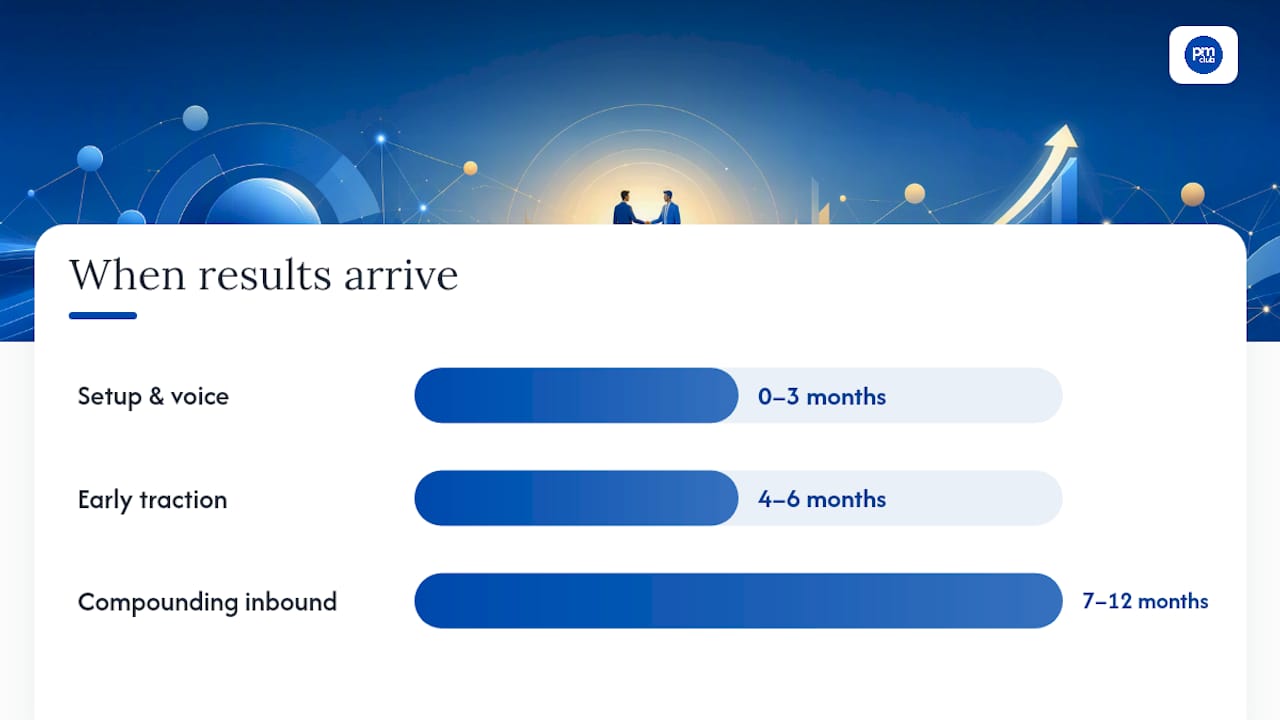
Set your timeline honestly: months 0 to 3 are setup and finding your voice, months 4 to 6 bring early traction, engagement, replies, the first inbound message, and months 7 to 12 are where compounding inbound actually shows up. Consultants who evaluate results at week six almost always quit right before the payoff.
Track these, in priority order:
- Qualified discovery calls booked, the number that matters most.
- Proposals that reference your content, a strong signal the piece is doing real selling work.
- Self-reported attribution, simply asking new leads "how did you hear about us?" on your intake form.
- Secondary signals worth watching but not obsessing over: engagement rate, newsletter open rate, checklist downloads, and speaking invitations.
Keep tracking dead simple. Add a "how did you hear about us" field to your intake form, use basic UTM tags on links you share, and add a "content source" field to whatever CRM or spreadsheet you use for pipeline. Copper's guide to consultant lead generation outlines similar lightweight conversion flows, DMs and email that route straight into a discovery call, without needing a marketing stack.
Templates You Can Copy This Week
You don't need to invent structure from scratch. Three templates cover most of what a consultant needs to publish consistently.
- Case study: Situation (anonymized industry and size) → Problem (specific and quantified) → What we found → What changed → Result. Never name the client without written permission; describe them by sector and scale instead.
- Opinion post: Claim → evidence supporting it → what it means for the reader's business → an invitation to discuss their situation.
- Framework post: Name the framework → break down its components → walk through one worked example.
Once you've written one piece using any template, run it through the repurposing checklist from the channel section: LinkedIn posts, an email, a PDF, a speaking pitch. One draft, five assets.
How The Freelance PM Club Supports This Playbook
Everything above assumes you have time to build systems from zero. The Freelance PM Club shortens that path for freelance consultants and project managers specifically. Its template library covers case study, framework, and outreach formats so you're not starting from a blank page, and its coaching track helps you sharpen the specific ICP and positioning that make content land with the right buyers.
The community layer matters more than it sounds. Getting a framework or case study draft reviewed by other working consultants before you publish it catches the vague spots you can't see in your own writing.
Consultants inside structured peer communities tend to refine their positioning faster because they get direct feedback on drafts instead of guessing what resonates.
, and once available, along with for this playbook's contributors.
What Actually Sustains a Content Habit
Founders should write the first six months of content themselves, even badly. A ghostwriter can't yet know your framework because you haven't fully articulated it. The tradeoff is real: some weeks you'll publish a rougher piece because client work ate your three hours, and that's fine. A consistent B minus beats a perfect piece you never finish.
Hire support once you have 20 or so published pieces and a clear sense of what resonates. Before that, you're not ready to delegate a voice you haven't found yet.
— Ashanti
Get the Templates and Coaching to Move Faster
Most of the friction in this playbook isn't strategic, it's operational. You know what a good case study looks like, but you don't have three hours to build the template from scratch every week. The Freelance PM Club exists for exactly that gap: a resource library built for freelance consultants, not repurposed corporate marketing kits.
Membership gives you the case study, opinion, and framework templates outlined above, ready to fill in rather than build from zero, plus career coaching to sharpen your ICP and positioning before you write a single word. The community adds peer review on drafts, something a solo consultant working alone simply doesn't get, and the job board connects you with businesses actively hiring project management talent while your content pipeline builds in the background. If you want the setup phase of this playbook to take weeks instead of months, start with The Freelance PM Club and get access to the templates, coaching, and community today.
Sources
For deeper grounding beyond this playbook, three sources stand out:
- Content marketing for consultants and solo practitioners — StratCommunications
- Content Marketing Strategy for Consultants | Constant Contact
- Content marketing for consulting firms — Beyond the blog | 100signals
- Content Marketing for Consultants: A Playbook That Wins Clients | ReferralProgramPros
Each covers a different angle, positioning, tactics, and proprietary-content strategy, worth reading in full once you've got your first piece drafted.