

The moment a client escalation lands in your inbox, do this first: pause before responding, capture the facts in writing, and acknowledge receipt within the hour without committing to a fix yet. That sequence buys you the two things every escalation destroys fast: time and clarity. Skip it, and you'll either overpromise in a panicked reply or go silent long enough for the client to assume you're ignoring them. Neither ends well.
Here's your 30 to 60 minute checklist:
- Stop. Don't reply to an angry email in the first five minutes. Read it twice.
- Write down what happened, when, and what the client claims the impact is.
- Send a short acknowledgment: you've seen it, you're looking into it, and you'll follow up by a specific time.
- Propose a 15 to 20-minute call if the issue is complex or emotionally charged.
- Confirm in writing what was discussed and the next step, even after a call.
The rationale is simple: PM communication research shows that leading with situation and impact, then offering options, keeps decision-makers engaged instead of defensive. Reacting instantly, before you know the full picture, does the opposite.
Pro Tip: Ask the client one clarifying question before proposing any solution. "Can you walk me through when you first noticed this?" slows the exchange down and often reveals the real issue isn't the one they led with.
Key Takeaways
Client escalations resolve faster and preserve trust when freelancers triage facts first, verify decision authority early, and document every resolution in writing.
| Point | Details |
|---|---|
| Act within the first hour | Acknowledge receipt and commit to a specific follow-up time before proposing any fix. |
| Name the approver upfront | Get a documented decision-maker in every contract to prevent authority disputes later. |
| Use the five-step workflow | Triage, acknowledge, diagnose, propose options, and confirm agreement in writing. |
| Watch for documentation resistance | Clients who avoid written approvals are a reliable predictor of future scope disputes. |
| Use Thefreelancepmclub's templates | Pre-built escalation scripts and coaching help freelancers respond fast without improvising under pressure. |
Table of Contents
- How Do You Prevent Client Escalations Before They Start?
- What's the Right Way to De-Escalate a Client Conflict?
- What Do You Actually Say During a Tense Client Call?
- Why Does Missing Decision Authority Cause the Worst Escalations?
- How Do You Close Out an Escalation Properly?
- Escalations Are Leadership Moments, Not Failures
- Get Templates and Coaching for Handling Client Escalations
- Frequently Asked Questions
- Sources
How Do You Prevent Client Escalations Before They Start?
Most escalations trace back to something that was never nailed down in week one. Fix that, and you eliminate the majority of fire drills before they ignite. Contra's guidance on handling project crises makes the same point: unclear expectations and scope, not difficult personalities, cause most conflict.
Build these into every proposal and contract:
- Name the approver. Write down exactly who can sign off on budget and scope changes, by title and name.
- Define a change-control process: how a scope change gets requested, priced, and approved in writing.
- Set response SLAs. State how fast you'll respond to non-urgent messages (24 to 48 hours is standard) and what counts as urgent.
- Spell out acceptance criteria for each deliverable so "done" isn't a debate later.
Your kickoff call should cover working norms, not just timelines: which channel for what type of message, how often you'll report status, and what happens if a deadline slips on either side. If a client resists putting an approver's name on paper, that's not a formality they're skipping. It's a signal they may want deniability later. Psychological safety research on project conflict backs this up: teams that define escalation triggers and communication norms early catch problems before they become disputes.
Pro Tip: Add one line to your onboarding email: "Please confirm who has authority to approve scope or budget changes on your side." Send it before the contract is signed, not after.
What's the Right Way to De-Escalate a Client Conflict?
Run this five-step workflow, and most escalations resolve inside a week without damaging the relationship or your margin.
- Triage. Verify the facts against your project notes and contract. Classify severity: does this threaten the timeline, the budget, or your reputation with their stakeholders? A missed Slack reply is not the same tier as a blown launch date.
- Acknowledge. Commit to a specific next step within a timebox, ideally a short live call within 24 hours, or a detailed written response if a call isn't possible.
- Diagnose. Map what actually changed since the original agreement. Who has authority to make the call? What does the contract say about this exact scenario? Structured conflict resolution guidance is clear that most disputes escalate simply because nobody laid out a shared version of events; a documented summary does more to de-escalate than any apology.
- Propose options. Frame it as "yes, and here's what that means" rather than a flat no. Give three paths: fix within current scope, extend timeline, or add budget. Let them choose the trade-off instead of you deciding for them.
- Agree and confirm. Get verbal agreement, then follow up in writing within the hour. No exceptions here, verbal-only agreements are how disputes get relitigated three weeks later.
Escalate further, to a sponsor, legal, or contract enforcement, only when the client's own decision-maker can't or won't resolve it, or when the ask falls outside what your contract covers.
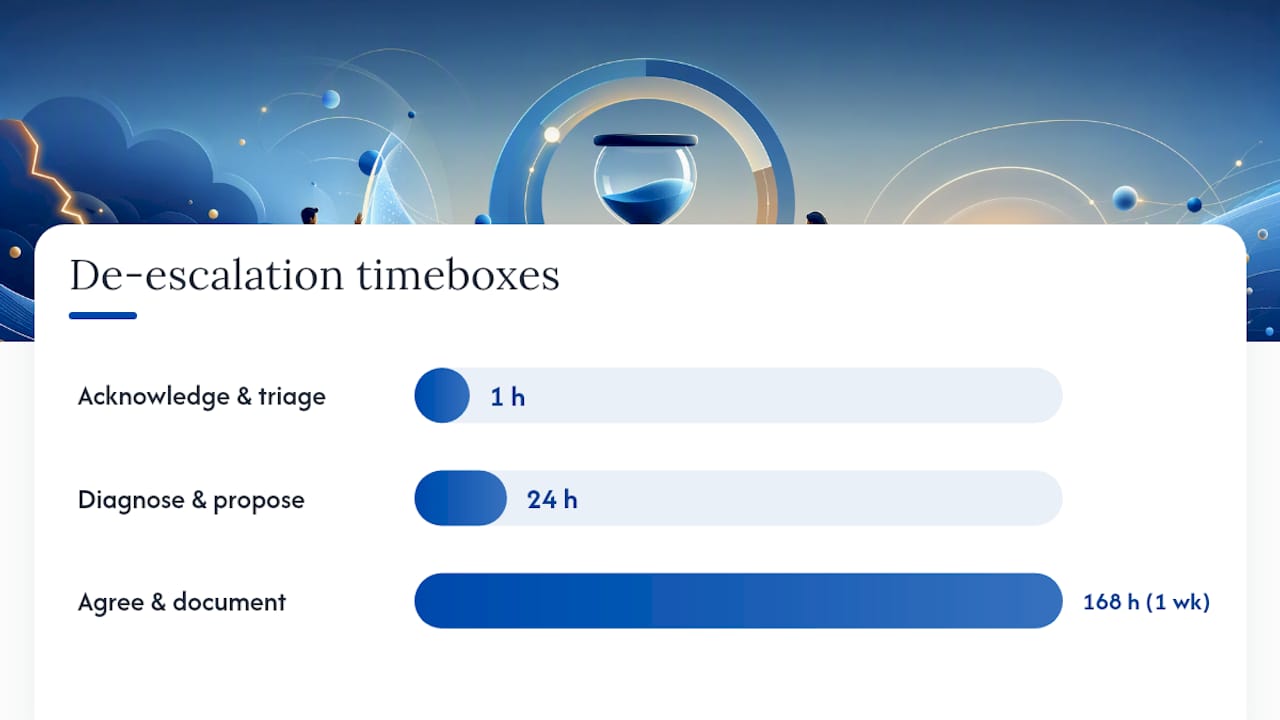
Timebox guidance: in the first hour, acknowledge and triage. In the first 24 hours, diagnose and propose. Within the first week, land on an agreement and document it.
Pro Tip: When a client says "I need this fixed today," respond with "Here's what's possible today, and here's what needs 48 hours to do properly." Speed without honesty about trade-offs just delays the next escalation.
What Do You Actually Say During a Tense Client Call?
The words matter more than most freelancers assume. A defensive opener guarantees a defensive client.
Opening a call: "Thanks for making time. I want to cover three things: what happened, what I found, and two options for moving forward. Does that work for you?" Setting the agenda in the first 60 seconds keeps the conversation from turning into a venting session with no destination.
Email template 1 (acknowledgment): "I've reviewed your message about [issue]. Here's what I know so far: [facts]. I'll have a full assessment and options for you by [specific time]." No apology-heavy language, no defensiveness, just facts and a deadline.
Email template 2 (scope change proposal): "This request falls outside our original scope in [specific way]. Here are two paths: Option A keeps the current timeline and adds [cost]. Option B keeps the current budget and shifts the deadline to [date]. Which works better for your priorities?"
Active-listening scripts: "What I'm hearing is that the delay is less about the deadline and more about how it affects your board update, is that right?" Reflecting the client's concern back to them, rather than just answering it, is a documented negotiation tactic that lowers defensiveness and forces a pause before things escalate further.
Pro Tip: Separate the person from the problem out loud: "I know this is frustrating, and I want to solve the actual issue, not just calm you down." That single sentence often turns a defensive client into a collaborator, because it names what's happening without accusing anyone.
Why Does Missing Decision Authority Cause the Worst Escalations?
Verify who can actually approve changes before you start work, not after a dispute forces the question. Ask directly: "Who signs off if we need to adjust scope or budget?" and get the answer in writing.
Watch for these red flags, they predict recurring disputes more reliably than almost anything else:
- The client avoids naming a single approver, or the "approver" keeps changing.
- Requests come in as informal verbal promises ("just do this, I'll sort the paperwork later").
- Someone repeatedly tries to route around your agreed change-control process.
Practitioner experience across freelance PM circles consistently flags clients who resist documentation as high risk for billing or scope fights down the line. If you spot this, don't confront it directly. Convert it into a process control instead: "To keep things moving fast, let's use a one-line approval email for any scope changes going forward." That's a workflow improvement, not an accusation.
Pro Tip: During onboarding, ask "What happens on your end if this project needs more budget mid-stream?" The answer tells you more about their internal authority structure than any org chart.
How Do You Close Out an Escalation Properly?
An escalation isn't over when the client stops being upset. It's over when it's documented and the lesson is built into your process.
Record these fields for every resolved escalation: the facts, the decision made, who owns each follow-up, the timeline agreed to, and any outstanding items. Then run this closing checklist:
- Confirm the deliverable matches what was agreed, not just what was delivered.
- Update your scope document to reflect any changes made mid-project.
- Reconcile invoicing, credits, or adjusted billing tied to the resolution.
- Get explicit sign-off from the client, even a one-line email confirming it's resolved.
Spend fifteen minutes afterward asking yourself what contract language or onboarding step would have prevented this. That's how one escalation becomes a permanent process fix instead of a story you tell other freelancers.
Pro Tip: Ask the client in your wrap-up message: "Is there anything about how we communicated during this that you'd want done differently next time?" It surfaces friction you might not see and signals you're serious about the relationship.
Escalations Are Leadership Moments, Not Failures
Most freelancers treat an escalation as proof something went wrong. It's actually the moment a client decides whether you're someone who folds under pressure or someone who runs a tight ship. I've watched freelancers lose clients not because they made a mistake, but because they apologized their way through a scope dispute instead of holding the line on what was agreed.
The freelancers who build long-term trust are the ones who stay calm, enforce the boundaries in the contract, and make a clear decision instead of scrambling to please. Effective project managers know that steady, factual judgment protects the project better than emotional appeasement ever does. That's not coldness. That's the job.
Keep your responses factual and your tone level, even when the client's isn't. The escalation ends faster when only one side is running hot.
Get Templates and Coaching for Handling Client Escalations
Writing a scope-change email from scratch at 11 PM while a client is upset is exactly the situation Thefreelancepmclub exists to prevent. Members get pre-built escalation and change-order templates, contract clauses that name decision authority upfront, and access to coaches who've negotiated their way through dozens of these exact conversations.

Membership benefits that apply directly here include a template library for acknowledgment emails and scope-change proposals, one-on-one coaching for negotiating trade-offs with difficult clients, and a community where freelancers share how they actually resolved a specific dispute, not theoretical advice. Faster resolution and stronger contracts come from having the language ready before you need it, not writing it under pressure.
Visit the Freelance PM Club to get the templates and coaching access before your next escalation lands in your inbox.
Frequently Asked Questions
What is client escalation management? Client escalation management is the process freelance project managers use to identify, respond to, and resolve urgent client conflicts, whether they involve scope disputes, missed deadlines, or breakdowns in communication, before they damage the project or the relationship.
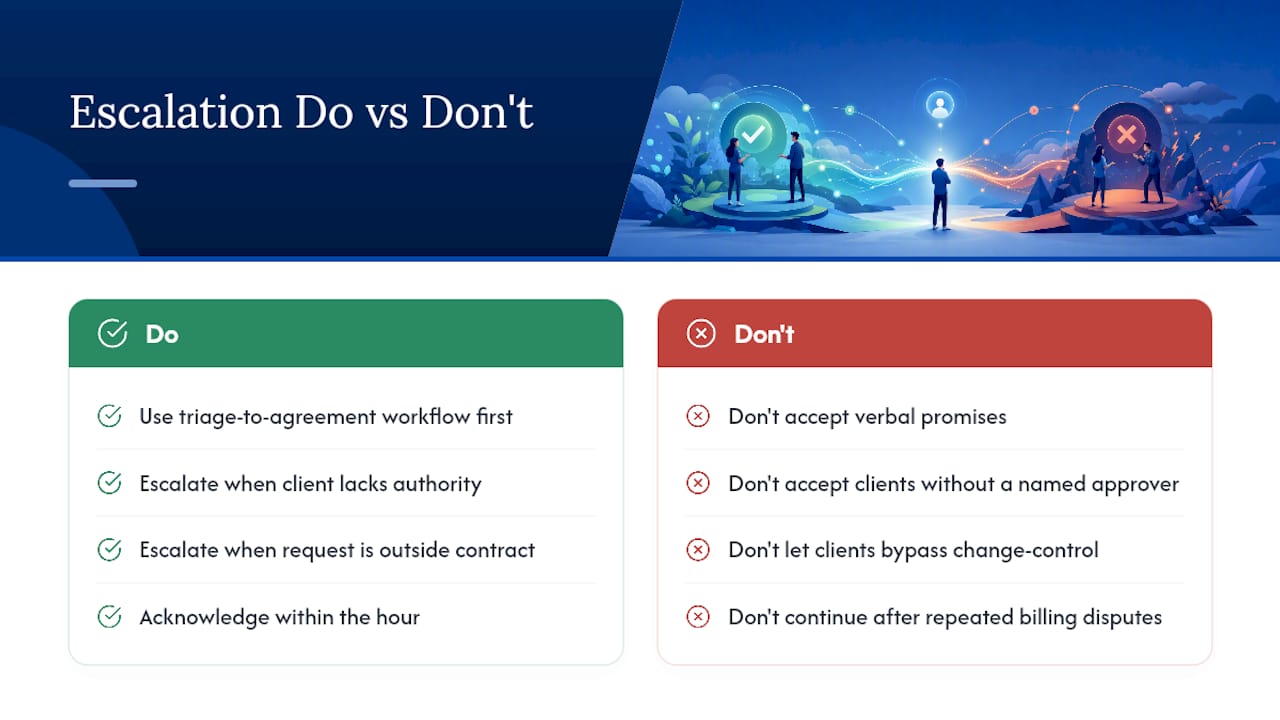
How do you know when to escalate a client complaint internally versus handling it yourself? Escalate to a sponsor or contract enforcement only when the client's own decision-maker lacks authority to resolve it, or the request falls outside what your contract covers. Most issues should be handled directly through the triage to agreement workflow first.
What are the biggest red flags that predict recurring client disputes? A client who avoids naming a single approver, relies on informal verbal promises instead of written approvals, or repeatedly tries to bypass your agreed change-control process is signaling a pattern that will likely repeat.
How do you know when it's time to fire a client? When a client repeatedly resists documentation, ignores agreed change-control processes, or creates the same billing dispute more than once despite clear contract terms, the cost of continuing usually outweighs the revenue.
How long should you wait before responding to an escalated client email? Acknowledge within the hour if possible, and always within the same business day. A fast acknowledgment, even without a full answer yet, is what keeps the situation from escalating further.
Sources
- Conflict Resolution in Project Teams: A Practical Guide | Vact
- How project managers deal with angry clients
- Navigating Project Conflict: Proven Strategies for Successful Outcomes – ITU Online