

A business analyst figures out whether a team is building the right solution. A project manager makes sure that solution gets delivered on time, on budget, and within scope. On larger initiatives, both roles exist side by side, and the friction between them is often a sign the project is being managed correctly.
TL;DR:
- Business analysts focus on ensuring the right problem is being solved, producing requirements documents, process maps, and traceability matrices that guide development.
- Project managers concentrate on delivering solutions on time and within budget, creating project plans, schedules, risk registers, and status reports for sponsors and senior leaders.
- Combining BA and PM roles on small projects is common but increases delivery risks when roles are not clearly separated, especially as project complexity grows.
- Certification preferences differ: BAs typically pursue ECBA, CCBA, or CBAP, while PMs often need PMP or PMI-PBA credentials to demonstrate expertise.
- Industry and company size influence role structure, with regulated sectors emphasizing documentation and formal governance, larger organizations often formalizing both positions, and startups collapsing roles into one.
Table of Contents
- Business Analyst vs Project Manager: What a BA Actually Does
- Business Analyst vs Project Manager: What a PM Actually Does
- Business Analyst vs Project Manager: A Side-By-Side Comparison
- Skills, Tools, and Certifications That Actually Matter
- Salary, Job Outlook, and Realistic Career Paths
- Can One Person Be Both a BA and a PM?
- Which Role Should You Choose?
- Common Misconceptions About BA and PM Roles
- The Challenges Each Role Faces That the Other Doesn't
- How Company Size and Industry Change Both Roles
- Real Scenarios Where BA and PM Roles Collide
- Where These Roles Are Headed
- Notes From the Field: Making BA-PM Partnerships Work
- Build Your Project Management Career With The Freelance PM Club
- Sources
Business Analyst vs Project Manager: What a BA Actually Does
The business analyst's job centers on one question: are we solving the right problem? That focus shapes everything a BA does day to day, from the first stakeholder interview to the final sign-off on requirements.
A typical week involves running requirements elicitation sessions, mapping current and future business processes, and translating vague business needs into acceptance criteria a development team can actually build against. BAs spend a surprising amount of time in workshops, pulling specifics out of stakeholders who often don't know exactly what they want until someone asks the right question. PMI's comparison of the two roles frames this clearly: the BA exists to help the organization reach its business goals, not just to finish a task list.
The paper trail a BA leaves behind is distinct from what a PM produces:
- Business requirements documents (BRDs) that capture the "why" behind a project
- User stories and acceptance criteria that guide development sprints
- Process flow diagrams showing current state versus future state
- Traceability matrices linking requirements to test cases and deliverables
Organizationally, BAs often report into a product or business unit rather than a project management office. On larger programs, the University of Michigan's engineering PM resources note that BA deliverables like the product breakdown and acceptance criteria typically get folded into the project's work breakdown structure, so the PM manages the schedule while the BA protects the integrity of what's actually being built.
Business Analyst vs Project Manager: What a PM Actually Does
The project manager's job centers on a different question: are we building it right, on time, and within budget? Everything a PM touches gets filtered through that lens of schedule, cost, and scope control.
Daily work looks like building and adjusting the project schedule, tracking budget burn, managing a risk register, and running steering committee updates that keep sponsors informed without drowning them in detail. A PM who's doing the job well spends real time on stakeholder governance, meaning they decide who needs to know what, and when, so surprises don't blow up a project in week 40 that should have surfaced in week 4.
Core deliverables from a PM's desk include:
- A project plan defining scope, milestones, and resource assignments
- A detailed schedule, often built in Gantt format
- A risk register that gets reviewed and updated regularly
- Status reports for sponsors and steering committees
PMs usually report to a program manager, a PMO director, or directly to an executive sponsor. That reporting line matters because PMs are accountable for hitting dates and budgets that a sponsor has already committed to, which puts them in a different political position than a BA who answers more to the business side of the house.
Business Analyst vs Project Manager: A Side-By-Side Comparison
| Dimension | Business Analyst | Project Manager |
|---|---|---|
| Primary focus | Is this the right solution? | Is this delivered correctly? |
| Typical deliverables | BRDs, user stories, process maps | Project plan, schedule, risk register |
| Stakeholder focus | End users, product owners, subject matter experts | Sponsors, steering committees, cross-functional leads |
| Skills and tools | Elicitation, modeling, JIRA, Visio, Power BI | Scheduling, budgeting, MS Project, Smartsheet |
| Common certifications | ECBA, CCBA, CBAP | PMP, PMI-PBA |
| Salary/outlook | competitive in specialized industries | competitive, related to program complexity |
The productive tension: BAs push toward the best possible solution; PMs protect the schedule and budget that make delivering any solution possible. Neither instinct is wrong, and the two roles are strongest when the disagreement between them stays visible instead of getting resolved by whichever person has more organizational leverage that week.
The job market backs both paths. The Bureau of Labor Statistics tracks management analyst roles, a category closely related to business analysis work, with growth outlooks that outpace many office occupations, and project management roles show similar strength across industries adopting formal delivery structures.
Skills, Tools, and Certifications That Actually Matter
Hard skills diverge sharply once you look past the shared vocabulary. BAs need requirements elicitation, data modeling, and facilitation skills strong enough to get a room of disagreeing stakeholders to a single agreed scope. PMs need scheduling, budgeting, and risk management skills, plus the political stamina to say no to a sponsor without losing the relationship.
Tool overlap exists but isn't total:
- BAs lean on JIRA, Visio, Excel, and increasingly Power BI for requirements traceability and process visualization
- PMs lean on Microsoft Project, Smartsheet, and Primavera for scheduling and resource leveling
- Both roles live in JIRA and Excel often enough that fluency there is nonnegotiable for either path
Certifications signal different things to hiring managers. The IIBA's certification tiers, ECBA for entry level, CCBA for mid-career, and CBAP for senior practitioners, demonstrate business analysis depth. PMI's PMP signals delivery and governance capability, while PMI-PBA sits deliberately between the two disciplines for people who move across both worlds.
Pro Tip: If you're under two years into your career, start with ECBA or a foundational Agile certification since they require less documented experience. If you've already led delivery on a few projects, PMP will open more doors faster than a BA credential, because it verifies experience you likely already have.
Salary, Job Outlook, and Realistic Career Paths
Pay for both roles tracks closely with industry and seniority rather than title alone. The BLS occupational data for management analysts shows strong long-term demand, and that demand shows up in compensation, particularly for BAs and PMs working in regulated industries like banking and healthcare.
A notable wrinkle: senior BAs in specialized domains can match or exceed PM pay, according to industry salary observations from BBA Institute, especially when their technical depth in a niche (compliance modeling, actuarial systems, clinical workflows) becomes hard to replace.
| Career stage | Business analyst path | Project manager path |
|---|---|---|
| Entry | Junior/associate BA | Project coordinator |
| Mid-career | Senior BA, business systems analyst | PM, senior PM |
| Advanced | Business architect, product owner | Program manager, PMO director |
Both ladders eventually converge toward roles that blend strategy and delivery. Program manager and business architect titles both require comfort with the other discipline's core questions, which is part of why so many practitioners eventually cross over.
Can One Person Be Both a BA and a PM?
On small projects, yes, and it happens constantly. A startup with five people and one initiative rarely has budget for two separate roles, so one person elicits requirements in the morning and updates the schedule in the afternoon.
The risk shows up as projects scale. PMI's research on BA-PM friction found that combining roles increases delivery risk because nobody is left to check the other function's blind spots. A PM under schedule pressure will quietly cut requirements discovery short. A BA left in charge of the budget will keep exploring "one more" stakeholder need past the point it's affordable.
If you're moving between the roles, here's a workable path:
- Build a portfolio showing the other discipline's work products (a project plan if you're BA-to-PM, a requirements document if you're PM-to-BA)
- Shadow someone in the target role on a real project before switching titles
- Pick up a targeted certification (PMI-PBA works well for either direction)
- Ask your current employer for a hybrid assignment on a smaller project first
Employers deciding whether to combine the roles should weigh project size and risk tolerance, not just budget. A $50,000 internal tool can survive one person wearing both hats. A multi-year system migration usually can't.
Which Role Should You Choose?
Start with a gut check: do you get energy from digging into how a process actually works, or from orchestrating dozens of moving pieces toward a fixed date?
If you're drawn to the "why" behind decisions, and you enjoy documentation, modeling, and pulling clarity out of a messy conversation, lean BA. If you're drawn to structure, deadlines, and the satisfaction of a Gantt chart that actually holds, lean PM.
Practical signals worth testing before committing:
- Volunteer to write requirements for a small internal project and see if you enjoy the elicitation process
- Ask to shadow a status meeting or steering committee update and gauge whether the schedule pressure energizes or drains you
- Try ECBA-level coursework or a PMP prep course; the material itself often reveals which mindset fits you better
Whichever path you pick, keep the other discipline's vocabulary sharp. A BA who understands scheduling constraints and a PM who understands requirements traceability both become more valuable, and more promotable, than peers who stay narrowly in their lane.
Common Misconceptions About BA and PM Roles
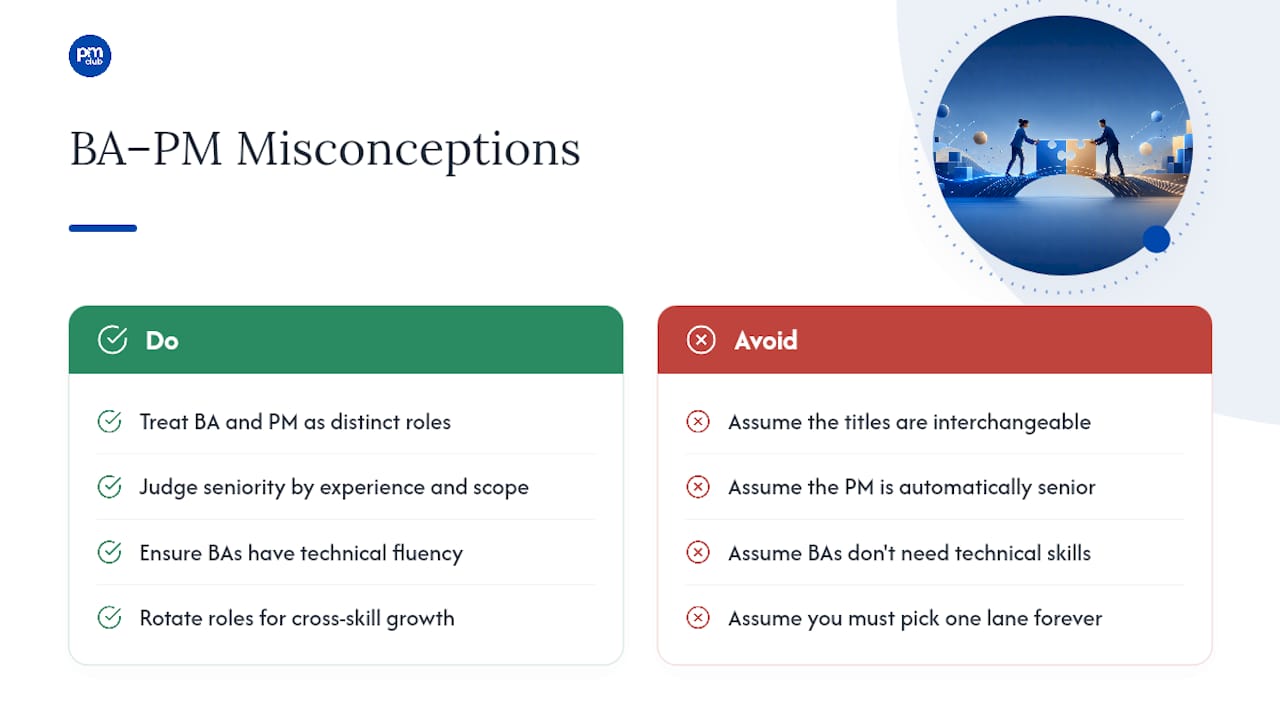
The biggest myth is that these roles are interchangeable job titles for the same work. They're not. A BA who gets handed pure scheduling work will do it poorly, because that's not where their training or instincts live, and the reverse is just as true for PMs asked to run deep requirements elicitation.
Another persistent myth: that the PM is automatically senior to the BA. Reporting lines vary by organization, and in many companies the BA reports to a business unit leader with more organizational weight than the PMO. Seniority is a function of experience and scope, not job title hierarchy.
People also assume BAs don't need technical skills. In software-heavy environments, BAs frequently need to read data models, understand API constraints, and speak enough of the engineering team's language to write requirements that don't get rejected in sprint planning.
There's a related assumption that PMs don't need domain knowledge, just process discipline. That works for generic projects, but PMs running specialized programs (clinical trials, financial system migrations) without domain context tend to miss risks that a domain-fluent BA would catch immediately.
Finally, many early-career professionals believe you have to pick one lane forever. In practice, the most valuable senior hires are usually the ones who spent a few years in each role and can speak both languages fluently when a project stalls because the two functions aren't talking to each other.
The Challenges Each Role Faces That the Other Doesn't
BAs fight a specific kind of frustration: stakeholders who don't know what they want until they see it built wrong. Requirements gathered in week two often need revision in week ten, not because the BA did poor work, but because business needs shift as people see early prototypes and realize their original request was incomplete.
BAs also carry the burden of translation. They sit between technical teams who think in systems and business stakeholders who think in outcomes, and a huge amount of BA effort goes into converting one language into the other without losing accuracy in either direction.
PMs face a different pressure entirely: they're accountable for dates and budgets they often didn't set themselves. A sponsor commits to a launch date before scope is fully understood, and the PM inherits that commitment along with all the risk it carries.
PMs also absorb blame asymmetrically. When a project runs late, the PM usually takes the visible hit even when the delay traces back to requirements churn, vendor delays, or scope creep nobody flagged early enough. That's an uncomfortable feature of the role, not a bug, and it's part of why PM compensation reflects accountability as much as technical skill.
How Company Size and Industry Change Both Roles
At a 20-person startup, the BA and PM functions frequently collapse into one person, or get absorbed entirely into a founder's job description. There's no separate BA title because there's no budget for the distinction, and the "requirements" often live in a shared document nobody formally owns.
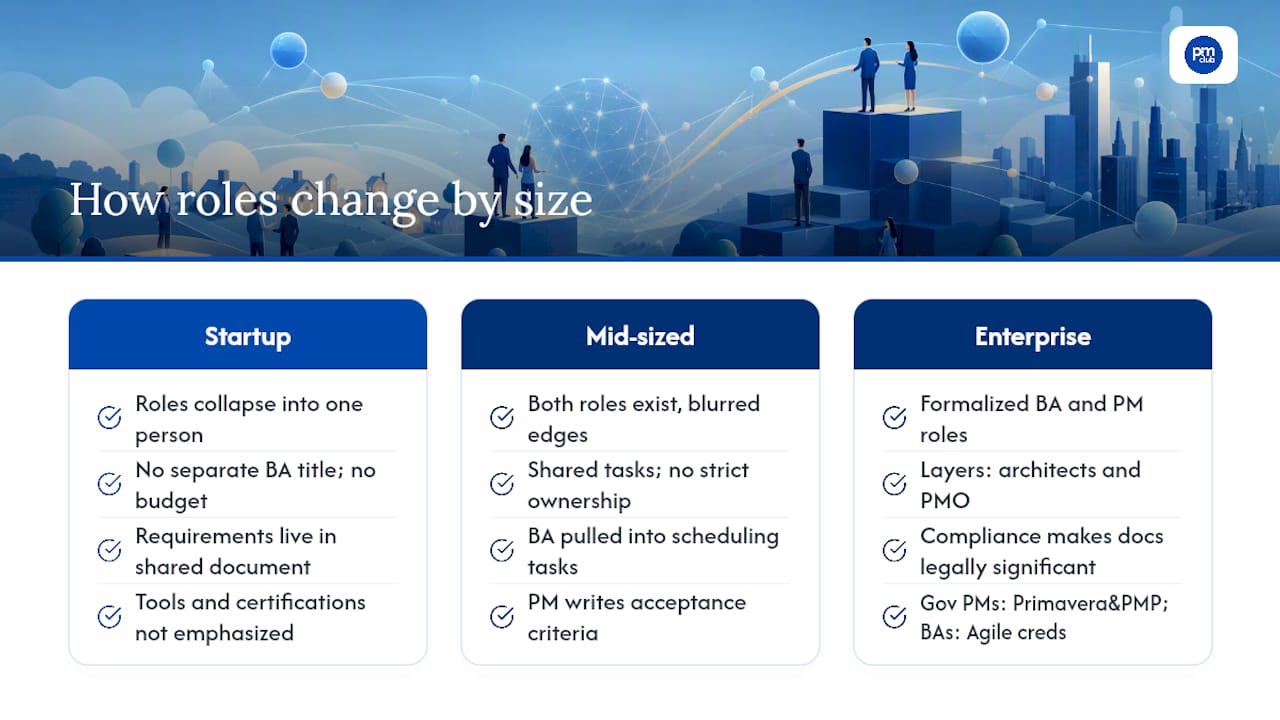
At a mid-sized company, both roles typically exist but with blurred edges. A BA might get pulled into light scheduling work, and a PM might end up writing acceptance criteria because there's no dedicated analyst on a smaller project team.
Enterprise organizations, particularly in banking, insurance, and healthcare, formalize both roles heavily, often layering in business architects and PMO governance structures on top. Regulated industries add compliance requirements that make the BA's documentation trail legally significant, not just operationally useful, which raises the stakes on getting requirements right the first time.
Industry also shapes tool choice and certification value. A government contractor PM will likely need Primavera fluency and PMP certification as a hard requirement, while a BA in a fast-moving tech company might get more value from Agile-specific credentials than from a traditional BABOK certification path.
Real Scenarios Where BA and PM Roles Collide
Consider a mid-sized insurance company migrating to a new claims processing system. The BA spends three months mapping the current claims workflow, interviewing adjusters, and writing requirements for exception handling that the vendor's default system doesn't cover. The PM, meanwhile, is negotiating vendor timelines and tracking a budget that assumed a six-month implementation.
When the BA discovers a regulatory requirement the vendor's software doesn't support, the PM has to decide: push the timeline, find a workaround, or escalate to the steering committee. That's the productive tension in action: the BA protects solution correctness, the PM protects the commitment already made to leadership.
A smaller scenario plays out constantly in startups. A five-person product team building an internal tool has one person, often called a "product manager" informally, doing both jobs. They interview two internal users, write a rough spec, then build a schedule and ship in six weeks. It works because the stakes are low and the feedback loop is fast.
Overlap also shows up in Agile teams where a business analyst functions as the product owner, writing user stories that double as both requirements and schedule inputs. The PM in that setup often becomes more of a Scrum facilitator, managing velocity and blockers rather than a traditional Gantt-chart schedule, which shows how flexible these role boundaries get once a delivery framework changes the vocabulary.
Where These Roles Are Headed
AI tools are already changing the BA's daily grind. Requirements drafting, process mapping, and even first-pass user story generation increasingly get an AI assist, which frees BAs to spend more time on stakeholder facilitation and less on documentation formatting.
PMs are seeing a parallel shift with AI-assisted scheduling and risk forecasting tools that flag budget overruns before they become visible in a status report. That doesn't replace judgment. It compresses the time between a warning sign and a PM's response to it.
Remote and hybrid work has also pushed both roles toward more asynchronous documentation. A BA who used to run in-person workshops now needs to write requirements clearly enough that a distributed team can act on them without a live conversation, and PMs increasingly rely on async status updates rather than daily standups.
The broader trend worth watching: organizations are hiring fewer purely siloed BAs and PMs, and more hybrid titles like "delivery lead" or "product operations manager" that expect fluency in both disciplines. That doesn't erase the distinction between the two core questions each role answers. It just means more professionals need to be conversant in both answers, even if they specialize in one.
Notes From the Field: Making BA-PM Partnerships Work
The BA-PM pairs that work best treat disagreement as information, not conflict. When a BA pushes back on a schedule because requirements aren't stable yet, that's not obstruction, it's the system working as designed.
Small changes reduce friction fast: a shared requirements-to-schedule mapping document, a standing 15-minute weekly sync between just the two roles, and an agreed rule that scope changes get logged the same day they're raised. None of that requires new software, just discipline.
For anyone building PM skills to complement a BA background, or the other way around, The Freelance PM Club offers structured paths worth exploring alongside on-the-job learning.
— Ashanti
Build Your Project Management Career With The Freelance PM Club
If this comparison has you leaning toward the PM path, the harder question isn't which role fits, it's how you actually build the skills and credibility to land the work. The Freelance PM Club exists for exactly that gap between deciding on a career direction and having the portfolio, certifications, and client pipeline to make it real.

Membership gives you expert-led courses covering the scheduling, budgeting, and stakeholder governance skills covered above, plus a template library so you're not building a risk register or status report format from scratch on your first contract. The career coaching component matters most for people transitioning from a BA background, since positioning that shift to clients requires a different pitch than a first-time PM resume. The job board connects you directly with businesses actively looking for freelance PM talent, and the community gives you a place to ask the kind of tactical questions ("how do I structure a fixed-fee scope change clause?") that generic career advice never answers.
Explore membership options at The Freelance PM Club and see which tier matches where you are in the transition.