

Pick your platform by your goal, not by hype: broad career hubs for visibility, referral networks for warm leads, niche communities for credibility, and event platforms for face-to-face trust. For freelance project managers specifically, the strongest path combines a curated professional community with built-in workflow tools, since raw connections mean nothing until you convert them into paid engagements. That is the gap The Freelance PM Club was built to close.
TL;DR:
- Most niche communities and referral networks are more effective than broad career hubs for freelance project managers seeking targeted opportunities.
- Prioritize platforms with a clear goal, enough relevant audience, contact export options, and measurable response signals during initial testing.
- Building a system to capture, enrich, segment, and follow up with contacts within 72 hours boosts conversion from connections to paid work.
- Open, unmoderated groups or paid communities lacking tangible outcomes tend to waste time and do not deliver reliable referral flow.
- The best platform for freelance PMs combines curated opportunities, structured support, and understanding of the specific business model, like The Freelance PM Club.
Table of Contents
- Best Networking Platforms by Type: What Each One Actually Does
- How to Choose Among Top Networking Sites: A 10-Minute Checklist
- Turning Connections Into Paid Work: The Capture-to-Convert Workflow
- Red Flags That Waste Your Time on Networking Apps for Professionals
- What Actually Works: Lessons From Running a PM Community
- Privacy and Security Considerations on Networking Platforms
- Profile Optimization Tips for Better Visibility on Professional Networks
- AI-Driven Matchmaking and Other Trends Reshaping Networking Apps
- An Editorial Take on Choosing Networking Platforms for Freelance Work
- Build Your Network Where Freelance PMs Actually Hire Each Other
- Sources
Best Networking Platforms by Type: What Each One Actually Does
Every platform on the market falls into one of seven functional buckets, and confusing them is the single biggest reason professionals waste months on the wrong one. Choosing among the best networking platforms starts with matching platform type to your actual objective, not chasing whichever app has the most downloads.
Broad career hubs (large general-purpose professional networks) offer reach. They work if your goal is visibility across industries, but the signal-to-noise ratio is often poor for niche skills like freelance project management. Industry estimates put global social network reach near 5.75 billion users by 2026, and that scale is exactly why broad hubs favor volume over precision.
Niche communities trade reach for relevance. A group built around project management, consulting, or a specific certification tends to surface warmer conversations and higher-trust referrals, and platforms like Thinkers360 show how credentialing inside a niche can open advisory work that a broad feed never would.
Referral networks run on structure. BNI, for example, reports more than 355,000 members across 11,100-plus chapters in 76 countries, built around weekly meetings and formal referral tracking. That model suits professionals who want predictable, recurring introductions rather than sporadic ones.
Other categories worth knowing:
- Event platforms (conferences, meetups, industry summits) build trust fast through face-to-face contact, but the payoff depends entirely on your follow-up discipline.
- Personal CRM and contact-capture tools turn scattered business cards and LinkedIn adds into a searchable, taggable pipeline.
- Warm-intro and AI discovery tools mine your existing email and calendar graph to surface referral paths you didn't know you had.
- Newsletters and content channels build authority slowly but compound over time as a lead source.
Career research consistently finds that about 85% of jobs are filled through networking, which is the real argument for treating platform choice as a business decision, not a hobby, as detailed in this Importance of Networking in Marketing overview.
How to Choose Among Top Networking Sites: A 10-Minute Checklist
Stop evaluating platforms on vibes. Run this checklist before you commit time to any new networking tool.
Decision criteria that actually matter:
- Primary goal. Are you hunting for clients, referral partners, mentors, or full-time hiring managers? Each goal points to a different platform type.
- Audience density. Does the platform have enough freelance PMs, consultants, or hiring businesses in your niche, or are you one of three relevant people in a sea of unrelated professionals?
- Integration and export. Can you pull contacts into a CRM, or are you locked into the platform's own messaging silo?
- Time budget. A referral chapter demands a weekly meeting; a newsletter demands consistent writing. Match the commitment to your calendar.
- Early ROI signals. Are people responding, scheduling calls, or just liking posts?
Pro Tip: Before paying for any membership, spend two weeks on the free tier or a guest pass. Track how many real replies you get from outreach versus how many connections you simply collect. If the reply rate stays near zero after ten genuine messages, that platform isn't your audience, regardless of how big it looks.
Turning Connections Into Paid Work: The Capture-to-Convert Workflow
Networking only pays off if you treat it as a pipeline, not a collection hobby. Manual contact capture breaks down fast: many business-card contacts often do not make it into a CRM without automated tools once the pile grows past a few dozen names, and that's when leads quietly die.
Here is a workflow that holds up whether you meet someone at a conference or in a Slack community:
- Capture immediately. Log the contact's name, context, and one specific detail from your conversation within 24 hours, ideally through a mobile scan or a quick CRM entry rather than a stack of cards.
- Enrich the record. Add their company, role, and the specific need they mentioned, so a follow-up message reads as personal, not generic.
- Segment by intent. Separate "potential client," "referral partner," and "peer mentor" into distinct tags or lists, since each needs a different follow-up cadence.
- Outreach within 72 hours. Reference the specific conversation, not a template. Warm-intro tools that map your email and calendar graph can also surface referral paths you'd otherwise miss.
- Follow up on a cadence. A simple three-touch sequence (week one, week four, week twelve) beats sporadic check-ins.
Measure leading indicators, not vanity metrics: response rate, meetings booked, and qualified conversations started. Revenue attribution lags too far behind to guide weekly decisions, since 85% of jobs traced back to networking rarely close on the first conversation.
Red Flags That Waste Your Time on Networking Apps for Professionals
Not every platform that looks active is worth your subscription. Watch for these patterns before you commit:
- Membership fees with no measurable referral flow. If a paid community can't show you recent, specific outcomes from current members, that's a warning sign, not a formality.
- High noise, low moderation. Groups flooded with self-promotion and no active moderation rarely produce quality introductions.
- No export path. If you can't pull your contacts and messages out, you're building someone else's asset, not your own network.
Pro Tip: Ask any paid community directly how members typically get introduced to opportunities. A vague answer usually means the platform sells access, not outcomes.
What Actually Works: Lessons From Running a PM Community
Running a community built specifically for freelance project managers surfaces a pattern fast: the people who land consistent work aren't the ones with the most connections. They're the ones who follow a system.
Members of The Freelance PM Club who move fastest tend to combine three things:
- A curated job board that filters out low-quality listings before they waste anyone's time.
- Career coaching that turns a vague "I want more clients" into a specific outreach plan.
- A community where referrals happen because members already know each other's work style.
The recurring testimonial theme isn't dramatic reinvention. It's clarity: people finally know which conversations to prioritize.
Privacy and Security Considerations on Networking Platforms
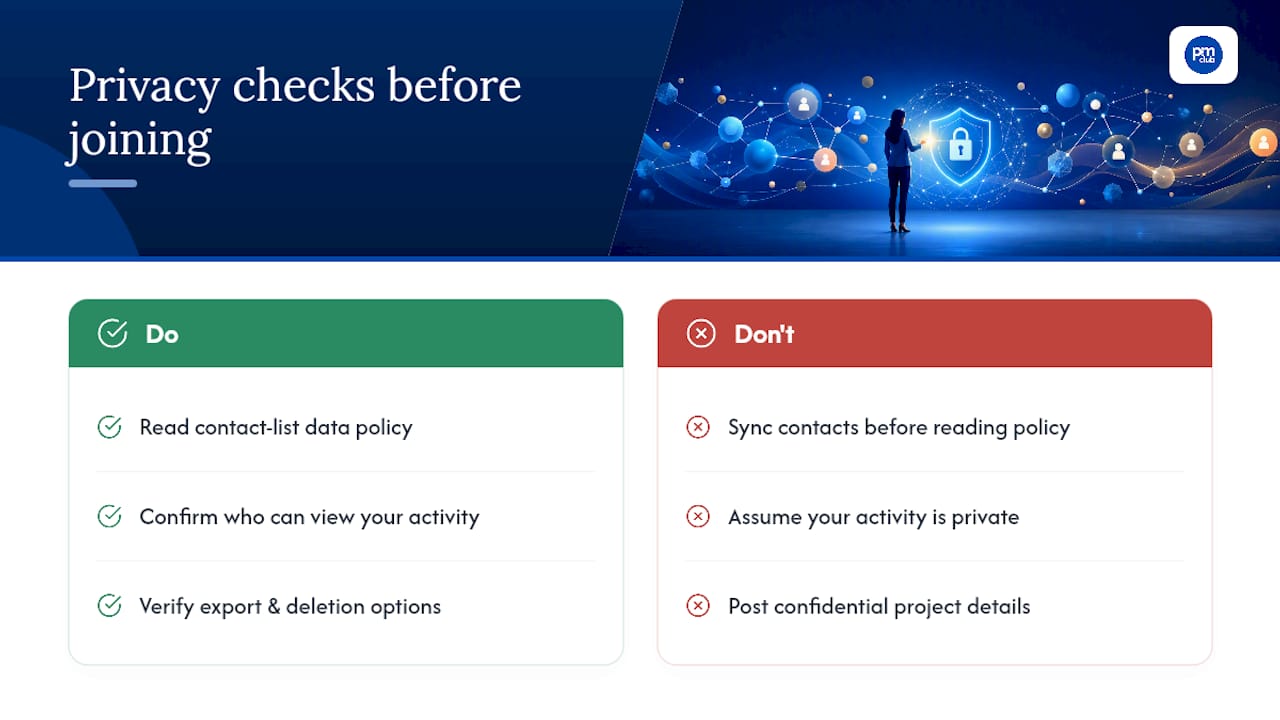
Every contact you add to a platform is data you no longer fully control, and that matters more on networking apps than on most other software because the entire product is built around exposing your identity, employer history, and connections to strangers.
Before joining any platform, check three things. First, what does the platform do with your contact list once you sync your email or calendar? Warm-intro and AI discovery tools are useful precisely because they mine that graph, but mining implies storage, and storage implies a data policy you should actually read. Second, who can see your activity? Broad career hubs often default to public visibility for job changes, connections, and even the content you engage with, which can tip off a current employer that you're building a freelance pipeline before you're ready to announce it. Third, can you delete your data cleanly if you leave? Platforms that make export or deletion difficult are optimizing for their retention numbers, not your control.
Referral networks built around in-person chapters, like BNI's structured model, carry a different risk profile: your business details are shared within a trusted group rather than broadcast publicly, which is part of why that model works for sensitive client conversations. Niche communities sit somewhere in between, often gated by application or invitation, which naturally limits exposure compared to open public networks. The safest default for any freelance PM handling client-sensitive information: assume anything you post is permanent and searchable, and keep confidential project details out of public profiles entirely.
Profile Optimization Tips for Better Visibility on Professional Networks
Your profile is doing sales work while you sleep, and most freelance PMs undersell themselves by writing a resume summary instead of a positioning statement.
Start with the headline. "Project Manager" tells a visitor nothing about who should hire you. "Freelance PM for SaaS companies scaling past 50 employees" tells them exactly why to click. Specificity filters for the right audience instead of trying to appeal to everyone.
Your summary should lead with outcomes, not duties. Instead of listing that you "managed cross-functional teams," state what that management produced: launches shipped on time, budgets held under a specific threshold, or teams brought back from missed deadlines. Recruiters and prospective clients scan for proof of results in the first two sentences or they move on.
Keep your work history focused on freelance and consulting engagements if that's your target market, since a profile heavy with full-time roles can signal to freelance clients that you're not truly independent. Add specific tools and methodologies (Agile, Scrum, specific PM software) because niche communities and referral networks both reward searchable, concrete skills over generic titles.
Finally, keep your profile photo and headline consistent across every platform you use. A referral partner who meets you at an event and later searches for you should recognize your profile instantly, not wonder if they found the right person.
AI-Driven Matchmaking and Other Trends Reshaping Networking Apps
The biggest shift among popular networking platforms right now is the move from passive browsing to active matchmaking. Instead of scrolling a feed hoping to spot a relevant contact, newer tools scan your existing email and calendar history to identify who in your extended network could make a specific introduction, then suggest the ask directly.
This warm-intro discovery approach solves the oldest problem in networking: most valuable connections are two or three degrees away, invisible until someone maps the path. AI tools that mine your existing graph are starting to make that mapping automatic rather than something you piece together by memory.
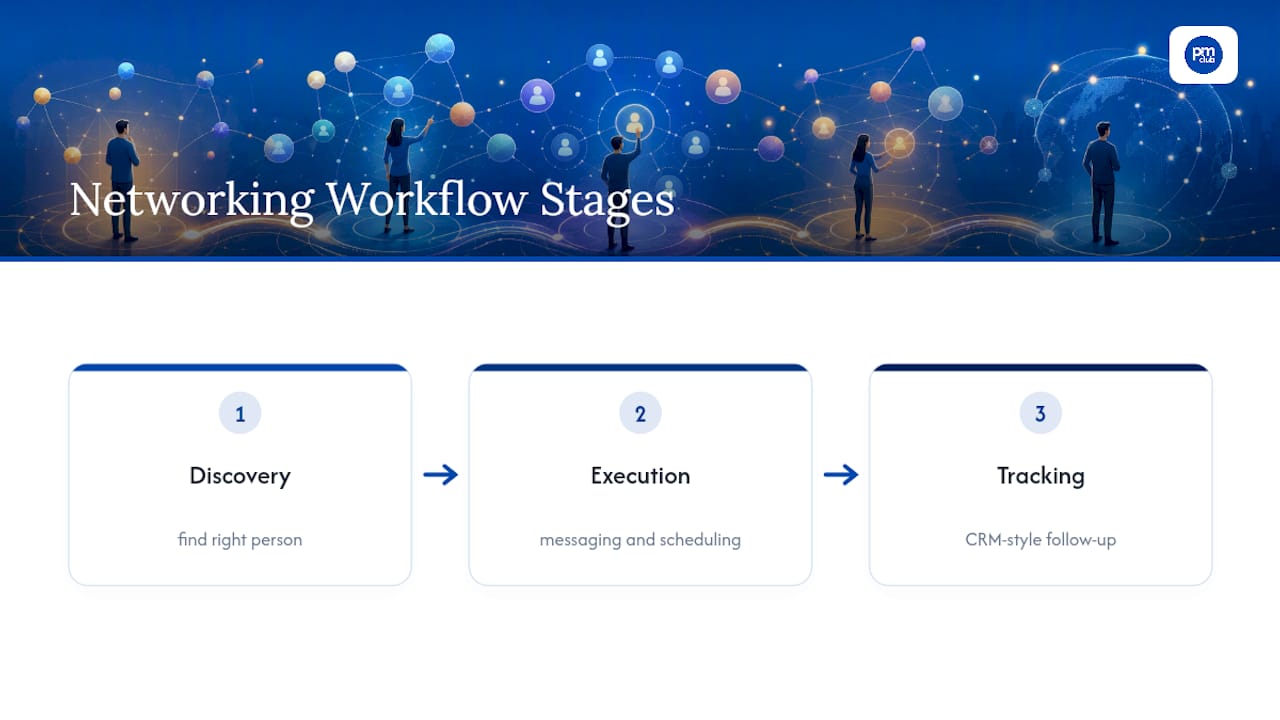
A second trend worth watching is workflow consolidation. Platforms are increasingly bundling discovery (finding the right person), execution (messaging and scheduling), and tracking (CRM-style follow-up) into a single tool rather than forcing professionals to stitch together three separate apps. That consolidation matters most for solo freelancers who don't have an assistant managing their pipeline.
Niche credentialing platforms are also gaining ground as a counterweight to broad, noisy hubs. Expert networks that validate specific expertise are becoming a faster route to advisory and consulting work than broadcasting to a general audience has ever been. For freelance PMs, the practical takeaway is simple: the platforms worth your time in 2026 are the ones that reduce manual busywork, not the ones with the flashiest new feature.
An Editorial Take on Choosing Networking Platforms for Freelance Work
Most networking advice treats platform choice as a popularity contest: join the biggest one, post consistently, hope something lands. That advice ignores what the data actually shows. Referral networks with real structure, like BNI's chapter model, outperform loosely moderated open communities precisely because structure forces follow-through. Freelancers don't need more exposure. They need fewer, better-qualified conversations that actually convert.
The conventional wisdom also underrates the operational side of networking. Collecting contacts isn't the hard part. Building a system to capture, tag, and follow up on them consistently is, and that's the piece most professionals skip because it feels unglamorous compared to attending another event.
If you're a freelance PM, prioritize platforms and communities that already understand your specific business problem, curated opportunities and structured peer support, over generalist networks that treat you like any other job seeker. The best networking platform isn't the one with the most members. It's the one where your specific expertise stops getting lost in the crowd.
— Ashanti
Build Your Network Where Freelance PMs Actually Hire Each Other
Generic professional networks make you compete for attention against every industry imaginable. The Freelance PM Club is built specifically around freelance project managers and consultants, so the people you meet already understand your business model, your rate structure, and the problems you solve.

Members get access to a job board, courses to sharpen specific skills, career coaching, and a template library to support proposal and scoping work. The community functions as a networking space where members can share leads with each other.
If you're tired of broad platforms diluting your best opportunities, explore membership at The Freelance PM Club and see the current job board before your next open week on the calendar.