

Every consultant needs seven documents doing the real work: a proposal that wins the deal, an agreement that protects both sides, a statement of work that defines what "done" means, an invoice that gets you paid on time, a report or presentation that proves the value, a one-page business plan that keeps your pricing sane, and a capability statement that turns strangers into leads. Miss one and something breaks: scope creep, late payments, or a client who never quite understood what they bought.
TL;DR:
- Proposal structures should be tailored to the client's industry, emphasizing outcomes for executives and actionable milestones for technical buyers.
- Keep legal agreements simple and separate the scope of work from the contractual relationship, with clauses for scope, payment, confidentiality, and governing law.
- Regularly update templates based on client feedback, new regulations, and evolving services, reviewing core documents at least twice a year.
- Using standardized templates can shorten sales cycles and streamline scope changes when separate SOWs are used for scope adjustments.
- Maintaining a curated template library with walkthroughs and community input reduces the time spent on document creation and improves proposal clarity.
Table of Contents
- What Makes a Consulting Proposal Template Work
- Consulting Agreement Templates: Clauses That Protect Without Scaring Clients Off
- Building a Statement of Work That Prevents Scope Creep
- Invoice Templates and Payment Terms That Actually Get You Paid
- Client Reports and Presentations That Clients Actually Act On
- The One-Page Business Plan Every Consultant Should Keep Updated
- Capability Statements and Sell Sheets That Turn Visitors Into Leads
- How to Choose, Adapt, and Maintain Templates for Your Practice
- Proof That Curated Templates Change How Consultants Work
- Get Access to a Maintained Consulting Template Library
- What I've Learned Watching Consultants Rebuild the Same Documents
- Sources
What Makes a Consulting Proposal Template Work
A proposal isn't a sales brochure. It's a document that proves you understood the client's problem, laid out a credible way to solve it, and attached a fair price to that solution. Get those three things right and the proposal does most of the persuading before you ever get on another call.
The strongest proposals follow a consistent structure: an executive summary, a clear statement of the client's problem, your proposed approach or methodology, specific deliverables, a timeline with milestones, the investment (fee), your team, a path to acceptance (usually a signature line or e-signature link), and an appendix for anything supplementary, as suggested by HubSpot's consulting proposal template. HubSpot's consulting proposal template breaks the document into exactly these eight sections, which is a useful checklist even if you build your own from scratch.
What changes is emphasis, not structure. A management consultant leads with ROI projections and change management framing. An IT consultant leans on implementation roadmaps and technical milestones. A finance consultant needs room for compliance language and modeling assumptions. Monday shows how the same eight-part skeleton gets reshaped for different specialties, and that reshaping is the difference between a template that feels generic and one that feels written for the client sitting across from you.
- Send a PDF for the final version but keep an editable source file for fast iteration
- Attach one relevant case study or work sample as an appendix, not three
- Keep the executive summary concise. If the client only reads that, it should still sell the deal
- Match your proposal's technical depth to who's reading it: a C-suite buyer wants outcomes, a technical buyer wants a schedule
Design platforms like Canva's consulting proposal templates offer pre-branded layouts that speed up formatting without making the document look like everyone else's.
Pro Tip: Write the executive summary last, after you've drafted the full proposal. You'll write a sharper summary once you know exactly what you're summarizing.
Consulting Agreement Templates: Clauses That Protect Without Scaring Clients Off
A consulting agreement has one job: define the relationship clearly enough that nobody has to guess later. That means covering the parties involved, scope of engagement, term (start and end, or renewal terms), fee structure and payment schedule, expense reimbursement, intellectual property ownership, confidentiality, termination conditions, liability limits, and governing law. Governing law matters more than people think. A contract written for a consultant in one country working with a client in another needs to specify which jurisdiction's rules apply if something goes wrong.
Independent consultants often make the mistake of cramming deliverables and legal terms into one document. Experts recommend keeping the SOW separate from the agreement. The agreement covers the relationship; the SOW covers the work. When you need to adjust scope on a project, you generally avoid reopening a signed legal contract to do it. A separate SOW lets you amend deliverables and timelines without touching liability caps or IP clauses.
- Parties, scope, and term (who, what, how long)
- Fees, payment schedule, and expense policy
- IP ownership (who owns the deliverables and the underlying methodology)
- Confidentiality and termination conditions
- Liability caps and governing law
Legalese doesn't make a contract stronger. It makes it harder for a client to trust what they're signing. HubSpot's guidance on proposal language suggests keeping legal terms concise in the main body and attaching standard terms as an appendix, especially for smaller clients who might be intimidated by dense contract language up front.
Consulting agreements that skip a liability cap or governing law clause tend to be the ones that end up in disputes nobody planned for. If your engagement involves proprietary client data, custom-built IP, or work across borders, get an actual attorney to review the template once. After that first review, you can reuse the vetted version for every client and only flag unusual clauses for a second look.
Building a Statement of Work That Prevents Scope Creep
A SOW template exists to answer one question before it becomes a fight: what exactly did we agree to deliver? The strongest SOWs include scope, deliverables paired with specific acceptance criteria, milestones and dates, responsibilities (yours and the client's), assumptions, a change control process, and payment triggers tied to milestones rather than vague dates.
Acceptance criteria are where most SOWs fall apart. "Deliver a marketing strategy" is not acceptance criteria. "Deliver a 15-page marketing strategy document covering channel mix, budget allocation, and a 90-day rollout calendar, approved by the client's marketing director within 5 business days of submission" is. The difference determines whether you get paid on schedule or spend three weeks in revision purgatory.
- List every deliverable as a discrete, checkable item, not a bundled phrase
- Attach a measurable acceptance standard to each deliverable (length, format, approver, review window)
- Break large engagements into phases with their own milestones rather than one end date six months out
- Build in a change control clause: any scope addition requires a written change order and a fee adjustment
- Tie payment triggers to milestone completion, not calendar dates alone
For sprint-based work, timeboxing (two-week sprints with fixed scope) works better than long phases with soft deadlines. For larger transformation projects, phased milestones with formal sign-off at each stage protect you from a client who wants to keep adding "just one more thing" without renegotiating.
Pro Tip: Keep a boilerplate line ready for out-of-scope requests: "This request falls outside the current SOW. We can add it as a change order at [rate] or scope it into a future phase." Having the phrase ready means you won't improvise an answer that sounds like you're negotiating on the spot.
Invoice Templates and Payment Terms That Actually Get You Paid
An invoice needs to answer exactly what was delivered, for how much, and by when it's due. That means clear fields: invoice number, issue date, due date, your business details, the client's billing contact, an itemized list of deliverables or hours (labeled specifically, not just "consulting services"), subtotal, any applicable tax, and total due.
Payment terms deserve more thought than most consultants give them. Net 15 is tighter and better for cash flow than the more common Net 30, especially for solo consultants who don't have the reserves to float a slow-paying client for a month. For larger projects, charging a significant deposit upfront, with the balance due at delivery or split across milestones, can protect you from doing the work and chasing payment afterward.
- Label deliverables specifically ("Phase 1 strategy report" not "consulting work")
- Set payment terms in the contract, then repeat them on every invoice
- Require a deposit on new client relationships before work begins
- Send invoices immediately upon milestone completion, not batched at month end
Templates built specifically for consultants, like the options at InvoiceLabs, tend to have these fields pre-formatted so you're not rebuilding the layout every time.
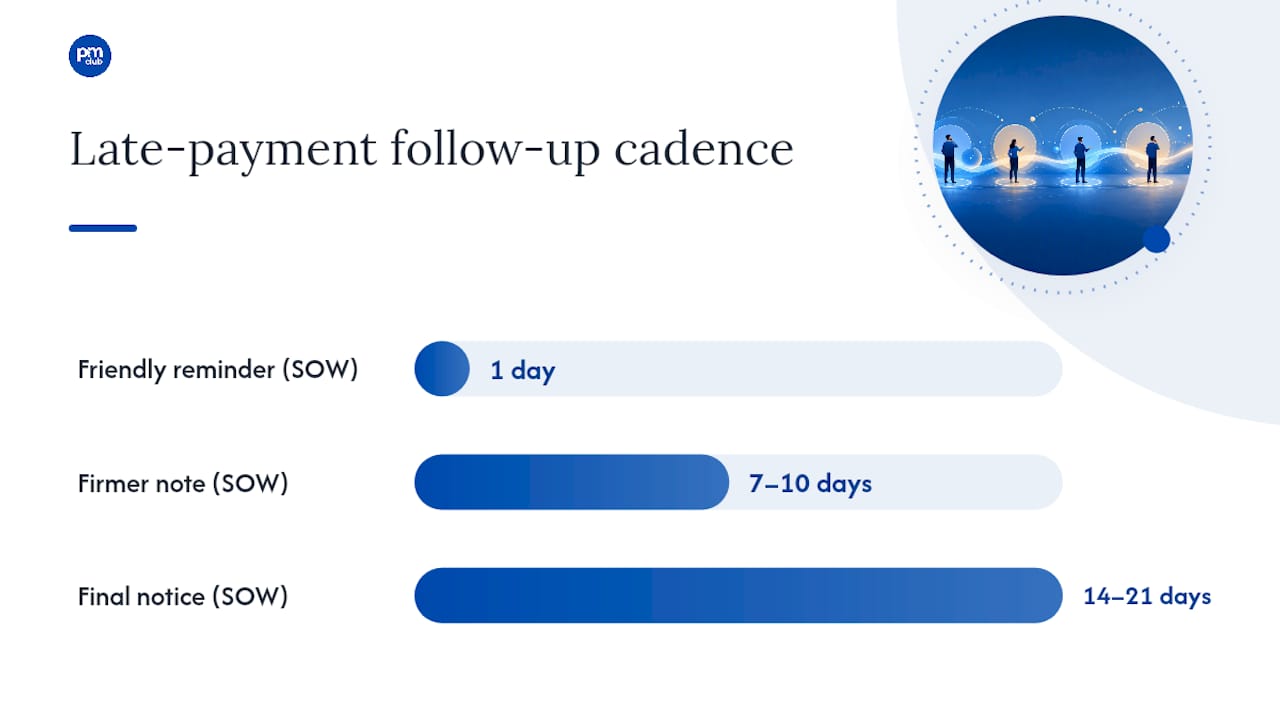
Late payment follow-up works best as a fixed three-step cadence: a friendly reminder the day after the due date, a firmer note at 7 to 10 days past due referencing the payment terms in the signed agreement, and a final notice at 14 to 21 days that states the next step (a late fee, if your contract specifies one, or a pause on active work). Link every invoice back to the SOW and agreement it belongs to. It gives you an audit trail if a client disputes an amount, and it makes bookkeeping at tax time far less painful.
Client Reports and Presentations That Clients Actually Act On
The best consulting decks follow one rule: headline first, evidence second, recommendation third. Every slide should carry a single conclusion in its title, not a topic label. "Revenue Grew 12% After Restructuring" tells a client something. "Q3 Revenue Analysis" tells them nothing until they've read the whole slide.
This structure comes straight out of consulting frameworks like the Pyramid Principle and SCR (Situation, Complication, Resolution), which slide libraries built by former Big 4 and McKinsey consultants use as their backbone. SlideWorks' toolkit collections are built entirely around this logic: one idea per slide, a clear headline, one supporting chart or visual, and nothing else competing for attention.
The templates speed up formatting, but the actual persuasion comes from customization. Use the executive summary and report headlines to show quantified outcomes, and use the supporting slides to show exactly how you measured them. That's what separates a report a client skims from one they act on.
Choose the format based on the audience and use case. A one-time strategic recommendation belongs in a slide deck. An ongoing engagement with recurring metrics belongs in a dashboard the client can check without waiting for you. A detailed technical finding, the kind that needs footnotes and methodology explanations, belongs in a written report, not squeezed onto a slide.
- Every slide title states a conclusion, not a topic
- One supporting visual per slide, labeled with units and time period
- Version control every draft (v1, v2, final) so nobody presents an outdated number
- State your assumptions on a dedicated slide before showing results, so nobody mistakes an estimate for fact
Data hygiene matters more than design polish. A client who catches one mislabeled chart will start questioning every number in the deck, even the correct ones.
The One-Page Business Plan Every Consultant Should Keep Updated
A one-page plan isn't a formality. It's the document that keeps your pricing and your proposals aligned instead of drifting apart engagement by engagement. The format stays deliberately short: your value proposition, your target client profile, your core service offers, your pricing model, three KPIs you're tracking (revenue per client, close rate, average project size, whatever matters most to your practice), and your next three action steps.
Consulting toolkit bundles commonly recommend keeping this document to one to three pages precisely because a longer plan tends to sit unread. HubSpot's consulting template collection treats the short-form business plan as a working document you revisit quarterly, not a one-time exercise you file away.
- Write your value proposition as one sentence a client would actually say back to you
- Define your target client tightly enough that you can name three companies who fit
- List your core offers with a price range for each, not just "custom pricing"
- Set three KPIs you'll check monthly and adjust your approach if they slip
- Note your next three actions: a marketing push, a pricing test, a niche pivot
The plan should shape your proposal scopes directly. If your KPI shows your average project size is shrinking, that's a signal to either raise your minimum engagement size in new proposals or bundle smaller offers into a package. Include a simple financial assumption too, something like expected close rate on proposals sent, so your pricing reflects reality instead of optimism. Once your practice adds employees, subcontractors, or multiple service lines, it's worth expanding this into a full business plan with financial projections and a formal marketing strategy.
Capability Statements and Sell Sheets That Turn Visitors Into Leads
A capability statement is the document (or homepage section) that answers a prospect's first question before they ever talk to you: can this person actually solve my problem? It needs a clear value proposition stated in the first line, a short list of the outcomes you deliver (not just the services you offer), your core service list, two or three proof points (a case bullet, a metric, a client type you've worked with), and a direct call to action.
The strongest capability statements borrow language straight from your proposal template. If your proposals consistently emphasize ROI and implementation speed, your homepage and one-pager should use the exact same framing. Consistency here does real work: a prospect who reads your capability statement, then later receives a proposal that sounds like a different person wrote it, starts to wonder which version is the real you.
- Lead with outcomes ("cut onboarding time by half"), not service categories ("project management consulting")
- Keep proof points specific: a metric or named client type beats a vague "years of experience" claim
- Create a downloadable one-page case study as a leave-behind for calls and meetings
- End with one clear call to action, not three competing ones
For consultants who want their online presence to actually rank and convert, basic SEO matters even on a one-page site: a clear title tag describing your specialty, fast load times, and a homepage structure that mirrors how prospects search (by problem, not by your internal service names). Services focused on positioning, like CV Made Better's professional writing help, can be useful if translating your own expertise into client-facing language feels harder than doing the actual consulting work.
How to Choose, Adapt, and Maintain Templates for Your Practice
Grabbing a random template off the internet and filling in the blanks is how you end up with a proposal that reads like it was written for someone else's business. Templates need to match four things: your audience's sophistication, the level of detail your engagements require, the format your clients expect (a formal PDF versus a working Google Doc), and any regulatory requirements specific to your niche. A financial consultant needs compliance language a marketing consultant doesn't. A government contractor needs procurement formatting a startup client won't care about.
The adaptation workflow that actually works follows five steps:
- Audit what you have. Pull every proposal, contract, and report you've sent in the last year and flag the phrases, sections, and structures that consistently worked (client signed quickly, few revision rounds) versus the ones that always triggered questions or delays.
- Localize the language and deliverables. Rewrite generic sections in your niche's actual vocabulary. A RACI matrix or operating model canvas copied straight from a generic template pack often fails because role labels stay vague. Adapting these structural templates to your client's specific governance and stakeholder names during discovery, before you deliver the document, prevents that ambiguity.
- Pilot on a low-risk engagement. Test the new template on a smaller or friendlier client before rolling it out to your whole pipeline. That single pilot surfaces awkward phrasing or missing fields faster than any amount of internal review.
- Collect feedback fast. Ask directly: was anything confusing, missing, or slower to approve than expected? Running an internal dry-run followed by a single-client pilot tests legal clauses, acceptance criteria, and timing before the template becomes your default.
- Version and centralize. Store one master copy per template type, dated and version-numbered, so you're never working from an outdated draft pulled from an old email thread.
Pro Tip: Keep a simple "template change log" alongside each master file, a running note of what you changed and why. Six months later, when you forget why a clause got reworded, that log saves you from reintroducing a problem you already solved.
Before using any new or edited template on a real client, run it through a quick three-part test: fill it out completely for a hypothetical engagement to catch missing fields, have the actual client review a draft version if the relationship allows for that kind of feedback, and run an internal postmortem after the engagement closes to note what worked and what didn't.
Maintenance isn't a one-time task. Review your core templates twice a year at minimum, more often if your niche has fast-moving regulatory or market changes. Update fee structures when your pricing changes, update case studies when you land a new signature client, and retire language that no longer reflects how you actually work. A capability statement referencing a service you stopped offering two years ago tells prospects your marketing isn't as current as your consulting.
- Review core templates on a fixed six-month schedule, not "whenever I remember"
- Update pricing and case study proof points as soon as they change, not at the next review cycle
- Keep one centralized, version-controlled folder so nobody works from an outdated file
- Retire or rewrite any section referencing services, rates, or clients that are no longer current
Proof That Curated Templates Change How Consultants Work
Independent consultants who build every document from a blank page lose hours they could spend on billable work or business development. The template library inside The Freelance PM Club exists specifically to close that gap: proposal, agreement, SOW, invoice, and report templates that members can adapt rather than build from scratch, alongside walkthroughs that explain the reasoning behind each section.
Consultants who adopt a standardized proposal and SOW pairing often report shorter sales cycles, mainly because clients spend less time asking clarifying questions when the deliverables and acceptance criteria are spelled out clearly the first time. One recurring pattern in member feedback: consultants who separate their SOW from their master agreement (exactly as recommended earlier) report faster turnaround on scope changes, since amending a SOW doesn't require reopening a signed contract.
- Direct access to a maintained template library can save time searching for free versions scattered across the internet
- Templates accompanied by walkthroughs explain why each section exists, not just a blank form to fill in
- Coaching sessions may help adapt templates to specific niches and client sizes
- Feedback from other consultants can surface wording and structure issues before a template reaches a client
Case examples shared within the community show a consistent theme: consultants who standardize their document set close deals faster not because the templates are flashy, but because clients spend less time confused about what they're agreeing to.
Get Access to a Maintained Consulting Template Library
Building all seven of these documents from scratch, then keeping them updated as your niche and pricing evolve, takes time most independent consultants would rather spend on client work. That's the exact gap The Freelance PM Club membership fills: a curated templates library covering proposals, agreements, SOWs, invoices, and reports, paired with walkthroughs that explain the reasoning behind each section instead of leaving you to guess.

Membership also gets you career coaching to help adapt those templates to your specific niche, a community of working consultants who can flag wording issues before they reach a real client, and ongoing updates as best practices shift. That maintenance piece matters more than it sounds. A template you built two years ago and never touched again is quietly costing you deals if your pricing, positioning, or client base has changed since.
If you're rebuilding your document set from scratch right now, the faster move is to check what's already built and vetted. Visit The Freelance PM Club and start with the templates library, then use the coaching sessions to adapt the proposal and SOW pairing to your specific niche before your next pitch.
What I've Learned Watching Consultants Rebuild the Same Documents
The consultants who struggle most aren't missing templates. They're missing a maintenance habit. A proposal template written two years ago, before a pricing change or a pivot into a new niche, quietly loses deals nobody notices losing.
Set a plain six-month check-in: pull your last five engagements, ask what confused clients, and edit accordingly. That feedback loop matters more than any template's original design.
— Ashanti