

Yes — experienced project managers can freelance for agencies, and the fastest path in is positioning yourself as an embedded or fractional PM who plugs into an existing toolset on day one. Start by naming a specialty (digital delivery, creative production, PMO overflow), building a 30-second pitch around it, and applying to messy middle projects agencies can't staff internally. Agencies aren't hiring a freelancer; they're buying lower onboarding risk and reliable milestone delivery.
TL;DR:
- Freelance project managers should position themselves as embedded or fractional leads with specific outcomes, targeting messy middle projects agencies can't staff internally.
- Building a clear, outcome-oriented pitch with a focus on a niche, measurable results, and ready-to-send scope templates improves chances of immediate engagement.
- The most common agency freelance roles include digital project managers, creative or production leads, fractional delivery heads, and interim PMO support, all requiring quick tool onboarding and milestone ownership.
- Rates typically range from $40 to $65 per hour for remote work, with fixed or retainer models justified by value, capacity gap closure, and risk reduction rather than hours worked.
- Effective management involves rapid onboarding, clear scope and change documentation, disciplined capacity limits, and leveraging AI to boost productivity without replacing judgment.
Table of Contents
- Who Hires Freelance Agency Project Managers?
- How Should You Position Your Freelance PM Offer?
- Where Do You Find Agency Freelance PM Work?
- What Should You Charge and Put in Your Contract?
- Which Tools and Habits Keep Agencies Hiring You Back?
- Why Does AI Augmentation Raise Your Market Value?
- What Legal Risks Should Freelance Agency PMs Watch For?
- How Do You Manage Multiple Agency Clients at Once?
- How Do You Handle Scope Changes With Agency Clients?
- How Long Do Agency Freelance PM Engagements Typically Last?
- What Should You Prioritize First? An Editorial Take
- Fast-Track Your Move Into Agency Freelance Work
- Curated Job Boards and Resources Worth Following
- Sources
- FAQ
Who Hires Freelance Agency Project Managers?
Agencies bring in freelance PMs for three predictable reasons: a client win outpaces their staffing, a project stalls in what insiders call the "messy middle," or leadership needs interim PMO coverage while they hire permanently. None of these are theoretical. Job boards show the demand in real time. LinkedIn alone lists thousands of freelance project manager openings at any given moment, spanning agencies of every size and specialty.
The roles cluster into a few recognizable types:
- Digital project manager — running web builds, martech implementations, or platform migrations for a client roster.
- Creative or production PM — managing campaign shoots, content sprints, or brand launches against tight deadlines.
- Fractional delivery lead — owning a portfolio of accounts part time, often three to four days a week.
- Interim PMO support — standing up governance, reporting cadence, and process while a permanent hire is recruited.
Whatever the label, agencies expect the same thing on day one: you can log into their project tool without a training session, you understand their intake process within the first meeting, and you take ownership of at least one milestone before the week ends. That expectation is the whole game. Agencies aren't paying for a generalist who needs three weeks to get oriented. They're paying to remove a bottleneck immediately, which is exactly why fractional and embedded framing outperforms a generic "freelance PM available" pitch.
How Should You Position Your Freelance PM Offer?
"Freelance project manager" is a commodity label. "Embedded delivery lead for e-commerce replatforms" is a hire. The difference isn't wording for its own sake — it signals to an overworked agency ops director that you already understand their world and won't need hand holding.
Portfolios from independent PMs who use this kind of framing consistently show it working: specific, outcome oriented language reduces the perceived risk of bringing in an outsider, the same pattern visible in freelance PM case pages built around digital delivery and team leadership rather than generic availability.
Three steps get you there:
- Pick a lane. Choose either a vertical (SaaS, e-commerce, healthcare marketing) or a deliverable type (paid media launches, website builds, video production pipelines) and lead with it everywhere you show up.
- Attach a number to your outcome. "I ran a 12-week website relaunch across four workstreams with zero missed milestones" beats any list of soft skills.
- Build a one-page scope template. Deliverables, timeline, acceptance criteria, and communication cadence, ready to attach to any pitch within minutes of a discovery call.
That one-pager does double duty. It shows agencies you think in scope and risk, not just hours, and it gives you a document to send within the same day a lead comes in, before they've moved on to the next candidate.
Pro Tip: Keep two versions of your pitch: a 30 second verbal one for discovery calls and a 100 word written one for cold outreach. Agencies skim; make the value clear before the second sentence.
Where Do You Find Agency Freelance PM Work?
Three channels do most of the heavy lifting, and each one rewards a different tactic.
Broad job boards move fast, so speed and keyword matching decide who gets seen. Indeed's listings for freelance PM roles show advertised hourly ranges around $40 to $65 for remote agency work, and ZipRecruiter regularly posts immediate hire freelance PM openings with similarly wide pay bands. Applying within the first few hours of a posting going live, and mirroring the exact tool names and role language from the listing in your profile, measurably improves response rates.
Curated communities and membership job boards work differently. Instead of competing against hundreds of applicants, you're pre-filtered against a smaller, often higher-intent pool, which is why conversion tends to run higher on that channel than on open boards.
- Optimize your profile headline with your specialty, not just "project manager."
- Apply within the first day a listing goes live whenever possible.
- Ask for a warm introduction before cold applying when you share a mutual connection.
- Follow up once, a week later, with a one-line update, not a repeat pitch.
Direct outreach and referrals close the loop. Reach out to agency ops leads or account directors directly, reference a specific project type you've delivered, and attach your one-page scope template instead of a resume.
What Should You Charge and Put in Your Contract?
Rate confusion kills more freelance PM deals than skill gaps do. Three pricing shapes cover almost every agency engagement:
- Day or hourly rate — best for short, bounded projects or when an agency needs coverage during a hiring gap. Advertised ranges on major boards cluster in the $40 to $65 per hour band for remote work, though senior fractional leads often price above that.
- Fractional retainer — a fixed monthly fee for a set number of days, ideal for ongoing portfolio management across multiple accounts.
- Fixed milestone pricing — a flat fee tied to specific deliverables, best when scope is well defined and the agency wants budget certainty.
Justify whichever rate you quote with value, not effort. An agency isn't paying for your hours; it's paying to close a capacity gap without the cost of a full-time hire, and to reduce the risk of a stalled deliverable in front of their own client. Frame your rate around that, not around what feels fair for your time.
Pro Tip: When an agency pushes back on rate, ask what the cost of a missed deadline looks like on that specific account. That number almost always dwarfs your fee, and it reframes the conversation from "expensive freelancer" to "cheap insurance."
Every contract, regardless of pricing shape, needs six things nailed down before you start:
- Scope of work, written specifically enough that "done" is obvious to both sides.
- A change control clause defining how new requests get priced and approved.
- A payment schedule with dates, not vague terms like "on completion."
- Acceptance criteria for each milestone.
- IP ownership terms, especially for creative or production deliverables.
- A termination clause with a notice period both sides can live with.
Which Tools and Habits Keep Agencies Hiring You Back?
Agencies expect you to move at their speed, not teach you theirs. That means comfort with Jira, Asana, Monday, or ClickUp depending on the shop, plus Slack for day-to-day communication and shared drives for asset handoff. Time tracking tools like Harvest or Toggl often come standard on hourly engagements, so quote fluency with at least one during your pitch.
A tight onboarding checklist prevents the wasted first week that makes agencies hesitate to rehire freelancers:
- Request the intake form or brief before your first call, not after.
- Build a stakeholder map in your first 48 hours: who approves, who executes, who gets blindsided if skipped.
- Confirm the governance rhythm: standups, weekly status, monthly steering, whatever the agency already runs.
- Set your reporting cadence in writing so nobody's guessing when updates land.
Close-out matters as much as kickoff. A short wrap document, what shipped, what's outstanding, what you'd flag for next time, is what turns a one-off gig into a referral.
| Practice | Why it matters |
|---|---|
| Same-day intake review | Cuts ramp time, shows ownership immediately |
| Written reporting cadence | Prevents status confusion across multiple stakeholders |
| Documented close-out | Drives repeat bookings and referrals |
| Shared tool fluency | Removes the biggest agency hesitation point |
Why Does AI Augmentation Raise Your Market Value?
AI doesn't replace the judgment part of project management, but it removes the busywork that used to eat your billable hours. Meeting summaries, status report drafts, and templated runbooks are exactly the tasks worth automating, and freelancers who mention this in pitches signal efficiency without sounding like they're cutting corners.
The productivity case is measurable at the agency level, not just anecdotal.
Agency teams using AI tools to augment workflows report measurably higher output and return, a pattern strong enough that freelancers can cite it directly when justifying an AI-augmented service offering.
Analysis of agency AI adoption points to gains as high as 3.2x ROI when teams integrate AI tools into existing workflows rather than bolting them on separately. For a freelance PM, that translates into a concrete pitch line: "I use AI to turn a 90 minute status meeting into a five minute written summary, so your team spends less time in rooms and more time shipping."
What Legal Risks Should Freelance Agency PMs Watch For?
Freelance PMs sit closer to legal exposure than most independent roles because you're often managing budgets, vendor relationships, and deliverables that touch a third party's client directly. A handful of protections matter more than the rest.
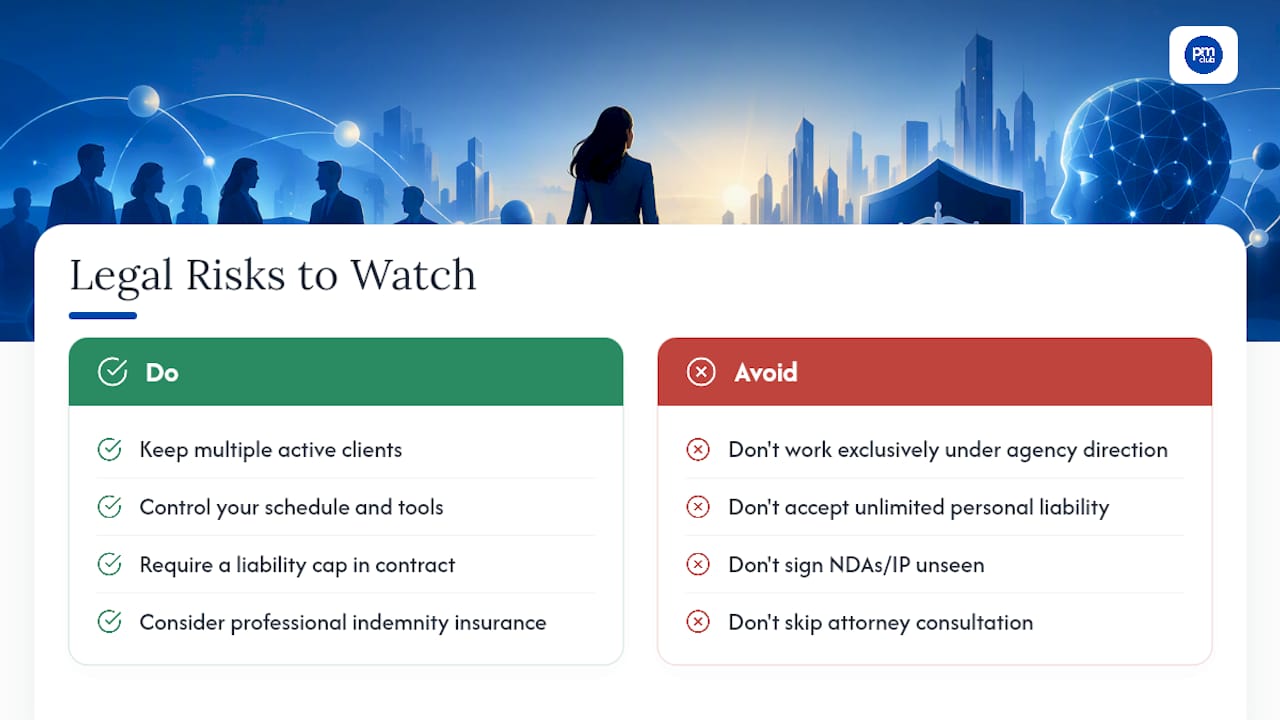
Misclassification is the first risk. Depending on where you and the agency are based, working exclusively for one agency under their direction for months can blur the line between contractor and employee in the eyes of tax authorities. Keep multiple active clients and control your own schedule and tools where possible, both to protect your independent status and because it's simply better business practice.
Liability exposure comes next. If a deliverable you managed causes financial loss for the agency's client, you want a contract that caps your liability at the value of the engagement, not an open-ended exposure. Professional indemnity insurance is worth pricing out once your average contract value climbs past a few thousand dollars.
Confidentiality and non-disclosure terms are standard in agency work since you'll see client budgets, strategy documents, and sometimes unreleased campaigns. Read these before signing rather than after a dispute starts. IP assignment deserves the same scrutiny: know whether templates, frameworks, or tools you build during an engagement belong to you or the agency once the contract ends.
None of this replaces a conversation with a qualified attorney about your specific situation and jurisdiction, but going in with these categories already flagged saves you from signing something you'll regret later.
How Do You Manage Multiple Agency Clients at Once?
Running two or three agency engagements simultaneously is where freelance PM work either becomes sustainable or falls apart. The skill isn't project management in the traditional sense; it's ruthless calendar architecture.
Block dedicated hours per client rather than context switching hour to hour. A PM juggling three accounts who checks Slack for all three constantly ends up doing shallow work on all of them. Better to give Client A your 9 to 11 AM block, Client B 11:30 to 1:30, and protect those windows the way you'd protect a client meeting.
Capacity limits need to be explicit, both to yourself and to prospective clients. If you're already at three fractional engagements, say so when a fourth opportunity appears rather than overcommitting and quietly under-delivering on all four. Agencies talk to each other more than freelancers expect, and a reputation for stretched-thin delivery travels fast.
Build a simple weekly triage ritual: a Monday morning pass across every active account to flag what's at risk before it becomes a fire. This is also where a shared status template pays off, since reusing one structure across clients cuts the mental overhead of remembering each agency's separate reporting format.
The freelancers who scale past two or three concurrent clients usually aren't working more hours than everyone else. They're just better at deciding, each week, exactly where those hours go.
How Do You Handle Scope Changes With Agency Clients?
Scope creep hits freelance PMs harder than in-house ones because there's no internal escalation path protecting your time. The fix isn't refusing changes; it's pricing and documenting them the moment they appear.
The moment a stakeholder asks for something outside the original brief, restate it in writing within the same conversation: "That's outside our current scope. Here's what adding it looks like in terms of timeline and cost." This single habit, done consistently, prevents the slow scope drift that turns a profitable fixed-fee project into an unpaid one.
Client communication during an agency engagement should follow a rhythm the agency already trusts rather than one you invent from scratch. Match their existing reporting cadence and escalation path instead of introducing a parallel process, since a freelancer who creates extra process friction is the fastest way to not get rehired.
When a change request is legitimate and valuable, don't treat it as an annoyance. Log it, price it using your change control clause, and confirm it in writing before work starts. That paper trail protects you if the agency's own client later disputes what was delivered, and it keeps the relationship transactional in the healthy sense: clear asks, clear costs, no resentment building quietly in the background.
How Long Do Agency Freelance PM Engagements Typically Last?
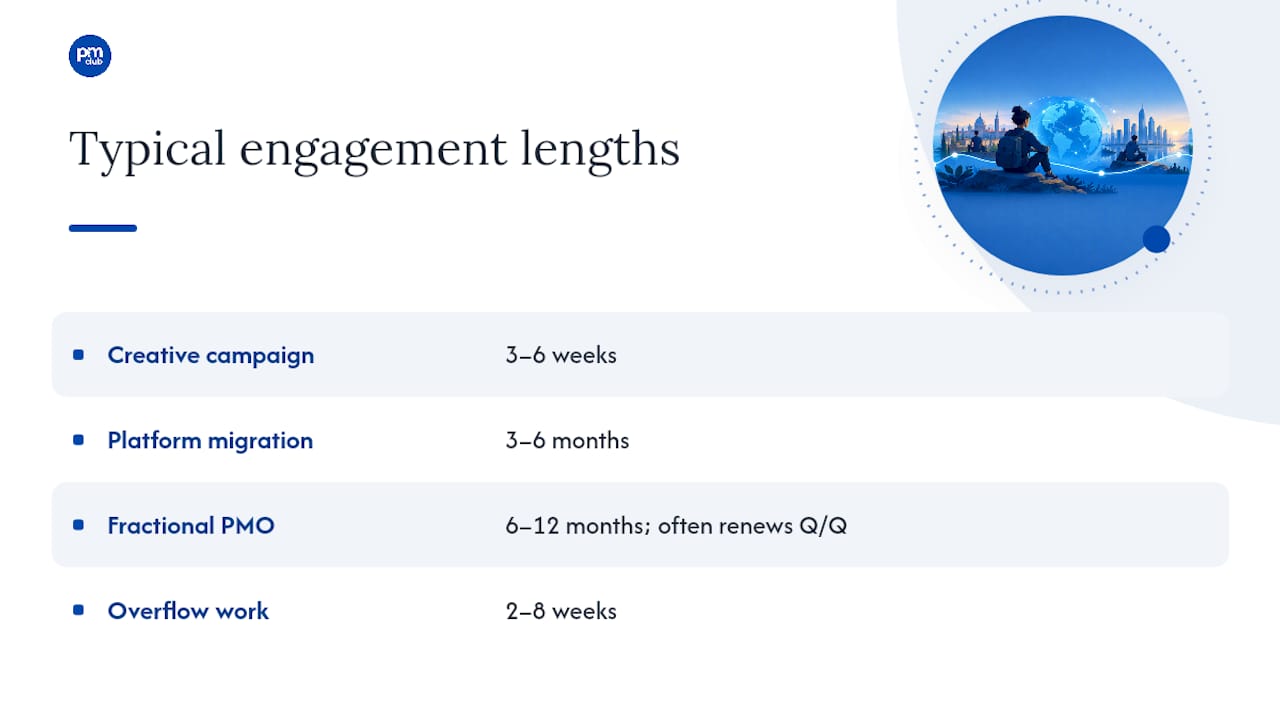
Engagement length varies more by role type than almost any other factor. A creative production PM brought in for a single campaign might work three to six weeks, tightly bound to a launch date. A digital PM running a website or platform migration typically sees engagements stretch three to six months, matching the natural arc of a build, test, and launch cycle.
Fractional delivery leads and interim PMO support tend to run longest, often six months to a year, especially when an agency is using the arrangement to cover a permanent hiring gap or manage a portfolio of ongoing accounts. These roles frequently renew quarter over quarter rather than ending on a fixed date.
Short-term overflow work, the kind you'll find heavily represented on general job boards, tends to run two to eight weeks and refills quickly once one project closes, which is part of why freelancers who specialize in overflow work build a steady pipeline rather than one big contract. Setting the right expectation upfront, rather than assuming every gig will extend indefinitely, keeps your own pipeline healthy and prevents the scramble that happens when a project ends sooner than planned.
What Should You Prioritize First? An Editorial Take
Most advice to freelance PMs treats agency work like a numbers game: apply to more postings, network harder, hope something lands. That misses what's actually happening. Agencies aren't short on applicants; they're short on people who can prove, in the first conversation, that hiring them removes risk rather than adding it.
If you're making the jump, here's a rough 30/60/90: in the first 30 days, pick your specialty and rebuild your pitch and portfolio around outcomes, not job titles. In the next 30, focus outreach on curated channels and two or three direct agency contacts rather than mass-applying. By day 90, you should have your contract template, your rate framework, and at least one live engagement to reference in the next pitch.
The Freelance PM Club's templates, job board access, and coaching exist to compress that timeline, particularly for PMs who've never had to sell themselves before. A full author bio, case studies, and reader testimonials for this piece are still being finalized and will appear here shortly.
— Ashanti
Fast-Track Your Move Into Agency Freelance Work
Some platforms exist for exactly the gap this article just walked through: you know how to run a project, but you might lack curated job leads, pitch templates, or a peer network agencies respond to. That's often the piece most freelance PMs are missing, not project management skill.

Memberships can break into tiers built around where you're stuck. Entry-level access may include curated freelance PM listings, while higher tiers add templates, courses, and networking communities that can help improve hiring chances. Coaching options may be available to help you with positioning before committing to membership.
Whichever fits your stage, the subscription plans are where to start. Pick a tier, get into the job board, and send your next pitch this week.
Curated Job Boards and Resources Worth Following
A handful of sources cover most of the demand for freelance agency PM work right now:
- LinkedIn Jobs — the deepest pool of freelance PM listings; check daily and apply within hours of a new posting.
- Indeed — strong for rate benchmarking alongside role variety across digital and creative PM work.
- ZipRecruiter — useful for immediate-hire listings when you need a fast-turnaround engagement.
- For a deeper look at how agencies are using AI internally, the productivity analysis on AI adoption is worth reading before you pitch AI-augmented services.
Sources
- Freelance Project Manager Jobs in United States ...
- 50 Freelance Project Manager Jobs & Work
- Freelance Project Manager Jobs (NOW HIRING)
- AI for agencies: 3.2x ROI and real productivity gains
FAQ
How much should I charge as a freelance project manager?
Rates depend heavily on engagement type, but advertised remote agency roles commonly fall in the $40 to $65 per hour range, with fractional retainers and milestone pricing often running higher for senior delivery leads. Price around the value of the capacity gap you're closing, not just your hourly cost.
Can I freelance as a project manager?
Yes, and agencies actively hire for it. Job boards consistently show thousands of open freelance PM roles across digital, creative, and PMO specialties, with the strongest demand for candidates who can integrate into existing tools and processes immediately.
What is the 80/20 rule for project managers?
In project management, this generally refers to the idea that roughly 20 percent of tasks or risks drive most of a project's outcomes or delays, so experienced PMs focus monitoring and escalation effort there first. Definitions vary by practitioner, so treat it as a prioritization habit rather than a fixed formula.
Is AI replacing freelancers?
No, AI is augmenting freelance PM work rather than replacing it. Agencies using AI tools to support workflows report measurable productivity and ROI gains, and freelance PMs who apply AI to reporting and documentation tend to deliver faster without cutting the judgment calls that still require a human.